
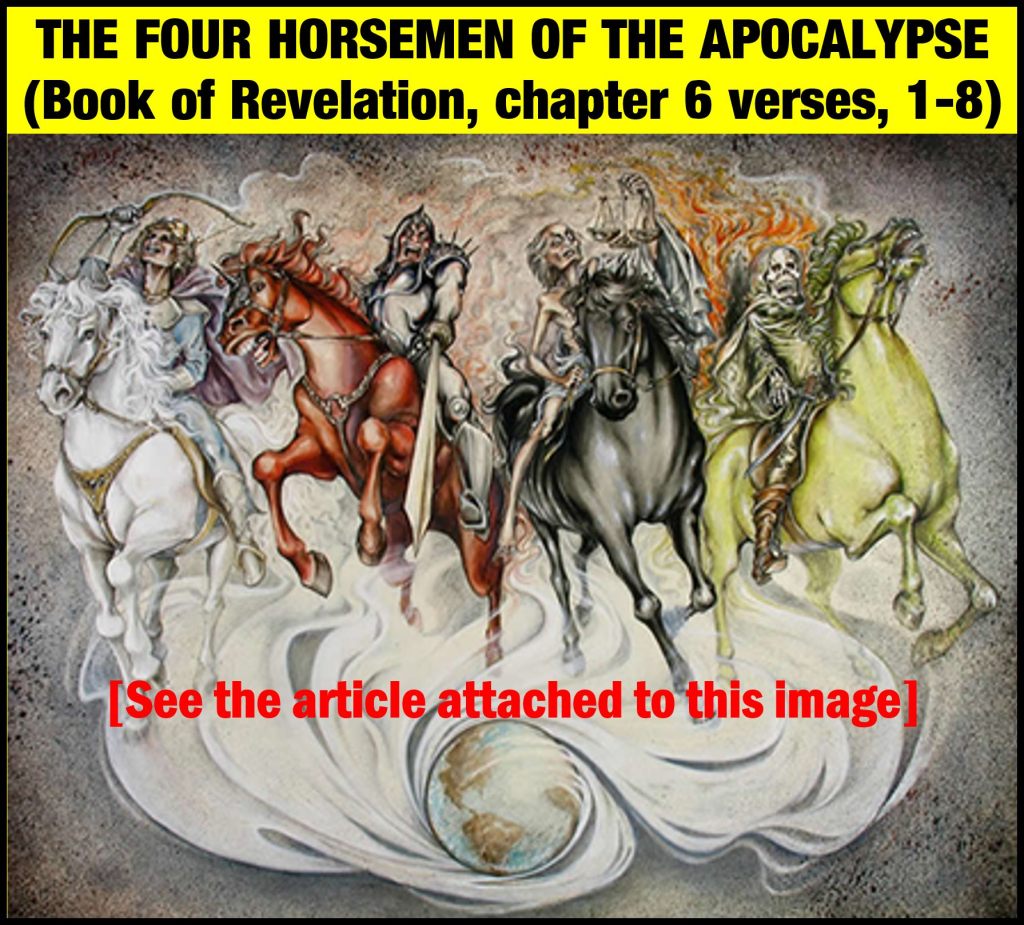
[The piece below is a little excerpt from the upcoming 2nd Edition of my hardcopy 590-page commentary on the Book of Revelation (more details at the foot of this article). It deals with the so-called “Four Horsemen of the Apocalypse”, which are just as revelant today as when the Book was written more than 1900 years ago in a cave on the Isle of Patmos in Greece. Many fanciful interpretations have been given. So let’s get real about the true identity of these revealing symbols (for that is what they are)]
IN CHAPTER 5, AS YOU WILL RECALL FROM OUR EARLIER SECTIONS, we are introduced to a scroll which is closed with seven seals and written on both sides, all of which is plainly symbolic of the fullness of the Divine decree of God — His plan of the ages and especially in the bringing to fruition of His kingdom at the end of this age through the ascended Christ, for that is where it has all been heading. His full plan from the beginning to restore the usurped kingdom of this world to Himself from the clutches of Satan is held within that scroll. Then the Christ was presented to us as the only One worthy of opening those seven symbolic seals of this symbolic scroll. Now we come to examine the first four of those seals.
Seals 1 to 4: The Four Horsemen of the Apocalypse (Revelation 6:1-8)
Here in the opening of the first four seals of the scroll (which, as we have seen in the previous section, only the Christ can perform) we are given an inner glimpse of some of the key influences which characterise this entire age and which will increase in intensity as the end of it approaches. I do not believe that these four horsemen pertain solely to the Endtimes but that they have significant influence through the entire period from the ascension of Christ to His second coming. This will intensify exponentially as the time of the end approaches, with a climax being reached as the great apostasy deepens to its fullness in the run-up to the revealing of the Antichrist and the final spiritual battle of Armageddon.
As Christ is the opener of the seals, they represent influences over which He has complete control. They are not random influences which are out of control entirely, even though it may seem like that in this crazy world. These first four seals of the scroll involve what have been styled as ‘The Four Horsemen of the Apocalypse’ and they have often been depicted in cultural memes.
As we have seen, the word ‘Apocalypse’ means revelation, the revelation of Jesus the Christ, as the opening words of The Book plainly state. Thus, everything in the Book of Revelation reveals something about Christ’s astonishing work in the creation and in the upholding of this cosmos. The scroll in chapter 5 of The Book and its seven seals are manifestations of that oversight and are a vital part of the manner in which the ‘God-management’ work of Christ restores this fallen world to what it was always supposed to have been. It is to destroy Satan’s usurped kingdom so that this cosmos once more becomes ‘the kingdom of our Lord and His Christ’ — exemplified in the Book of Revelation as when the seventh angel sounds his trumpet, and loud voices call out in heaven: “The kingdom of the world has become the kingdom of our Lord and of His Christ, and He will reign forever and ever” (Revelation 11:15). Everything is moving inexorably towards that cataclysmic event.
So what do these four horses and their riders represent? As the first four seals are part of God’s decree for what must come to pass and how Satan’s counterfeit kingdom will be overthrown in this Age of the Ekklesia (the clear meaning of the scroll itself), they must represent powerful influences which are involved in some way in that process. In chapter 6, the first seal reveals a white horse. “…and its rider held a bow. And he was given a crown, and he rode out to overcome and conquer” (verse 2). The second seal reveals a horse which was “bright red, and its rider was granted permission to take away peace from the earth and to make men slay one another. And he was given a great sword” (verse 4). The third seal reveals
“a black horse, and its rider held in his hand a pair of scales. And I heard what sounded like a voice from among the four living creatures, saying, ‘A quart of wheat for a denarius and three quarts of barley for a denarius, and do not harm the oil and wine’” (verse 6).
The fourth seal reveals a horse with a colour which in the Greek is χλωρός, chloros, which Walter Bauer’s Greek-English Lexicon of the New Testament and Early Christian Literature translates as “pale, greenish gray…as the color of a person in sickness contrasted with appearance in health”. In other words, it is like when we describe someone as looking ‘ashen’, or like ‘death warmed-up’, or the colour of an actual corpse — a pale yellowy-greenish-grey hue. We are explicitly told that
“Its rider’s name was Death, and Hades followed close behind. And they were given authority over a fourth of the earth, to kill by sword, by famine, by plague, and by the beasts of the earth” (verse 8).
During my research and readings over the past few decades, I have found that there is a huge number of interpretations of these four horsemen. Some of them are reasonable and understandable (though not necessarily having the ring of truth), but others are so far out that I could only laugh at them. [See a classic example of this in a UK national newspaper at this link: https://tinyurl.com/4atkejwc ]. In such obviously symbolic passages, I am looking for what is the meaning which is most consistent with the rest of the Book of Revelation and with the Old Testament passages which have inspired those passages. We must never overlook the Old Testament influences on the Book of Revelation. For example, in the first chapter of the Book of Zechariah, four horses of various colours were sent out by God on a mission to check out what was happening on the earth. In that context, they were plainly angels carrying out cosmic ‘God-management’. We see the same principle in the other set of four horses in the sixth chapter of the Book of Zechariah. Thus, it is surely reasonable to assume that the use of the symbol of four horses here in the Book of Revelation also represents God’s management of affairs across this earth, which is what the sealed scroll is all about — how God manages the cosmos during this final age between the ascension of Christ and His second coming.
So, we have a white horse, a red horse, a black horse, and a pale-coloured horse. Each of these is symbolic of the way that God controls everything during this present age, even what people would regard as ‘bad’ things. The red horse is symbolic of war and everything that war entails. The fact that it says that “its rider was granted permission to take away peace from the earth and to make men slay one another” shows that even war takes place because God permits it for His own inscrutable purposes. The black horse ridden by the rider with the weighing scales is symbolic of everything connected with inequality and social strife, such as famine on the one hand and luxury on the other (the text says that the oil and wine were to be left untouched, which most likely indicates a restraint on the extremity of the famine). The pale horse is symbolic of the level of death which affects the human race in all parts of the earth. I believe that this fourth horse is a kind of summary of the previous three horses. It is said “to kill by sword, by famine, by plague, and by the beasts of the earth”. These sum up the effects of the first three horses which deal in war (the red horse), famine (of which plague is an offshoot, the black horse) and satanic assault (the white horse, as we will see below). I believe that the word “beasts” there does not refer to literal animals but is a symbol of the enforcement of the satanic world-system that is actually styled as “beasts” in chapter 13, as we will see later in our explorations.
The White Horse is in Need of Special Consideration
I have left dealing with the white horse until last because it is worthy of special consideration as it has not had a uniform interpretation down the centuries. This is because many have assumed that the white horse there is identical to that in chapter 19 of The Book, where we see a white horse which is described in the following manner:
“Then I saw heaven standing open, and there before me was a white horse. And its rider is called Faithful and True. With righteousness He judges and wages war. He has eyes like blazing fire, and many royal crowns on His head. He has a name written on Him that only He Himself knows. He is dressed in a robe dipped in blood, and His name is The Word of God” (Revelation 19:11-13).
That is a symbolic description of the Christ as king and judge of the world at the end of the age when He comes to wrap up the last hideous surge of humanistic spiritual warfare known as Armageddon. That is the clear context of that entire chapter which is set after the judgement on spiritual Babylon.
There is no controversy that the rider on the white horse in chapter 19 is a symbol of the true Christ. However, there have been many who assume that the white horse in chapter 6 is the same as that in chapter 19 and that therefore the white horse in chapter 6 is also representative of Christ. I have tried to find ways to agree with this, but in all conscience I cannot. The four horses in chapter 6 are plainly part of God’s management of earthly circumstances throughout this entire age. But when I looked closely at that chapter, I realised that these four horses are symbols of powers being given full reign, as if unleashed, in a common purpose of evil and representative of the fallenness of humanity.
Therefore, I believe that the white horse in chapter 6 of the Book of Revelation is symbolic of the ‘spirit of the Antichrist’, which has been permitted to act throughout the entire span of history and now throughout this age, though still constrained from reaching its climax in the actual Antichrist himself until the end of the age, as we will see in more detail in chapter 6 below when looking at chapters 12-14 of the Book of Revelation. In other words, the white horse in chapter 6 is a counterfeit of that in chapter 19, just as the Antichrist will appear as a counterfeit of the Christ, setting himself up as the messiah and saviour of the world under the direction of Satan.
One of the reasons that I believe this is a counterfeit ‘Christ’ is because there are so many fundamental differences between the rider on the white horse in chapter 19 and the one here in chapter 6. If I put the two passages side by side you can then compare them. You will see them in the table below. The verses from chapter 19 are on the left and the verse from chapter 6 is on the right.

The description itself in chapter 19 is so full and elaborate that it makes the verse in chapter 6 seem puny and rather tame by comparison. I do not see any great character in that description on the right but rather a comparatively spineless wimp who has been permitted to exercise a measure of power though without the vast eternal effect of the rider in chapter 19. Some say, “Well, the rider in chapter 6 was given a crown and he was allowed to overcome and conquer. Surely that must be Christ”. To which I reply, “No, not at all!” He was given a single ordinary crown, whereas the Christ in chapter 19 has, by nature, as it says, “many royal crowns”. Even the Greek word for crown is different between the two texts. The rider in chapter 6 merely has a στέφανος, stephanos, which was the kind of crown given to someone who excelled in an athletic competition, like a wreath or garland. Whereas the crowns on the rider in chapter 19 are διαδήματα, diademata, which are royal crowns worn by nobility. The rider in chapter 19 is without a doubt a King but not the one in chapter 6! The Christ in chapter 19 has armies of angels and restored humans who follow Him. The rider in chapter 6 is all on his own (apart from the other three horses). The Christ in chapter 19 has a sword which comes from His mouth (His words and decrees) with which He subdues the nations, whereas all that the rider has in chapter 6 is a measly bow (not even any mention of arrows). It seems clear to me that the rider in chapter 6 is an attempted ‘knock-off’ — a cheap copy of the real deal in chapter 19.
As these horses are part of God’s permitted forces to keep humanity in check during this Age of the Ekklesia — from the ascension to the end of the age — I can only conclude that the rider on the white horse in chapter 6 of the Book of Revelation is the ‘spirit of the Antichrist’ which operates like leaven throughout this age and comes to its head at the end of the age in the person of the man of lawlessness, the Antichrist. Christ Himself does not need to be presented alongside these other three symbolic riders, as if He is their equal. That He rules over human affairs is already well-established. The white horse and its rider are simply one more way that Christ manages this world. In this case, it represents the ‘spirit of the Antichrist’ and, ultimately, this dark spirit will manifest in the actual Antichrist himself.
Some will say, “How can it be the Antichrist as it says that he ‘rode out to overcome and conquer’. Surely only the Christ does that”. Again, not so. As the text says about beast-government which culminates in the Antichrist, the beast “was permitted to wage war against the saints and to conquer them” (Revelation 13:7). This pseudo-christ in chapter 6 is therefore hellbent on overcoming and conquering the saints, whereas the true Christ in chapter 19 overcomes and conquers — indeed “strikes down” — the nations of the world. Are you convinced yet? I would say that the two horses and riders are as different as chalk and cheese — a fitting idiom for the counterfeit of Christ that the Antichrist is.
You may well accept and understand the reason why the ‘spirit of the Antichrist’ should be portrayed as a kind of ‘yeast’ working its way through the zeitgeist of this present evil age. But you may wonder why there should be war, poverty, inequality, and famine, and death in all its hideousness and what possible purpose they could serve. For this, I shall have to go into a saga or two which have run down through the ages. It may seem to be a digression, but it provides us with important background data concerning what we are dealing with in the Book of Revelation in general and in these first four seals in particular.
Examples of Christ Controlling Evil and Using it for Good
Prior to the New Testament era and the coming of the Christ, Satan — who had experienced firsthand the earliest flicker of a prophecy of the coming of the Christ, as demonstrated in the Genesis 3:15 — did everything he could to prevent the coming of the Christ by trying to sabotage the sacred bloodline through which He would come. Many times, throughout history, Satan tried to flush out this coming Redeemer, as I will show in chapter 6, §1, but because the devil is not omniscient, it was just a matter of hit-and-miss on his part down through the ages. But it is a singular fact that every single attempt of Satan in history to destroy the “seed of the woman” — the Redeemer who he had heard promised by God, as recorded in Genesis 3:15 — has been an abject failure. The forces of darkness are always doomed to failure, no matter what they may attempt or carry out; and by the way, the purpose of this whole creation is precisely the demonstration of that!
Now, just as Satan throughout the whole time before Christ’s resurrection tried to prevent the promised Seed, the Christ, from being manifest on earth (and was thwarted at every turn by God’s intervention), so he has also continually tried to establish his counterfeit empire in ‘the spirit of the Antichrist’, and similarly been thwarted in that. This thwarting of the building of Satan’s earthly empire (a counterfeit of the spiritual kingdom of God) from being realised prematurely is a teaching which points right back to earliest times when the incident at Babel — hubristic kingdoms coming together to create a kind of localised one-world conglomerate or confederation — was thwarted under restraint by God (Genesis 11:1-9). Since that was brought to nothing, Satan has worked through countless empires, principalities, and kingdoms to get his world empire in place. But he is, and always has been, under restraint from bringing that to fruition. This kind of restraint of satanic activity is expressly stated in the prophecy of the Antichrist, the “man of lawlessness” who will be revealed at the end of this age:
“And you know what is now restraining him, so that he may be revealed at the proper time. For the mystery of lawlessness is already at work, but the one who now restrains it will continue until he is taken out of the way” (2 Thessalonians 2:6-7).
One assumes that some kind of angelic power is responsible for the restraint, as we see such restraint of judgement being exercised and then loosed with the Divine involvement of angels in the Book of Revelation (For example, Revelation 9:14-15).
My reason for briefly going into all this here is to demonstrate God’s absolute hold over world affairs which we see symbolised in these four horsemen. For these four seals and horsemen are not forces which are only let loose at the end of this age (as has often been asserted by many), but they are part of the way in which God is managing the entire span of this age (known as “the last days”), from the ascension of Christ to His return at the end of the age, just as in all the other parallel sections of the Book of Revelation.
Thus, we see the ‘spirit of the Antichrist’ (white horse) seeping through the pores of this world throughout this age and rising to a climax in the actual Antichrist at the end of it. Meanwhile, the turmoil of war (red horse), the struggle to make ends meet leading to hunger and famine and the distraction of luxury (black horse), and the many manners of death (pale horse) through disease, plagues, accidents, suicide, and murder, all play their part in both the building of the satanic empire and also in their own ways preventing the premature establishment of that empire in which that ‘spirit of the Antichrist’ is involved. For wars, inequalities, disease, and death have created considerable obstacles in the making of a unified global governmental confederation as well as giving the impetus to unscrupulous leaders on the world stage to try and capitalise on those things in their advocation of it.
So, these four seals reveal the way that the establishment of Satan’s kingdom in the spirit of the Antichrist has been prevented from premature realization. The three horses (red, black, and pale) constrain the development of the satanic counterfeit kingdom (white horse) throughout this entire age through distraction and the day-to-day struggles of life and death. However, there will come a time when all those constraints will be removed and the moment comes for the Antichrist to be revealed. The verse in the Bible where this ‘revealing’ is mentioned is also based on the same Greek word as the ‘revelation’ of the Christ (2 Thessalonians 2:3). Apocalypse. The Antichrist is there known as “the man of lawlessness” and the workings of the process throughout this age which leads to his revealing is known as “the mystery of lawlessness”. The ‘mystery of lawlessness’ and the ‘spirit of the Antichrist’ are two sides of the same coin, working their dastardly way through world affairs like yeast in a harmless-looking loaf.
The Four Horsemen Represent the fruits of Judgement in the Fall
There is even more: For there is a thread which runs through these first four seals, the so-called four horsemen of the apocalypse. They are all dark forces over which Christ has complete control and, though they appear to be evil, they are still used as vehicles through which the Christ brings to fruition the fulfilment of His kingdom. In other words, whatever Satan has done down through the ages, or can do in this present age, Christ secretly overrules it all. And this is the background message of the whole of the Book of Revelation. It is the great cosmic irony, though one which the demonic realm plainly does not ‘get’. That is what Christ’s opening of these seals proves without a doubt.
In an interesting parallel, these four horsemen represent four elements which have come into the world as a direct result of the Fall. Division between people, beginning right after the Fall as we see in the story of Cain and Abel in Genesis, chapter 4, ultimately resulting in war (which we see echoed in the red horse). Famine and inequalities (which are echoed in the black horse) reflect what God said to Adam in the creation story: “Cursed is the ground because of you; through toil you will eat of it all the days of your life. Both thorns and thistles it will yield for you” (Genesis 3:17-18). Death also came into being as a direct result of the Fall (echoed in the pale horse). Furthermore, when God said that He would put enmity between Satan and the woman and between his offspring and the offspring of the woman, this signified the spiritual battle between Christ and His Light on the one hand, and Satan and his darkness on the other. This is echoed in our text in the white horse and its rider, involving the spirit of the Antichrist and Satan’s evil desire to conquer the good through it. So we see how these four horsemen are echoes of the outworkings of the judgement in the Fall, the curse which will last until the new heaven and new earth in which “no longer will there be any curse” (Revelation 22:3).
The Four Horsemen Are Also Parallel to a Saying of Christ
In another extraordinary parallel, the elements in the four horsemen are also strikingly similar to those which the Christ, in His teaching on the Mount of Olives, said would characterise the remainder of this present age:
“Many will come in My name, claiming, ‘I am the Christ,’ and will deceive many. You will hear of wars and rumours of wars, but see to it that you are not alarmed. These things must happen, but the end is still to come. Nation will rise against nation, and kingdom against kingdom. There will be famines and earthquakes in various places. All these are the beginning of birth pains” (Matthew 24:5-8).
Once again, we see that all those elements are echoed in the four horsemen. There are mentioned ‘false Christs’ (of which the white horse is representative in terms of the ‘spirit of the Antichrist’ and, ultimately the Antichrist). He additionally says, shortly after the above words, in verse 23: “At that time if anyone says to you, ‘Look, here is the Christ!’ or ‘There He is!’ do not believe it”. This is yet another reason to believe that the rider on the white horse in chapter 6 of the Book of Revelation represents the ‘spirit of the Antichrist’ and ultimately the Antichrist himself. It dovetails perfectly with what Christ said would characterise signs leading up to the end of this age. The “wars and rumours of wars” which Christ mentions in the passage above tally with the red horse. The “famines in various places” tallies with the black horse (Luke also mentions plagues/ pandemics in his account, Luke 21:11). Death, of course, is ubiquitous on this planet. At present, around fifty-five million humans die each year. All of these elements are realities in which Satan revels, but which Christ controls.
Now you may say, “Well if He controls it all, why doesn’t He just stop it all, which He could easily do?” The reason He does not intervene in the way you would like Him to do so is, firstly, because the world is not one which can be reformed with a bit of tweaking here and there. There is a whole process at work by which a wholly new created cosmos will inevitably come to pass. First, the full number of disciples have to be called out of the world into the Ekklesia. Second, this present age is an “age of evil” (Galatians 1:4), and, as part of the necessary process at work, that evil has to come to its head, all the lying pretence about “the intrinsic goodness in everyone” and “our glorious civilisation” has to be stripped away, and all those who despise the Light of Christ must show their true colours so that there can be a righteous judgement of the whole mess at the end of the age.
This cannot be rushed or interfered with. And if you say, “Well God must be a sadist as so many suffer and death is everywhere”, I reply that this is a world of suffering because humans will not acknowledge their Creator and only persist in their petty narcissistic vision of themselves and their actions. In any case, how long or short we live, how much we suffer, and the fact that we die are of zero importance in themselves. Life is brief and our only “brief” in this life is to find our way back to God, become part of the great and true Ekklesia, and thereby eventually become a part of the new creation. This world is just a theatre of lessons, a ‘workout’ gymnasium — a school which we either pass through with faith and acknowledgement of God in Christ, or flunk through our self-obsession and complete denial of God and the incarnation of Christ. From a human standpoint, it’s all on us.
So we cannot rush or interfere with the process of transformation which is already underway. It is being masterminded by a Power infinitely wiser than us! The tipping point will be the cataclysmic return of the Christ in a cosmic flash of lightning which will make the Aurora Borealis seem like a cheap disco lightshow. However, it has to be said that the prayers of the faithful can not only “anticipate” but can also “hasten the coming of the day of God, when the heavens will be destroyed by fire and the elements will melt in the heat” (2 Peter 3:12). How that works involves the mystery of prayer. Suffice it to say that it involves human volition and the Divine will working in glorious sync, as I will show in detail later below.
So the main message of this section about the four horsemen in chapter 6 of the Book of Revelation is that although the counterfeit kingdom of Satan is being gradually infused throughout the world like yeast in a loaf — building up to a one-world government via the ‘mystery of lawlessness’ (aka the ‘spirit of the Antichrist’), while war, inequality, famine, sickness, and death ravage humanity — God is managing the whole show through world developments which both constrain it from engulfing the world too soon, while allowing it in the perfect way to come to its full head of evil, ripe for judgement and Divine transformation.
Whether, in our hubris, we approve of that or not is irrelevant, as the Creator knows best how to manage His creation. Always remember that Satan, like Pontius Pilate (John 19:11), could have no power unless it is permitted to him from the One who rules over all. Our only calling is to have faith in that process while submitting in discipleship to the Christ who secretly controls it all.
[The piece above is a little excerpt from the upcoming 2nd Edition of my 590-page hardcopy commentary on the Book of Revelation. This will be available in physical paperback format around November 1st. If you would like to reserve a copy (as the print-run will be limited) please send an email to diakrisis-project@outlook.com ]
.
.
.
© Copyright, Alan Morrison, 2023
[The copyright on my works is merely to protect them from any wanton plagiarism which could result in undesirable changes (as has actually happened!). Readers are free to reproduce my work, so long as it is in the same format and with the exact same content and its origin is acknowledged]
 Diakrisis Project