
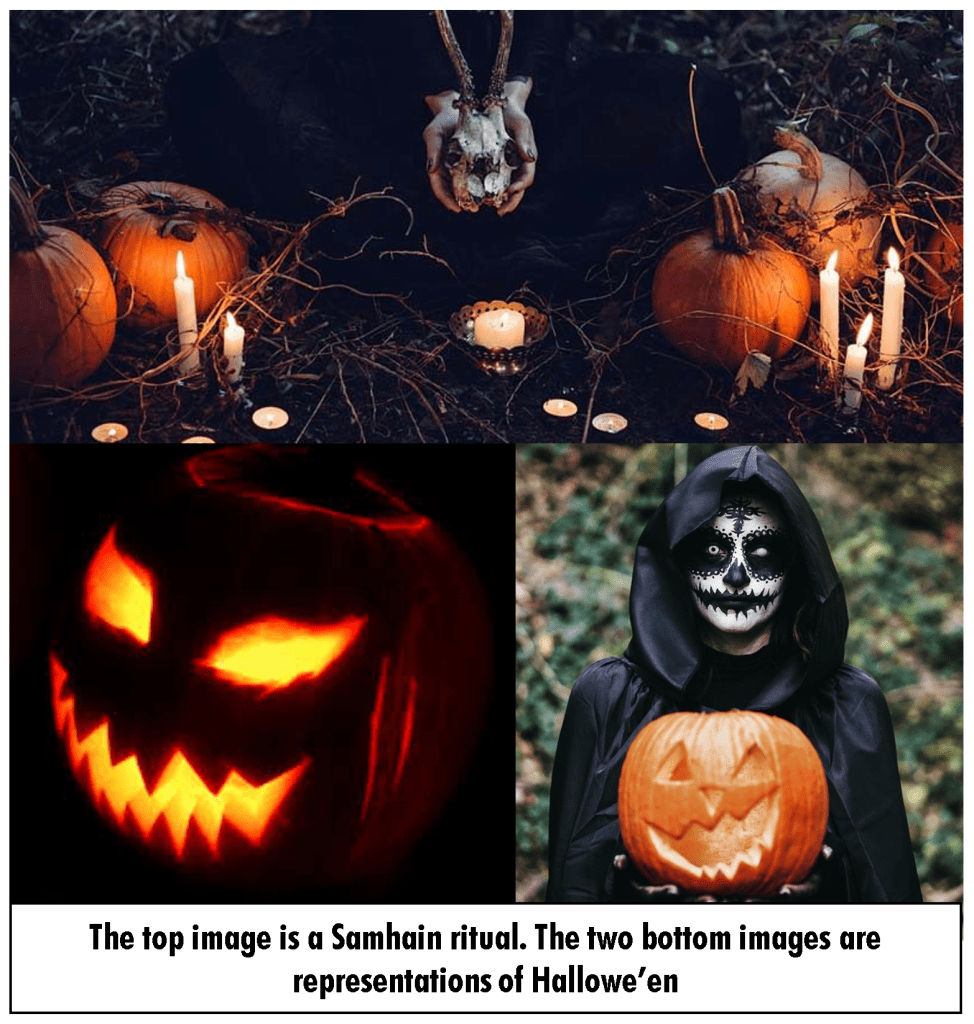
The dialogue below, originally written in 1999 (twenty-five years ago!), is loosely based on an exchange I had with a typical ‘woke’ young man when I was a pastor back then. I think it sums up the thinking of many who merely play at being “Christians” but who do not have the Spirit and who therefore have no idea of the seriousness of uncleanness in relation to the realm of evil spirits (demons)
First Reading: Deuteronomy 18:9-14
Second Reading: Ephesians 5:1-16
Focus Texts: Ezra 9:10-11; Ephesians 5:11
“And now, our God, what can we say after this? For we have forsaken the commandments that You gave through Your servants the prophets, saying: ‘The land that you are entering to possess is a land polluted by the impurity of its peoples and the abominations with which they have filled it from end to end’” (Ezra 9:10-11).
“Have no fellowship with the fruitless deeds of darkness, but rather expose them” (Ephesians 5:11).
[Below is a dialogue between Alex, an ‘enthusiastic young churchgoer’, and Michael, one of the elders of his church. The subject is Halloween. The young man wants to organise a Halloween celebration as an evangelistic activity. He presents his idea to the elder. The elder responds]
Alex: I’ve got a great idea for our evangelistic work as a church. Why don’t we celebrate Halloween? We’ve been doing all this visiting for years now and it hasn’t done very much for our outreach. Let’s do a Halloween celebration. It’ll bring in piles of young people. We could have a parade through the town to the church with pumpkins and candles. We could throw in the Gospel as well somewhere in the evening…
Michael: Whoa… hold it Alex. There’s something we mustn’t forget here — a vital principle. The means that you use to put across the Gospel must always be a fitting medium through which to present it. The Gospel is a holy thing, not a cheap form of entertainment or a sell-out charade. Therefore the means must also fit into that holiness. The Bible says that it is Christ’s Gospel (2 Corinthians 2:12), that it is Divinely revealed (Galatians 1:11-12), and that it is a unique Gospel (Galatians 1:6-10). Do you really think that a bunch of kids dressed up as witches and ghouls with demon faces carved out of pumpkins is a fitting medium through which to proclaim the fact that the Son of God has come to destroy the works of the devil? Think about that seriously, Alex. If the variety of means that you use to present the Gospel aren’t compatible with the Gospel itself, then you just give the wrong impression to people and wind up cheapening the Gospel and dishonouring God.
Alex: [Becoming indignant…] That sounds like narrow-mindedness to me. You’re stuck in a time-warp, man. Nowadays Halloween is just a bit of harmless fun for kids. How can a bit of harmless fun cheapen the Gospel?
Michael: Well is it really just “a bit of harmless fun”, or is there more to Halloween than meets the eye?
Alex: [Even more indignant…] Oh, come on! Halloween just means the evening before All Saints’ Day on November 1st. It’s a recognised day in the Christian year calendar.
Michael: Recognised by whom, Alex? Do you know where it comes from, when it first happened, who it was who began it and why? Let me tell you what Halloween is really all about. I have a paper I wrote on this somewhere. Let me dig it out and share it with you.
[Michael pulls a file from a drawer and hands a sheet to Alex, who immediately begins to read with a readiness to critique it. Here follows the contents of what he read…]
THE ORIGINS OF HALLOWE’EN
“What we now know as ‘Halloween’ developed from ancient New Year festivals and festivals of the dead. In pre-Christian Britain, October 31st was considered as the eve of New Year, when the souls of the dead — especially those who had died in the past year — were believed to revisit their homes. After it became a so-called “Christian” festival (as we’ll see later), the evil supernatural symbolic associations continued — alongside such customs as the shaping of a demonic face out of a hollow pumpkin, in which a candle is placed. In the Halloween which people celebrate today, many of the practices have a direct association with witchcraft. Let’s have a look at the history:
The origin of the present-day Halloween celebration is generally believed to be the Celtic festival of Samhain — also known as The Lord of Death. The Celts lived more than two thousand years ago in what is now the United Kingdom, Ireland, and Northern France. Their New Year began on November 1st. A festival that began the previous evening honoured this Samhain, the Lord of Death. The celebration marked the beginning of the season of cold, darkness, and decay.
On the evening of the festival, the Druids, who were the Celtic priests, ordered the people to put out their hearth fires. The Druidic priests then built a huge New Year’s bonfire made out of oak branches — which they considered sacred — and burned animals and crops (some believe that they also used human beings as sacrifices). These were performed in the belief that they would protect the crops and flocks from demonic influence, for without them the Celts believed that they couldn’t beat the perils of the season or ward off the activities of the deities who were also believed to perform various tricks at this time of the year.
The Celts believed that on the Feast of Samhain, the spirits of their ancestors would rise up from the cold fields and graves and come into the warm homes and cottages of the people, and thus had to be greeted with decorations and festivities, parties and acceptance, in order to get “protection” for the household from evil spirits during the coming winter months.
So, in its origin, the Feast of Samhain was a rite designed to protect humans from the ‘evil’ activities of discarnate entities. It was, in effect, a bargain with the dead so they’d stay away and cause no trouble during the coming year. The Feast of Samhain was seen essentially as a celebration of chaos and destruction, in which spirits of any kind would be unleashed on the earth. People would dress themselves as ghosts and ghouls to disguise themselves in the hope of not being possessed by the spirits. In order to depict the abolition of order and a descent into chaos, people would switch genders and cross-dress — an element which would go down well today!
Each family then relit its hearth fire from the New Year’s fire. During the celebration, people sometimes wore costumes made of animal heads and skins. They told fortunes about the coming year by examining the remains of the animals that had been sacrificed — an occult practice which is referenced in Ezekiel 21:21: “For the king of Babylon stands at the fork in the road, at the junction of the two roads, to seek an omen: He shakes the arrows, he consults the idols, he examines the liver”.
This date was also the eve of the New Year in both Celtic and Anglo-Saxon times and was the occasion for one of the ancient fire festivals when huge bonfires were set on hilltops to frighten away evil spirits. The date was connected with the return of herds from pasture, and laws and land tenures were renewed. The souls of the dead were supposed to revisit their homes on this day, and the autumnal festival acquired sinister significance, with ghosts, witches, hobgoblins, black cats, fairies, and demons of all kinds said to be roaming about. It was the time to placate the supernatural powers controlling the processes of nature.
In addition, Halloween was thought to be the most favourable time for divinations concerning marriage, luck, health, and death. It was the only day on which the help of the devil was invoked for such purposes. Gradually, Halloween became a secular observance, and many customs and practices developed. In Scotland young people assembled for games to see which of them would marry during the year and in what order the marriages would occur. Many Halloween customs have become games played by children.
Immigrants to the U.S., particularly the Irish, introduced secular Halloween customs that became popular in the late 19th century. Mischief-making on this day by boys and young men included overturning sheds and outhouses and breaking windows, and damage to property was sometimes serious. In later years, this has come to be observed mainly by small children, who go from house to house, often in costume, demanding “trick or treat”. The neighbours, to avoid having tricks played on them, give the children such treats as fruit, money, and sweets. Since 1965, UNICEF, an agency of the United Nations, has attempted to incorporate into the Halloween observance the collection of money for the United Nations Children’s Fund!!!
A common symbol of Halloween is the Jack O’Lantern (the name was possibly derived from that used for a night watchman). This is a hollowed-out pumpkin carved in the appearance of a demonic face and with a lighted candle fixed inside. In Scotland a turnip was used, but the native pumpkin was substituted in the United States. Many years ago, people in England and Ireland once carved out beets, potatoes, and turnips to use as lanterns on Halloween. These lanterns were hung allegedly to frighten away witches and evil spirits (as if they would!). Today, they mainly use pumpkins. In England, Halloween was sometimes called Nutcrack Night, or Crab Apple Night, or Apple and Candle Night. Families sat by the fire and told stories while they ate apples and nuts.
On All Souls’ Day, in olden times, poor people used to go “a–souling” (begging). They received pastries called “soulcakes” in exchange for promising to say prayers for the dead. In England, some Halloween customs became mixed up with Guy Fawkes Night, on November 5, which is also celebrated by lighting bonfires. The Encyclopedia Britannica (eleventh edition) states:
“Halloween and its formerly attendant ceremonies long antedate Christianity. The two chief characteristics of ancient Halloween were the lighting of bonfires and the belief that of all nights in the year this is the one during which ghosts and witches are most likely to wander abroad. Now on or about the first of November the Druids held their great autumnal festival and lighted fires in honor of the SUN-GOD in thanksgiving for the harvest. Further, it was a Druid belief that on the eve of this festival, Saman, LORD OF DEATH, called together the wicked souls that within the past twelve months had been condemned to inhabit the bodies of animals. Thus it is clear that the main celebrations of Hallowe’en were purely Druidical, and this is further proved by the fact that in parts of Ireland the 31st of October was, and even still is, known as Oidhche Shamhna, “Vigil of Samhan”. Onto the Druid ceremonies were grafted some of the characteristics of the Roman festival in honor of Pomona held about the end of November, in which nuts and apples, as representing the winter store of fruits, played an important part. Thus the roasting of nuts and the sport known as ‘apple-ducking’ — attempting to seize with the teeth an apple floating in a tub of water — were once the universal occupation of the young folk in medieval England on the 31st of October. The custom of lighting Hallowe’en fires survived until recent years in the highlands of Scotland and Wales. In the dying embers it was usual to place as many small stones as there were persons around, and next morning a search was made. If any of the pebbles were displaced it was regarded as certain that the person represented would die within the next twelve months. In AD 43, the Romans conquered the Celts and ruled what are now England and Wales for about 400 years. Now, during this period, two Roman autumn festivals were combined with the Celtic festival of Samhain, Lord of the Dead. One of them, called Feralia, was held in late October to honour the dead,. The other festival honoured Pomona, the Roman goddess of fruit and trees. It seems likely that apples and nuts first became associated with Halloween because of this festival.”
[Alex puts the sheet of paper down and looks reluctantly pensive…]
Michael: Now, tell me, did you know all that, Alex?
Alex: Well… er… no… er… sort of… but… that’s not what we’re doing on Hallowe’en, is it? I mean I wouldn’t have anything to do with all that stuff that you’ve been talking about.
Michael: You might not, Alex; but there are plenty of people who would! We’ve got to consider the effect these things have on other people. Those powerful visual symbols are much more likely to turn someone on to Old Nick than they are to bring someone to the Lord Jesus Christ.
Alex: But it is a Christian Festival, isn’t it?
Michael: To be honest, I’ve always found the idea of Christian Festivals extremely weird. Festivals were certainly tied up with the nation of Israel under the Old Mosaic Covenant. But these have all found their fulfilment and ultimate expression in the Lord Jesus Christ, who has set them aside as unnecessary celebrations: “Therefore let no one judge you by what you eat or drink, or with regard to a feast, a New Moon, or a Sabbath. These are a shadow of the things to come, but the body that casts it belongs to Christ” (Colossians 2:16-17). We need to bear in mind that the idea of Church or Christian Festivals is very much a man-made concept. The only commemorations commended to us by the Lord are Baptism and the Lord’s Supper. [Pointing to the paper…] If you look, there’s more at the bottom of the paper.
[Alex picks up the paper again and reads the next section…]
CHRISTIANITY & HALLOWE’EN
What people call All Saints Day in the Christian Church is a day which is said to commemorate all the saints of the church, both known and unknown, celebrated on November 1st in the Western churches and on the first Sunday after Pentecost in the Eastern churches. Its origin cannot be traced with absolute certainty, and it has been observed on various days in different places. But the connections are pretty easy to discern because the coincidences are in plentiful supply.
A feast of All Martyrs was kept on May 13th in the Eastern Church according to Ephraim Syrus (died circa 373), which may have determined the choice of May 13th by Pope Boniface IV when he dedicated the Pantheon in Rome as a church in honour of the Virgin Mary and all martyrs in 609. The first evidence for the November 1st date of celebration, and of the broadening of the festival to include all saints as well as all martyrs, occurred during the reign of Pope Gregory III (731-741), who dedicated a chapel in St. Peter’s, Rome, on November 1st in honour of all the saints.
In 800, All Saints’ Day was kept by the Yorkshire scholar Alcuin (735-804) on November 1, and it also appeared in a 9th-century English calendar on that day. In 837 Pope Gregory IV ordered its general observance. In medieval England, the festival was known as All Hallows, and its eve was known as Hallowe’en.
People fail to realise that many ancient pagan practices became incorporated into the practices of the post-Apostolic Church, including virtually every pagan festival known to the Romans and the inhabitants of the Roman Empire. Hallowe’en was no exception. But what happened? How did the ancient Druid, Celtic festival in honour of the “Lord of the Dead,” and celebrated in worship of the “Sun-god,” ever creep into the practice of the “Christian Church”? The World Book Encyclopedia relates:
“Many of the customs of the Celts survived even after the people became Christians. During the 800’s, the church established All Saints’ Day on November 1. The people made the old pagan customs part of this Christian holy day. Then the church began to honor the dead on November 2. This day became known as All Souls’ Day.”
When All Saints’ Day had become established on November 1st, the Mass that was said was called Allhallowmas. The evening before All Saints’ Day then became known as All Hallows’ Eve, or All Hallow e’en. And that’s what we have today.
Now it is easy to find out all this information without having to look very far. It is all in the public domain. However, amazingly, the New Catholic Encyclopedia says: “How a feast of all the saints came to be celebrated on November 1st has not yet been demonstrated”. I guess there is a vested interest in them saying that!
[Alex looks up and goes on to challenge Michael…]
Alex: Hold on a minute. You’ve said a great deal about history, but you haven’t even mentioned the Bible. And you’re supposed to be the big Bible man. As far as I know, there’s nothing about Halloween in the Bible, for or against.
Michael: Just because the word “Halloween” or the so-called ‘festival’ isn’t specifically mentioned in the Bible doesn’t mean that there’s nothing which can help us to know how we should respond to it. In fact, everything we need to know about how to respond must be in the Bible because “All Scripture is God-breathed and is useful for instruction, for conviction, for correction, and for training in righteousness, so that the man of God may be complete, fully equipped for every good work” (2 Timothy 3:16-17). Let’s just look at the reasons we can learn from the Bible about why we shouldn’t celebrate Halloween.
First, Halloween clearly has occult implications, being a direct offshoot of the ancient pagan beliefs of the magical cult of Druidism. The fact that these practices today are largely symbolic for the average person in the street doesn’t diminish their implications. The Christian is intimately concerned with symbols. Baptism and the Lord’s Supper are massive symbols of great spiritual importance relating to the work of God through the Lord Jesus Christ; and they are acted out with great significance on a regular basis. In the same way, acting out ceremonies which are symbolic of devilish and demonic works also carries great spiritual significance.
Now you may say well what’s wrong with doing something which only has occult implications. I’ll tell you — and this is my second reason why we shouldn’t have anything to do with Hallowe’en: It is that connecting with occultism causes spiritual pollution. It actually renders people “unclean”. The Bible makes it very clear that to have any association with witchcraft or evil spirits — far from being “good clean fun” — actually defiles a person:
“You must not turn to mediums or spiritists; do not seek them out, or you will be defiled by them. I am the LORD your God” (Lev.19:31).
“And now, our God, what can we say after this? For we have forsaken the commandments that You gave through Your servants the prophets, saying: ‘The land that you are entering to possess is a land polluted by the impurity of its peoples and the abominations with which they have filled it from end to end” (Ezra 9:11).
You may have noticed that in Ephesians 5:1-16 “uncleanness” is often referred to as something which believers should avoid. The Christian has been cleansed by Christ from the taint and stench of his former evil deeds: “You were washed clean, you were sanctified, you were justified, in the name of the Lord Jesus Christ and by the Spirit of our God” (1 Corinthians 6:10). Is it really fitting that we should overturn that cleansing by polluting ourselves with the powerful symbols of wickedness and sorcery through participating in a festival which has its roots in outright satanic activity and paganism of the very worst sort?
Thirdly, God’s people are to disassociate themselves from evil works. We are a people separated from worldly living and called to live a life of holiness:
“When you enter the land that the LORD your God is giving you, do not imitate the detestable ways of the nations there. Let no one be found among you who sacrifices his son or daughter in the fire, practices divination or conjury, interprets omens, practices sorcery, casts spells, consults a medium or spiritist, or inquires of the dead. For whoever does these things is detestable to the LORD. And because of these detestable things, the LORD your God is driving out the nations before you. You must be blameless before the LORD your God. Though these nations, which you will dispossess, listen to conjurers and diviners, the LORD your God has not permitted you to do so” (Deuteronomy 18:11-14).
“Have no fellowship with the unfruitful works of darkness, but rather expose them” (Ephesians 5:11).
“Do not be unequally yoked with unbelievers. For what partnership can righteousness have with wickedness? Or what fellowship does light have with darkness? What harmony is there between Christ and Belial? Or what does a believer have in common with an unbeliever? What agreement can exist between the temple of God and idols? For we are the temple of the living God. As God has said: “I will dwell with them and walk among them, and I will be their God, and they will be My people”. “Therefore come out from among them and be separate, says the Lord. Touch no unclean thing, and I will receive you” And: “I will be a Father to you, and you will be My sons and daughters, says the Lord Almighty” (2 Corinthians 6:14-18).
By the way, Alex, that doesn’t mean that we should have nothing whatsoever to do with unbelievers. That would be silly and counterproductive to the spirit of the Gospel, which expects us to be witnesses alongside of people (cf. 1 Corinthians 5:9). However, it does mean that we should not be intimately involved with any of their evil, religious anti-Christian activities. We are to be spiritually separate.
Alex: But the things which kids do on Halloween aren’t actually evil. That’s ridiculous!
Michael: My friend, we’re not only called to refrain from the actual practise of evil, but we are also called to have nothing to do with things which even appear to be evil. “Abstain from all appearance of evil” (1 Thessalonians 5:22). The word “appearance” is a translation of the Greek word eidos, the external outward appearance, which comes from eido, to see, to perceive with the eyes. In other words, the Apostle is commanding us to abstain not only from actually practicing evil but also from doing anything which may be perceived by others looking on as being evil. “Abstain from all appearance of evil”. Surely the celebrating of Hallowe’en and participating in its activities comes under that command.
Alex [Incredulously…]: Are you saying that even non-Christians shouldn’t be celebrating Halloween?
Michael: Well, that would certainly be the ideal. Association with magic and the occult is harmful to society. Wherever it occurs it causes numerous problems in the offending culture. If you look at all the countries which do the most to promote blatant witchcraft, sorcery and the occult, you will see that they are riddled with other negative, debilitating social phenomena such as hunger, disease, financial catastrophe, corrupt government, sexual perversions, pestilences, etc. Now that the supposedly civilised Western world is also being officially given over to syncretism, sodomy, amorality and the widespread acceptance of occultism, those same phenomena are making massive inroads into…
Alex [Interrupting irritatedly…]: Look, I don’t need a lecture. If you’re going to be like this about Hallowe’en, then what will you do with Christmas and Easter? Soon we’ll all be living in a closet with our eyes shut. This is religion gone mad. These are the kinds of issues that set one sect over and against another.
Michael: I have written something on the pagan origins of Christmas and Easter as well, but they are not really in the same league as Hallowe’en, which still has all the blatantly evil trappings about demonic ghouls and satanic rites. Christmas and Easter have, if you will, been much more efficiently and cleanly incorporated into the ancient pagan origins! They are not at all a celebration of demonology, as Hallowe’en is. Whether or not to observe Easter & Christmas is, to my mind, a question of conscience, not binding either way, so long as there is dignity and the centrality of the Gospel. I’m sure that the Lord will forgive us for commemorating His birth and death (which can be used to great evangelistic advantage). However, I can’t honestly see Him ignoring our celebration of demonic activity, even if we do want to fool ourselves that we are doing it for evangelistic purposes!
This kind of issue only “sets one sect over and against another” if those sects are more interested in tradition than in biblical values and morality. Besides, I am not forcing my ideas into anyone’s life. Obviously, they are free to commemorate demons if they wish. But…
Alex [Interrupting even more irritatedly…]: My kids are certainly going to be doing something at home anyway, so you can’t stop that. We have freedom in Christ to celebrate Hallowe’en, as Paul shows in Colossians 2. We need to be like the world in order to evangelize it, like Paul did on Mars Hill.
Michael: To say that “we need to be like the world in order to evangelise it” is a gargantuan mistake. It flies in the face of numerous Bible passages (e.g. Romans 12:2; John 5:19; 17:14; 2 Corinthians 6:14-16; 1 John 2:15; James 4:4; Ephesians 2:1-2; 4:17-20; James 1:27; 2 Peter 2:20). I am well aware that one of the biggest problems today in this relativistic, post-Christian culture, is how to reach out to people without coming across as a wacky obscurantist or a trendy con artist (both of which account for significant sectors of the Christian scene!). Simply being like the world is NOT the answer. It is true that it is good for us to find ways of getting alongside people (especially our neighbours and workmates) so that we can form some kind of productive relationship with them. But this should never involve trying to be like them or even becoming like them as some kind of bait and snare approach. Paul spoke of becoming all things to all people but that doesn’t mean that he advocated becoming a murderer to convert murderers or becoming a prostitute to convert prostitutes. And to think that we need to dress up as Dracula or Satan on Hallowe’en in order to build bridges into a community is as daft as all those English vicars in the 1950’s who smeared grease into their hair, wore winklepicker shoes and opened coffee bars with glitzy jukeboxes in order to get some more bums on the pews! Actually, it would be far less harmful to pretend to be a 50s Teddy Boy than to pretend to be a ghoul!
Alex: You know what your problem is don’t you. You’re a legalist.
Michael: Alex, you know very well that I have always been passionately opposed to legalism; and I don’t think that what I’m saying about Hallowe’en is at all legalistic. I believe we do have freedom in Christ, if that freedom is understood correctly. For that freedom must always be tempered by higher considerations. Paul hit the nail on the head when he said: “All things are lawful for me, but not all things are helpful; all things are lawful for me, but not all things edify. Let no one seek his own, but each one the other’s well-being” (1 Corinthians 10:23-24; cf. 1 Corinthians 6:12). In the exercising of one’s Christian freedom, one must put other considerations first, and think about whether our actions are helpful or edifying and also whether they are likely to adversely affect others. It is selfish indeed to claim that one has the freedom in Christ to celebrate Hallowe’en without considering the double message which is given to unbelievers (and also weaker believers) concerning spiritual truth.
It is ironic that you should use Colossians 2 in order to support Hallowe’en. The Apostle Paul certainly condemns legalism in that second chapter of his letter to the Colossians. He says that we should not judge people who either celebrate or don’t celebrate the divinely-given Jewish Old Testament festivals (Colossians 2:16), for that is a matter of conscience under the New Covenant in Christ. But Paul does not give us the same leeway with regard to humanly-devised plainly demonic festivals. He roundly condemns mysticism and false religion.
In that letter, Paul was actually saying: “See to it that no one takes you captive through philosophy and empty deception, which are based on human tradition and the spiritual forces of the world rather than on Christ” (Colossians 2:8). To encourage people to celebrate Hallowe’en so that they can have a better witness about Christ is the ultimate “empty deception”. The Gospel is essentially saying (in its negative aspect) “You can be free from Satan”. How bizarre, then, to dress up as Dracula or Frankenstein’s monster or a ghastly old hag in order to do so! As I said earlier, the means that you use to put across the Gospel must be a fitting medium through which to present it.
It is indeed true that Christ “disarmed principalities and powers” and “made a public spectacle of them, triumphing over them” (Colossians 2:15); but it is bizarre in the extreme to make a joke out of those evil powers, even impersonating them at fancy dress parties. This seems like the height of weirdness to me. Those evil powers still have a hold over all unbelievers: “We know that we are of God, and the whole world lies under the power of the wicked one” (1 John 5:19). The Greek word keimai, translated here as “lies under the power of”, carries the meaning “lies in the power of the evil one, i.e. is held in subjection by the devil” (Strong’s Enhanced Lexicon). It completely minimises that evil power (and the power of the Gospel to take away that power) if we just join in the world’s jokey, festive, celebrational attitude toward the dark purveyors and vehicles of that evil power.
What the church needs today is an earth-shattering, pew-cracking exposition of Ephesians 6:10-13! Then modern professing Christians who waffle Hallowe’en away may begin to understand what is really at stake here.
Alex [Rolling his eyes and sounding exasperated]: Look, are you saying that you’re not going to let me hold this Halloween Celebration in the church?
Michael: Alex, it’s out of the question. Haven’t you understood a word of what we’ve been talking about? There’s no way that I could agree to hold a meeting here which would defile the church and all those involved — not to mention our responsibility towards the children and unbelievers in our town. I have to think of what’s spiritually best for the people in general rather than pleasing the whims of a few, even if it makes me unpopular — although the Lord knows that I don’t deliberately seek that unpopularity.
I am all for “good, clean fun”. I think that Christians should enjoy themselves and in fact should be able to enjoy themselves in the truest, highest sense, even more so than unbelievers. The Christian should be the ultimate Happy Man or Woman. But surely you can see that even on a natural level, it seems wrong and oddly out of place for good people to commemorate a whole day to the impersonation of the worst sort of spiritual evil, even if it is only symbolic.
I don’t want to see my kids, or anyone else’s, dressed up as witches. I don’t want to see my kids, or anyone else’s, lighting up pumpkins which look like the faces of demons. I don’t want to see my kids, or anyone else’s, pretending to be blood-sucking vampires. Vampires may not be real in a physical, non-symbolic sense, but they do symbolise demons, and demons do suck the individuality and life-force out of a person and take them over. That is what vampires represent. Demons are for real. Witches are for real. Sorcery is for real. There is nothing good or clean or funny about any of it. To encourage children to be involved in such things in any way is surely irresponsible and can ultimately be damaging to their spiritual health.
I find it sad that so many people think that the impersonation of satanic representation is “good clean fun”. Any society which imagines that it is worthy of the title ‘civilised’ while it regards Hallowe’en as “good, clean fun” has well and truly lost its way.
We could also say the same thing about a society which promotes abortion for casual use as a contraceptive, or commends sodomy as a comparable lifestyle to heterosexuality, and which advocates wanton warfare — but that’s another story for another day!
Oh Alex! If only you could see all this for what it really is. It breaks my heart. Truly it does.
Alex throws up his hands and leaves the room exasperatedly in disgust… Michael closes his eyes, sighs, and prays.
.
.
.
© Copyright, Alan Morrison, 2023
[The copyright on my works is merely to protect them from any wanton plagiarism which could result in undesirable changes (as has actually happened!). Readers are free to reproduce my work, so long as it is in the same format and with the exact same content and its origin is acknowledged]
 Diakrisis Project