
This CyberSermon is (according to WordPress) a 46-minute read. 🙂 Please read the following passages of Scripture as preparation:
First Reading: Leviticus 10:1-11
Second Reading: Acts 5:1-11
Focus Texts: Leviticus 10:3, Acts 5:11
Leviticus 10:3: “Then Moses said to Aaron, “This is what the LORD meant when He said: ‘I must be regarded as holy by those who come near Me, and before all the people I must be glorified’. But Aaron remained silent”.
Acts 5:11: “And great fear came over the whole church and upon all who heard about these events”.
INTRODUCTION
Over the last half-century or so, there has been an increasing number of people who claim to be apostles in the same mould as those chosen by Christ at the beginning of the early church. They claim that they can heal, perform miracles, cast out demons and many other extraordinary acts of the supernatural. Some have even claimed that they can raise the dead. But they are liars and impostors — “false apostles, deceitful workers, masquerading as apostles of Christ” (2 Corinthians 11:13). They never go into hospitals to heal the sick or into morgues to raise the dead. Funny that. The so-called healings they carry out are not wholly organic in nature. That is to say that they do not make poliomyelitis-withered limbs instantaneously grow into normal limbs, or make congenitally-blind people able to see, or visibly make tumours instantly shrivel to nothing. When one understands the power of suggestion and the gullibility of the human mind, one can see that the healings which are claimed at these healing events are either spurious or psychosomatic. It is called “faith healing” and has been practised in the secular scene for millennia. This is not to say that God does not heal. Far from it. But those who claim that all Christians have the right to be physically healed (and even to have worldly prosperity), or need demons casting out of them, know nothing of the true nature of salvation, of what real healing and deliverance are all about.
Those in the Charismatic Movement who claim that they are apostles today are nothing of the sort. They are part of the great apostasy involving a grotesque misrepresentation of Christian discipleship before a impressionable and easily deceived world. [Readers who want to know more about all this, including a detailed exposition of the qualifications for a genuine New Testament Apostle, can read my book, “Signs, Wonders & Divine Revelation: The Gifts of the Spirit & their Abuses in Today’s Churches”. Download it freely here: https://diakrisis-project.com/2023/05/13/new-book-signs-wonders-divine-revelation-the-gifts-of-the-spirit-their-abuses-in-todays-churches/ ].
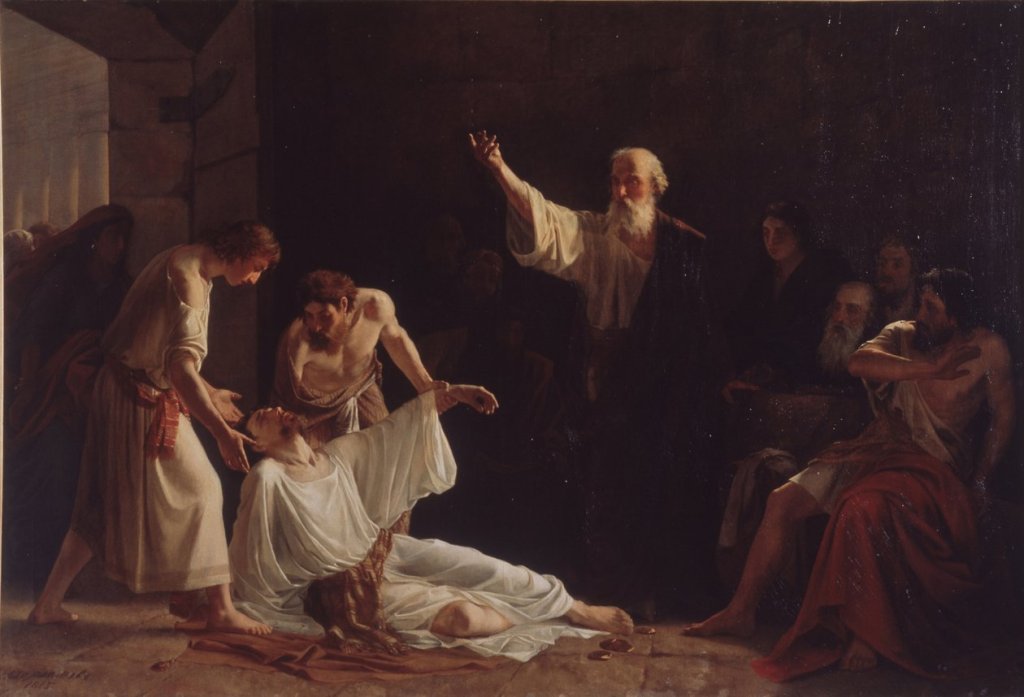
My reason for sharing the above information is because our New Testament reading in the Book of Acts, chapter 5, reveals the kind of power which the genuine early church Apostles possessed, in contrast to the vast number of pseudo-apostles of today. Those genuine Apostles could literally exercise the Divinely-appointed judicial killings of hypocritical or faithless followers of Christ who are a threat to the Church, as we see in this fifth chapter of the Book of Acts (I hope you are reading it) which contains the account of the Ananias and Sapphira affair. This episode is rather foreboding, to say the least. It is not a chapter on which preachers relish preaching (unless they are part of the “fire and brimstone only” brigade or they delight in using it as a lever to squeeze some more money out of a frightened congregation!).
There are a number of profound and awesome aspects to this account. If we want to understand the background to it, then we have to go to the Old Testament counterpart of this story — the slaying by the Lord of Aaron’s sons, Nadab and Abihu, in the Book of Leviticus, chapter 10, just after the institution of tabernacle worship.
“Now Aaron’s sons Nadab and Abihu took their censers, put fire in them and added incense, and offered unauthorized fire before the LORD, contrary to His command. So fire came out from the presence of the LORD and consumed them, and they died in the presence of the LORD” (Leviticus 10:1-2).
Instead of following the Divine instructions, they did their own thing and did it their way. Then God’s judgement hit them. We find the reason for this in Leviticus 10:3 where the Scripture qotes God as saying, “I must be regarded as holy by those who come near Me, and before all the people I must be glorified”. In other words, if I may take the liberty of paraphrasing what the Lord is saying here, it goes something along these lines:
“This gathering, this community, this covenant, this thing which I am setting up for the first time in this world of Mine, among these people of Mine, is not about YOU. It is not about setting YOU up or inflating YOU in any kind of a way or giving YOU any opportunity to exercise something that YOU think is right for YOURself. It is actually about glorifying ME and ME ALONE. If you fail to realise that and pursue your own pathway, ignoring my commandments, and thus risk bringing my people into disrepute, you will pay a terrible price, even your own premature death at My hands”.
That is what the Lord is really saying here. He is putting His stamp on the whole thing: “I must be regarded as holy by those who come near Me, and before all the people I must be glorified”. [I will be developing this incident and its implications more fully below]. It is this same holiness and glory which lies at the back of this incident in the Book of Acts, chapter 5 — this very chilling story of Ananias and Sapphira, who sold some land and claimed that they had given all the proceeds from the sale to the work of the church, when in reality they had secretly kept back half of it for themselves.
Now some people have said that this story cannot possibly be true, as it is just too horrible for words and “the Lord would never do anything like this because He is love” (bla-bla) and therefore (so they say) it’s probably just a legend or a myth that has been incorporated into Scripture at a later date just as a way of putting the fear of God into people. So many are so prideful that they can say, “the Lord wouldn’t do that”, all because they wouldn’t do it if they were God. But they aren’t, and for good reason! They are so full of it: “The Lord wouldn’t elect some people to salvation and not others as He loves everyone”. “The Lord wouldn’t send anyone to hell because He is a God of love”. “The Lord wouldn’t do this”. “The Lord wouldn’t do that”. Who on earth do these self-styled apologists for God (who also do not know the Scriptures) think they are? What unbelievable chutzpah!
Moreover, to claim that this event concerning Ananias and Sapphira is a myth is to underestimate the sovereignty of God and how he can exercise His power in whatever way he likes. For He is the potter and we are merely the clay with which He works His eternal plan of the ages. My friends, this is a real incident that really happened and it has been recorded in the Bible for very good reasons, not least of which is to demonstrate the reality of those words of the Lord: “I must be regarded as holy by those who come near Me, and before all the people I must be glorified”. Establishing that holiness and glorification at the beginning of a new work of the Lord is vital, and the church was only just being established.
I want to look at three spiritual lessons that we can learn from this chapter that are actually positive lessons. But before we look at these spiritual lessons, I just want to draw your attention to some great introductory truths of Christian teaching that are in this chapter, because here the Holy Spirit is mentioned in a very powerful way, and the Holy Spirit is one of the most misunderstood (and misused) elements of Scripture.
One reads in verse 9 that Ananias and Sapphira have tested the Spirit of the Lord; and their sin, it says, was lying to the Holy Spirit (v.3). Then, in v.4, Peter says: “You have not lied to men but to God”. In other words, we find here a very great proof that the Holy Spirit is part of the Godhead: Father, Son and Holy Spirit. So the deity of the Holy Spirit is very clearly shown in this chapter.
Another great truth of Christian teaching is that the Holy Spirit has personality! He is shown to be a person. And this is a very important aspect of Christian teaching because often people can get the idea that the Holy Spirit is just some kind of impersonal force that can apparently be manipulated to create all sorts of moronic special effects in churches (as we see so much today in the now ubiquitous Charismatic scene, which has gone mainstream), or that the Holy Spirit is just an aspect of God’s character. Many heresies have been built around those ideas. Some people have said that when it says “Father, Son and Holy Spirit”, they are just different aspects of God. But the Bible ascribes actual separate personality to Father, Son and Holy Spirit.
We see here, in verses 3 and 4, that it is possible to lie to the Holy Spirit; and they lied to the Holy Spirit because the Holy Spirit is the Spirit of truth (John 16:13), empowering the church. The Holy Spirit was embodied in these apostles here during this first phase of the building of Christ’s church as they laid the foundations of it (cf. Ephesians 2:20). The Holy Spirit had empowered the church, had brought the body of Christ into being as we can see in Acts chapter 2. So you can lie to the Holy Spirit. But you cannot lie to a mere force! You cannot lie to an “aspect” of God. You can only lie to a person, to a personality. And that is the true Christian teaching: That Father, Son and Holy Spirit are ONE in essence, in substance, but that there are THREE distinct personalities. This is born out in many other places in the New Testament.
The Spirit speaks to people. In Acts chapter 10, we read that “the Spirit said to him, ‘Behold, three men are seeking you. Arise therefore, go down and go with them, doubting nothing; for I have sent them’“. And he did so. That is Personality. A mere force or aspect does not speak to people like that.
You can also resist the Holy Spirit. Steven said to the Jews just before they stoned him, “You stiff-necked and uncircumcised in heart and ears! You always resist the Holy Spirit; as your fathers did, so do you!” (Acts 7:51). Well this is resistance of a person, a personality.
You can grieve the Holy Spirit. Ephesians chapter 4 verse 30; “And do not grieve the Holy Spirit of God, with whom you were sealed for the day of redemption”. If you are indwelt by the Holy Spirit, as all Christians are, every time we do something that is contrary to God’s law — an offence either against God or our fellow Christians — it grieves the Holy Spirit. That is personality. You cannot grieve a mere force or an aspect.
You can quench the Holy Spirit. 1 Thessalonians 5:19: “Do not quench the Holy Spirit”. Now you may say, “how can you possibly quench God? Surely if He wants something to happen, he will make it happen. How can you possibly quench Him?” Well it’s like this: Just as we have seen in the making of King Saul, sometimes the Lord permits things to happen that are contrary to His will, for His own purposes, in order to teach us a lesson or show us the truth about something. So you can quench the Holy Spirit or, rather, stifle His efficacy in our lives because of stubbornness or pride. It is much more unlikely for the Holy Spirit to be operating in fullness in our lives where there are spiritual difficulties and deliberate sinfulness and so on.
You can insult the Holy Spirit. Imagine that! In Hebrews chapter 10, verses 28 and 29, we read: “Anyone who has rejected Moses’ law dies without mercy on the testimony of two or three witnesses. Of how much worse punishment, do you suppose, will he be thought worthy who has trampled the Son of God underfoot, counted the blood of the covenant by which he was sanctified a common thing, and insulted the Spirit of grace?” That, my friends, is Personality! You cannot insult a mere force or aspect.
Finally, you can blaspheme against the Holy Spirit (Mark 3:28-29). Well, you can’t blaspheme against a “force” or an “aspect” of God! The Holy Spirit has personality. He can be blasphemed against. You may say “What does it mean to blaspheme against the Holy Spirit?” Well, we could spend another sermon looking at that whole thing. But in brief, to blaspheme the Holy Spirit, doesn’t mean merely denying the evidence of the Spirit in operation, because the vast majority of people in the world do that and they haven’t committed a blasphemy against the Holy Spirit. To blaspheme against the Holy Spirit means to deliberately despise and viciously oppose the work of the Holy Spirit when it is plainly, obviously His work and is known to be His work. And that’s what the Pharisees were guilty of. They knew very well that the Holy Spirit, the Spirit of God was in operation and the Lord Jesus was saying that especially against them, because they ascribed Jesus’ acts and works to Satan. They said He was working through Satan, that’s how He was operating and performed miracles and so on and the Lord Jesus said that’s a blasphemy against the Holy Spirit. (Incidentally, in case you are ever worried that you may have blasphemed the Holy Spirit, then it is very doubtful that you will have done so. I can assure you that those who are truly guilty of blaspheming the Holy Spirit never worry about it one iota! The same goes for those believers who fret that they may not be saved. I can assure you that if you were not saved you would not be fretting about it. Only the saved would fret over that!).
So we see from this Acts 5 incident with Ananias and Sapphira that the Holy Spirit is God, very God of very God and that He has personality and is not some force like a genie in a bottle that so many seem to attribute Him with today in order to trigger the pseudo special effects department in their churches (e.g. the slain in the spirit garbage, the pseudo ‘Baptism in the Spirit’ tongues routine, etc. which I deal with in detail in the book I recommended earlier in this sermon).
Now I want to draw out the spiritual lessons of this very awesome incident. I have isolated three. You can probably think of many more, but I just wanted to draw a number of aspects together under three main lesson headings.
The first spiritual lesson is that
I. WHEN GOD BEGINS A NEW WORK, HE MEANS BUSINESS!
A comparable situation to that of Ananias and Sapphira — the Old Testament equivalent of that New Testament event — was the slaying by the Lord of Nadab and Abihu, Aaron’s sons (Leviticus 10:2). (At this point, you’ll need to turn in your Bibles to the Book of Leviticus chapter 10 and read it). This was taking place at the time when all the commandments for the sacrifices and for what was going to be happening in the tabernacle were being set up. And it was the great order that had been set up by the Lord that lay at the heart of the old covenant that Moses had brought to the people from God.
Straight away, we discover that Nadab and Abihu were carrying out things, in the order of service, that the Lord had not commanded. When God begins a new work, He shows He means business. And here He showed it in an unmistakable manner.
One of the greatest, most sobering and most extraordinary things that one finds in Leviticus chapter 10 is the statement: “But Aaron remained silent” (Leviticus 10:3). He, the high priest and their father, didn’t say a word. He said absolutely nothing. Imagine the situation. He had just seen his two sons blasted into oblivion before His eyes by the Lord, and he just kept silent. It was as if he was saying in his heart, “This is fair, Lord, I understand absolutely”. The key was in that statement by the Lord about the situation: “I must be regarded as holy by those who come near Me, and before all the people I must be glorified” (Leviticus 10:3). The Lord was beginning a new work in the tabernacle — it was the dawn of a new era for the Lord’s people. There was an overriding need to emphasise that this was all about the glorifying of God and the service of His people rather than a way for people to do their own thing and seek aggrandisement for themselves. There are so many like that in churches today who think they have the right to “exercise my gifts” which is all just ego stuff. “Pastor, I want to exercise my gifts by playing my guitar in worship”. Me, me, me. Well I have news for you, sunshine: It isn’t about you exercising your alleged gifts but about you denying yourself and giving God the glory, letting God be God. If you claim that you are glorying God with your gifts, that is usually just a pious-sounding excuse to show off in front of people. Church is not about exercising our gifts in front of everyone. We have to learn absolute humility and a willingness to lay down our own lives in death before we are remotely capable of anything else. When you can quietly be a disciple of Christ in the background, without being obsessed with the need to “exercise your gifts”, then you may possibly become eligible to do more. Seeking self-validation from others (or even from God) or elders humouring people by letting any old (or young!) Tom, Dick or Karen exercise their “gifts” has no place whatsoever in the body of Christ. The Ekklesia is not a psychological therapy group to make people feel wanted or useful. That is just immature ego-games which disciples of Christ should be well beyond (though most, sadly, are not). Rather, the Ekklesia is solely about this saying of God: “I must be regarded as holy by those who come near Me, and before all the people I must be glorified”.
It was just the same in the incident with Ananias and Sapphira. We need to understand what is happening in the first five chapters of the Book of Acts. The church had just been instituted through the Holy Spirit in Acts, chapter 2. And the Lord is impressing upon the people the fact that when He begins a new work He means business. There is no room for the sort of human-centred nonsense and religious hypocrisy that was happening here. You see…
1. God’s Business is Actually Spiritual Warfare
Above all, He is impressing upon us that the church is God’s primary instrument of spiritual warfare. That is what the church is, His primary instrument of spiritual warfare. So it is as if He is saying: “You can’t play around with Me. There’s no room for messing about in here. No room for any kind of pretence, setting yourself up as the centre of it all. It isn’t about you but about ME. Now deal with that!” The church is God’s primary instrument of spiritual warfare and thus must be kept as pure as can be, reputation intact, giving no unnecessary opportunity for people to ridicule it.
Imagine if Ananias and Sapphira had got away with their deception — their lie. People in the community will have known what price their land was sold for. The buyer will have known it; probably his friends will have known it; if it had been advertised publicly many will have known it. Their flamboyant act of donating what they claimed was the full proceeds of the sale will no doubt have ensured that the shortfall will have been known too. Thus, the reputation and credibility of the new community of believers was at stake, and at a fragile point in church history. The Lord had begun a new work and it must be seen to be powerful and different to anything which the world has to offer. Believers must not have the reputation of being liars, crooks and swindlers. Neither must they be seen to be proud, full of themselves, puffed up and self-promoting.
The work of the church is to plunder souls out of this world, to pluck them right out from under the nose of Satan, from under the power of Satan and transform them into those who follow the Lord Jesus Christ. To act in that way, the church must sweep its own house clean. For the church is Gods primary instrument of spiritual warfare. This awful end happened to Ananias and Sapphira because they didn’t take this seriously enough. They were playing around with the Lord. They were testing the Holy Spirit, as it says in Acts 5:9.
The work of the church is to turn people from darkness to light, from Satan to Christ. This is no game. There are beautiful aspects to being part of the church. There is great fellowship in being part of the body of Christ. There are wonderful relationships that come out of being part of the body of Christ. It is warm and comforting to be amongst the true people of God. But those are not the prime reasons for the existence of the church; they are just by-products. The very existence of the church is to act as God’s primary instrument of spiritual warfare in this world, confronting Satan and plundering his subjects. Anything less than that is either failure or misrepresentation.
“The very existence of the church is to act as God’s primary instrument
of spiritual warfare in this world, confronting Satan and plundering his
subjects. Anything less than that is either failure or misrepresentation“.
The work of the church is to demonstrate the true meaning of righteousness. Demonstrating the true meaning of righteousness is an act of spiritual warfare, because it runs completely counter to what exists at the heart of this corrupt world in its present state. You see, what happened to righteousness originally is that there was a great Fall which took place at the beginning when our first parents, the first created people, turned away from God and followed the lies of Satan. The image of God in humans was then utterly defaced in terms of righteousness and holiness (please compare Ephesians 4:24 with Colossians 3:10). From that time on, unrighteousness came into this world and the human heart was naturally inclined towards unrighteousness.
2. God’s Business is Establishing Righteousness
The whole of the story of the Scriptures is about how God is going to re-establish righteousness and holiness in this universe in the renewing of the image of God in those who become a new creation in Christ (again, please compare Ephesians 4:24 with Colossians 3:10). The re-establishing of righteousness is an act of spiritual warfare. It is an act of spiritual warfare because it is cutting completely across the darkness, unrighteousness and unholiness that Satan has brought into this world. The church (or “Church Militant“, as it is often called) is God’s primary instrument of spiritual warfare, and Ananias and Sapphira did not take that seriously. They were playing, they were testing, they were establishing themselves rather than the church. But God’s business is far too serious for that kind of egocentric activity. In his second letter, chapter 3, Peter refers to the end of this world when the whole universe is going to be recreated. He says:
“Since everything will be destroyed in this way, what kind of people ought you to be? You ought to conduct yourselves in holiness and godliness as you anticipate and hasten the coming of the day of God, when the heavens will be destroyed by fire and the elements will melt in the heat. But in keeping with God’s promise, we are looking forward to a new heaven and a new earth, where righteousness dwells” (2 Peter 3:11-13).
The whole of Scripture is about how righteousness is going to be re-established. And at the moment, in this gospel age, in this process of the reestablishment of righteousness — which is first of all set up in individual human hearts when they come to Christ and believe in Him and follow Him — the whole of this age is looking forward to that time when the new heaven and the new earth will be created and there will be righteousness through and through. But at the moment in this gospel age, it is about spiritual warfare. Bringing righteousness about in this fallen world involves spiritual warfare; because people in this world exist under the power of Satan, and we have to do battle with Satan — even in the preaching of the gospel. The preaching of the gospel is the ultimate act of spiritual warfare. It is turning people, as Paul put it, from Satan to Christ and from darkness to light (Acts 26:18). The church is God’s primary instrument of spiritual warfare. And when God begins a new work, He shows that He means business.
The purpose of the church is to demonstrate this righteousness which is from God to the world — to show how it works in our hearts when we believe the Lord Jesus Christ and obey the gospel and follow His truth. What is happening here in the Acts of the Apostles is this. The gospel has been preached — a gospel which says that Christ has come into this world, He has died on the cross, He has been raised from the dead; He has ascended to the right hand of God the Father in heaven, and the Acts of the Apostles is the story of how all of that has been brought into the world, how people are being made to believe it and they are following Christ as a result of that. The Book of Acts traces what happens as a result of the gospel of Christ coming into this world. This gospel says; “Yes, Christ has taken upon Himself the penalty for your sin, and if you follow Him, YOU will be made righteous, the image of God will be increasingly restored in you, and then — ultimately, after the return of the Christ — you will be part of the new heaven and new earth that is being created at the very end of this age”. On the way towards that time and prior to the Day of Judgement, the church — that is, the true Ekklesia rather than merely the visible church which contains a huge amount of dross and nonsense — is God’s primary instrument of spiritual warfare.
The church is designed alongside of that to bring glory to God. That’s what lies at the very heart of the existence of the church, the body of Christ, to glorify God; “I must be regarded as holy by those who come near Me, and before all the people I must be glorified”. Ananias and Sapphira did not take that seriously, they thought that they could play games with God; but when God begins a new work, He shows that He means business! He was showing that this isn’t any person’s church. He is saying “This is MY church, not yours to do with as you will!”
The Greek word which is translated most often as church, Ekklesia, means, literally, “those who are called out”. Called out of the world and transformed. The very first mention by Luke of the word “ekklesia” occurs in the Book of the Acts of the Apostles and in verse 11 of this very passage at which we are now looking. When God begins a work, He shows He means business. What He did to Ananias and Sapphira worked. “Great fear”, it says, “came upon all the ekklesia and upon all who heard these things” (Acts 5:11).
3. God’s Business is Judgement
This whole incident is a real slap in the face for all those who think that God never becomes angry or never makes terrifying judgements. True, His anger is not like ours. His is Divine wrath against all that which contradicts His law, which is about as far from human anger as it could be. [Please see my Excursus on the Wrath of God in my commentary on the Book of Revelation]. This Divine wrath against all that which contradicts God’s law is revealed everywhere in Scripture, but it is especially poignantly manifested in the incidents involving Nadab and Abihu and Ananias and Sapphira. Yet many professing Christians today — even influential Christian leaders — deny the existence of the wrath of God or His terrible judgement. Here is a typical quotation from a book released in a pivotal decade (1994-2004) in the undermining of evangelicalism, which came to sum up the side-stepping denialism of modern-day so-called “evangelicals”:
“The Bible never defines God as anger, power, or judgement — in fact it never defines him as anything other than love. But more than that, it never makes assertions about his anger, power or judgement independently of his love. So, though we read about his various attributes, in reality they are, as Karl Barth points out, never more than ‘repetitions and amplifications of the one statement that God loves’” [Steve Chalke & Alan Mann, “The Lost Message of Jesus”, Zondervan, 2003, p.63].
This book, described in a contemporary review in one Christian paper as “an alarming, painful, dangerous book” [review by Andrew Sach & Mike Ovey of Oak Hill Theological College, London, in “Evangelicals Now”, June 2004, p.27], is typical of many which can be found in Christian bookshops today. In the same book, which is an object lesson in the misapplication and misinterpretation of Scripture (not to mention the tendentious manipulation of its readers), the authors claim that the Son of God could not have been punished by the Father as this would be “a form of cosmic child abuse” [Chalke & Mann, op. cit. p.182]. Words almost fail me! Remember that Steve Chalke has been a keynote speaker at the highly popular Spring Harvest/Word Alive evangelical conferences in the UK, is a recently appointed canon of Southwark Cathedral, a television personality, director of the Oasis Trust, who works closely with Youth For Christ and has been associated with evangelical youth movements in the UK for many years. He also is a champion of same-sex marriage and LGBT/transgender acceptance and encouragement in the church. One wonders how such people gain credibility in the Christian scene at all, unless one has changed the definition of “Christian” (which, of course is the case!). From the time that he was promoting the demonic Toronto Blessing in 1994/5 through to his lightweight neo-liberal theological essay on an alleged “lost message of Jesus” in the 2000s, like so many leaders today he has been a classic wolf in sheep’s clothing. Now you know why I have often used the word-form “evanjellycals”. Like jelly, they wobble about so much that you cannot tell where they stand! However, these days it might be more appropriate to use the word-form “evanhellicals” as so much satanic baloney seems to infect the evangelical scene that I no longer use the original word to describe myself.
What are these people going to do with the descriptions of the Lord’s hand of judgement in Leviticus 10 and Acts 5? The stark reality is that the Lord uses profoundly disturbing means to impress His power upon us. You see, my friends, that great truth had to be shown — publicly demonstrated — that Paul speaks about in 1 Corinthians 3:11: “For no one can lay a foundation other than the one already laid, which is Jesus Christ”. The foundation of the church is Jesus Christ. But if a church is founded on the dishonest actions of people like Ananias and Sapphira, it is no church at all. And so it had to be spelled out to everyone right at the outset — just as it did with Nadab and Abihu — that no one can lay any foundation in the believing community of the Lord other than the one which has already been laid, which in the New Covenant is Jesus Christ. The Lord was here showing, “When I begin a new work, I mean business! This is a serious matter”. So that is the first spiritual lesson.
The second spiritual lesson from the incident involving Ananias and Sapphira is that…
II. GOD HATES HYPOCRISY
That is what lay at the heart what Ananias and Sapphira did. There is nothing which provokes God more than making a mere show of holiness (known as pietism). They came along and piously laid down some money, so Peter says to them very plainly; “Hey, hold on, that land was yours to do with as you like. You needn’t have sold it even”. They weren’t obliged to give the proceeds to the church and they certainly weren’t obliged to give ALL the proceeds to the church. But it looks as if Ananias and Sapphira entered into some kind of contract with the church and said “Whatever money we get from the land, we’ll give you the whole thing”. But they didn’t, they gave part of it and held some back for themselves.
Well even that itself wasn’t the main problem. The main problem was that they claimed that was all that they had and they laid it down at the feet of the Apostles as if to say; “What generous and marvellous people we are. How holy we are providing so much for the work of the Lord”. (Does that sound familiar?). But yet it was an act of hypocrisy.
Do you know where the word “hypocrite” comes from? You don’t have to speak Greek to know this, or to be a Greek expert to know this. You can look in any concordance and see for yourself. The word for “hypocrite” in Greek is ηυποκρίτε, hupocrite. It literally means “actor — a stage actor”. The main use of it today in Modern Greek is someone who is a pretender, someone who plays a role, pretends to be something other than who or what they really are. Well obviously if you are just a stage actor, that’s not done in a malicious way. But to be a hypocrite is to pretend to be something other than what you really are — to pass yourself off in such a way that you aggrandise yourself. And that is what was happening here. There’s nothing which provokes God more than hypocrisy. In fact, I believe that God would find an out-and-out outspoken “honest” atheist more “acceptable” than a professing Christian who is pretending to be something other than what they are. This is what lies at the heart of this Ananias and Sapphira incident. They wanted to appear to be wonderfully helpful to the church with their good works, putting this money at the feet of the apostles; but they were actually putting themselves first. They were thinking; how can I get the best for myself out of this deal here? That is a big mistake with the Lord.
The awesome reality is that hypocrisy can never be hidden from God. It is possible to fool people very easily. Very easily. However, you can conceal your motives from people but you can NEVER conceal them from God. God sees what lies behind something, everything. He sees the truth of it, the inner workings of it. That is what lay behind the Lord Jesus’ exposé of the people who made a show of putting money in the temple treasury. You know the passage I am speaking about in Mark 12:41-44: “Now Jesus sat opposite the treasury and saw how the people put money into the treasury”. You can imagine all the wealthy people putting a great amount in and thinking, “Wow! He’s going to think I’m really something — a real somebody — very spiritual”. Many rich people threw in large amounts. But a poor widow came and put in two very small copper coins, worth only a fraction of a penny. Calling his disciples to him, Jesus said, “Assuredly, I say to you that this poor widow has put in more than all those who have given to the treasury; for they all put in out of their abundance, but she out of her poverty put in all that she had, her whole livelihood”. God sees the heart, and that is what counts.
Somebody on the outside could have said “Well what’s the use of her offering? A few pennies, pathetic, what’s that going to do, it’s worthless!” but she had actually given everything she had! More than that, it wasn’t just a question of giving everything she had, it was her motivation. In other words, it’s not how much or how little one contributes which counts before God. What counts is how generous you’ve been out of what you have. And you know why? Because she knew that no matter how much she deprived herself by her giving — even if she gave her last penny — the Lord would look after her very generously. This is a fundamental rule — an absolutely fundamental rule. She knew that no matter how much she deprived herself, even if she gave everything she had, that God would honour that, and God would reward her and look after her. Of course, her motivation wasn’t to be rewarded by God; she just knew that it was a fact. But the rich folk there, they always made sure they looked after themselves, so even if it looked as if they had given a lot, in actual fact, they hadn’t GIVEN from the heart as much as she had, and she had infinitely more faith than they did.
That is what is demonstrated here with Ananias and Sapphira. The mighty fact of God’s omniscience (all-knowingness) had to be demonstrated right at the outset of the church — the visible manifestation of the Body of Christ in the world. God sees the motivation. You can do what you like on the outside but God sees the motivation, what lies behind things. We as people very often judge people’s motivation, what lies on the surface, because we can’t see with Divine eyes and because we’re not apostles like Peter. All those who call themselves “apostles” today are no such thing. They are false apostles. Heaven help us if there really were apostles like Peter in the church today and they marched into our churches! I shudder to imagine the scenes.
God hates hypocrisy. That is the lesson that comes from this chapter. This awful judgement was given out by God to impress on the church both then and throughout this whole age — applicable even now — to demonstrate how much He hates hypocrisy and how much He will drive it out at all costs, because falsehood ruins fellowship. That’s a truth we must all remember; falsehood ruins fellowship. Whenever deceit of any kind comes into a fellowship, it ceases to be a fellowship. It will bring about its destruction. So there must be no guile in the church — no pretence — no play-acting — no hypocrisy. Deceit is always a spiritual disaster, wherever it happens and in a church setting doubly so, because it not only ruins fellowship but it brings disgrace to the glory of Christ before the world.
So that’s the second lesson: God hates hypocrisy.
The third and final lesson that we learn from this incident involving Ananias and Sapphira is that
III. SATAN HAS DEFINITE STRATEGIES FOR THE DESTRUCTION OF THE CHURCH
Satan deliberately targets churches in order to destroy them. And he is very good at it. That shouldn’t surprise us as he’s been doing it for countless millennia, which is a lot longer than we have had in order to be able to understand these things. He has been doing all he can to destroy God’s people for a very long time — from time immemorial. He is very well practiced and he is far wilier than any of us are by ourselves.
He has a pincer movement you see. He tries to destroy the church from the outside with false teaching, persecution and all kinds of things coming at the church from the outside, and ultimately martyring the disciples. But he also comes at the church from the inside. And I think this is one aspect of Satan’s strategy which many Christians fail to recognise. Satan doesn’t just come at the church from the outside; he operates from within. Paul drew attention to this in the Book of Acts 20:28 when he was just about to leave Ephesus. It was a very emotional departure because he knew terrible things were going to happen to the church there and he prophesied to the elders what it was:
“Take heed to yourselves and to all the flock, among which the Holy Spirit has made you overseers, to shepherd the church of God which He purchased with His own blood. For I know this, that after my departure savage wolves will come in among you, not sparing the flock. Also from among yourselves men will rise up, speaking perverse things, to draw away the disciples after themselves. Therefore watch…” (Acts 20:28-31).
That warning given to that church in Ephesus is no less pertinent today. It is not something to which we can say, “Well that was Paul talking just to them”. It’s the kind of thing which happens everywhere. There’s a satanic pincer movement from outside and from within.
We can see the persecution from the outside in the previous chapter, chapter 4 of Acts, which began in earnest. Satan began to assault the church. Why? Well we mustn’t imagine that if we’ve got a church, and everything seems to be rosy in the garden, that we can just sit back and relax. We mustn’t imagine that we will be free from assault of any kind. One can imagine that in the early church they might have thought that. That description at the end of Acts chapter 2 in those final verses there of the church, as they were going in and out of each other’s homes, praising God continually, filled with joy, going up to the temple and all that sort of thing, breaking bread together, giving money to everyone and everyone sharing things with each other, living on that great high… and straight away, Satan comes in with his pincer movement: Persecution in Acts chapter 4. Here in chapter 5, we see Satan’s strategy from within explained. That’s why Peter said, “Ananias, why has Satan filled your heart…” (Acts 5:3). He ascribes this whole event to an act of Satan which Ananias and Sapphira brought about through giving him a foothold in their hearts (cf. Ephesians 4:26-27). Satan will operate from within the church, from among those who are members of the church — right there in their hearts. And this is a law that has happened throughout history.
Let me say this: a church becomes a lot more prone to successful attacks by Satan when its members do not keep watch over themselves and do not resolve to keep themselves free from the kind of emotions and actions which enable Satan to exploit them and thereby to find a way into the church.
Top of the list must be anger. Anger is a very serious thing, much underestimated by many in terms of its ability to bring satanic interference. In Ephesians 4:24-27, Paul shows that if anger takes a hold in our hearts, then we give a foothold to Satan. You know how sometimes our anger can be misdirected. We can have great difficulties in our lives, all kind of things we are struggling with, we don’t know how to cope with it, how to deal with it and then we can lump our anger about that onto somebody else. Usually the person we are married to gets it in the neck, or the kids, or our fellow believers, somebody who is close to us. “You always hurt the one you love”, as the saying goes. Very often that anger can get twisted around and around. So we have to deal with anger and deal with it in its right context.
Bitterness is another thing that eats a person up and eats its way into the church and provides a foothold for Satan. Envy, jealousy, backbiting, arguing, greed, pornographic thoughts and actions, improper sexual relationships and urges, deceit, underhandedness, subterfuge, pride, false teaching, all these things inside a church — and not just in the church in an anonymous way but in our personal lives and our own behaviour, in the things that we do — all of these will attract Satan and the demonic realm like a magnet. Believe me, he’ll come rushing in and will thoroughly take advantage of them unless we deal with them before the Lord.
How often churches — groups of believers — fall into these things without even realising that they have happened; or without even realising that Satan is what lies behind them. This is why Jude wrote his letter. Have you ever noticed why Jude wrote the letter that he did, which is a very sad and powerful letter which many people might shy away from? He says to the recipients “…while I was very diligent to write to you concerning our common salvation…”. That was his original intention: To write a really uplifting letter about the salvation that they shared. He then goes on to say that instead of such a letter, “I found it necessary to write to you exhorting you to contend earnestly for the faith which was once for all delivered to the saints”. So he started out with one purpose and then thought “No, hold on a minute, I must write and tell them to contend for the faith for at the moment that is even more important than speaking about salvation”. This is the most important thing. Why did he change his mind? Well, he tells us: “For certain men have crept in unnoticed, who long ago were marked out for this condemnation, ungodly men” (Jude 4). And this is something that happens throughout the whole of church history. Satan finds a way into the church by any means. He knows he can’t take away a believer’s salvation, for that cannot be lost if it is genuine (despite so many claiming today otherwise, thereby defying the witness of Scripture, John 10:27-30). He knows that he cannot destroy the body of Christ,the true Ekklesia (Matthew 16:18). But he can cause a lot of mayhem and problems in the meantime. And it is in his mind continually to do so.
So how careful we have to be.. and how careful pastors and teachers have to be to protect the flock.
If we don’t put the glory of Christ first in a church but instead seek to pursue our selfish ends like Nadab and Abihu, Ananias and Sapphira, we will be many times more prone to successful attacks from Satan. He seeks to destroy a church and many churches have been destroyed through him. Many! I have seen it happen. More than once. They have turned back in on themselves and devoured themselves with bitterness and anger and rancour and splits and fighting tooth and nail. It’s a satanic work and it can be avoided — though it helps enormously if one is truly saved in the first place!
So the third lesson from the account of Ananias and Sapphira is that Satan has definite strategies for church destruction.
CONCLUSION
At this point, one may ask, “Were Ananias and Sapphira saved?” We do not know for certain, but there is no reason to say absolutely that they were not believers. You may say that genuinely saved people could not behave in that way. The sad reality is that on occasion they can, if they are not mindful of the dangers, though they will always repent. This is how one progresses in sanctification. King David was a believer and he arranged for a man to be killed on the front line of a battle so that he could steal his wife (2 Samuel 11:2-22). Peter was a believer and part of the Lord Jesus’ inner circle who publicly denied knowing his Lord (Matthew 26:69-74). A believer in the Corinthian church committed incest (1 Corinthians 5:1-5). Of course, they all later repented (Psalm 51; Matthew 26:75; 2 Corinthians 2:6-7).
However, Ananias and Sapphira never got the chance to repent publicly — but who is to say what was in their minds and hearts in the moments before they expired. Believers or not, they were made an example of in order to show that when God begins a new work, He means business. It was simply that important at that point in church history. The reputation of the church was at stake. The Lord knew very well that “a little leaven leavens the whole lump” (1 Corinthians 5:6), if not removed. Taking the lives of Ananias and Sapphira ensured that “great fear came upon all the church and upon all who heard these things” (Acts 5:11), thus preserving the integrity of the church and showing the danger of self-centredness and hypocrisy. Do not be fooled. The Lord can kill people any time He wants, even His own children. He gives life and He takes it away. It is but a small part of His awesome power. And if you were to start blustering with indignation that God would not do that to any of His people, then truly you are living in cloud-cuckoo land and have no idea of who God really is and how any one of us is expendable in the cause of preserving the reputation of His Ekklesia.
By way of conclusion, I want to reiterate two verses which I quoted earlier. “I must be regarded as holy by those who come near Me, and before all the people I must be glorified” (Leviticus 10:3). That is the prime mover in the church. And the second verse: “For no one can lay a foundation other than the one already laid, which is Jesus Christ” (1 Corinthians 3:11). Those are the key-concepts which lie behind this incident. This awful thing happened to Ananias and Sapphira because they ignored those two principles. They made the church into something to manipulate for themselves, to boost their own egos, rather than building the glory of Christ from within.
Their lives were the price which was paid so that the church would continue as a spiritual force to be reckoned with in the world. When the church doesn’t compromise by playing the world’s games, it becomes an organic force with great spiritual power. But when it does compromise and plays the world’s games it becomes a pathetic and spent organisation, relying on empty ritual and phoney authority for its continuation.
The fate of Nadab and Abihu alongside Ananias and Sapphira has much to tell us today. Aaron’s sons tell us that we must never add to God’s word or attempt to do things our own way instead of His, when He has made His way so clear; while Ananias and Sapphira tell us that the Lord will not tolerate the kind of behaviour which is likely to undermine the message of His people and give Satan a foothold in our midst.
Have we been sufficiently chastened by this extraordinary event?
.
.
© Copyright, Alan Morrison, 2023
[The copyright on my works is merely to protect them from any wanton plagiarism which could result in undesirable changes (as has actually happened!). Readers are free to reproduce my work, so long as it is in the same format and with the exact same content and its origin is acknowledged]
 Diakrisis Project
There is so much Spiritual nourishment in this sermon! Thank you! This is one I will read again.
LikeLiked by 1 person