
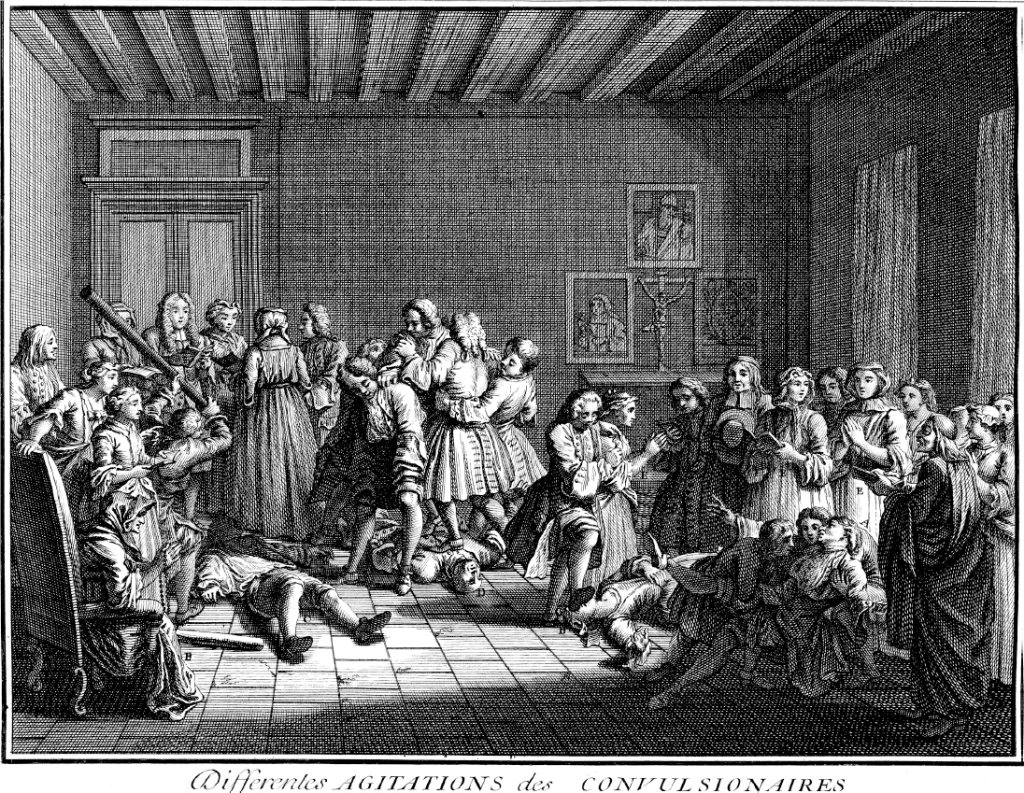
The above image is a 1741 engraving by Bernard Picart depicting “agitations and convulsions” in a Radical Pietist meeting
[This is a comparatively brief 6,700-word Extract from a 52,000-word Chapter entitled “The Secret Ladder: The Corruption of the Church with Eastern Mysticism” in the upcoming 2nd Edition of my book, “The Serpent & the Cross”. That chapter traces the entrance into the Church of mysticism, showing the parallels between Eastern mysticism, Mesmerism, Medieval mysticism, fanatical “Holy Spirit” movements at the time of the Reformation, right through to the Pentecostal/Charismatic Movements of today. History has repeated itself over and over again through a battle which involves the exclusive veracity of the Word of God versus personal notions and revelations dreamed-up by assorted crackpots and schismatics. This chapter shows precisely why one needs a good perspective and overview of Church history. This extract is around 30 minutes reading time. I hope that you find it to be a helpful ‘taster’ for the book as a whole].
The Response of the Reformers to All Forms of Mysticism
The Catholic mystics of the Reformation period — people such as Ignatius Loyola, who founded the Jesuits and, later, Francis de Sales — were decidedly anti-Reformation. Then there was John of the Cross and Teresa of Avila in Spain. Teresa believed herself and her nuns to be involved in a battle to overturn “the mischief and ravages those Lutherans had wrought in France” (Ruth Tucker and Walter Liefield, Daughters of the Church, Zondervan, 1987, pp.203-204). That is a big red mark right there!
In fact, we find that the whole issue of whether or not mysticism is a valid Christian pursuit comes into perspective at the time of the European Reformation with the vast number of individuals and groups which claimed some sort of mystical inspiration from the Spirit. These ‘spiritualists’ as they were known, who were mystical Charismatics, simply abounded. It represented a huge assault by Satan on the Word-of-God foundation of the Christian faith.
It is interesting that one so often finds that mysticism and mystical notions will come in like a flood when a society or civilisation is going through big changes. As Philip Schaff puts it: “Protestantism had reached a very critical juncture. Reformation or revolution, the written Word or illusive inspirations, order or confusion. That was the question” (Philip Schaff, History of the Christian Church, Vol. VI, “Modern Christianity, The German Reformation”, Charles Scribner’s Sons, 1892, p.388).
There was the Roman Catholic Church with all its corruption. Then the Reformers appear on the scene. But there was competition. Two groups vied to be the one which would ‘restore’ the visible Church. Both claimed that their desire was to restore it to its rightful condition. One group rested on Biblical authority, the other on mystical promptings of the Spirit through direct revelations from God. This is a battle which has perennially affected the Church from the beginning with the Gnostics and pre-Gnostic docetic type of conceits, right through to the present day Charismatic Movement. It is a battle which involves the exclusive veracity of the Word of God versus personal notions and revelations dreamed-up by assorted crackpots and schismatics. This is precisely why one needs a good perspective and overview of Church history. [Those “pre-Gnostic docetic type of conceits”, in which there was a denial that Christ’s body was real but was just an illusion, can be seen even as early as the late first century when John seemed to be countering it in his letters (1 John 4:1–3; 2 John 7). When Gnosticism began to hit the scene in the following century, that idea turned into a full-blown movement, Docetism, which was a spin-off from Gnosticism which shares that same belief about the illusory nature of Christ’s body].
All the while that the genuine Reformers were at work on this process of restoration, they were regularly plagued by various sects and characters who claimed they had received “words from the Lord” about this, that and the other matter. Martin Luther called them schwarmer, which to this day in German means ‘enthusiasts’, ‘fanatics’, ‘fantasists’, or ‘ravers’! This continued right through into the Puritan period in the seventeenth century and beyond. [By the word ‘enthusiast’ I am referring to “religious extravagance” (as it is defined in Chambers English Dictionary). The Puritans used the word “enthusiasm” to refer to utterances and physical manifestations which were claimed to be happening under the pretence of ‘Divine inspiration’ by assorted religious fanatics and lunatics. Thus, “enthusiasts” were those who readily gave vent to any religious feeling which was based on subjective sentiment rather than objective truth. Today these terms would encompass the extravagances of the Pentecostal-Charismatic movements, including the bizarre manifestations which masqueraded in the 1990s under the title “Toronto Blessing” and the associated phony “revivalism” which has been a watershed of spiritual delusion in church history].
The essence of this strain to religious ‘enthusiasm’ is an obsession with the subjective ‘Inner Light’ over and above the objective external Word of God. This was one of the principal controversies at the time of the Reformation, and it still is to this day. This is epitomized in Luther’s dealings with the revolutionary Thomas Müntzer, who was instrumental in the Peasant’s War in 1525. He believed that justification by faith alone was an invented doctrine, and (like any heretical ‘enthusiast’) he was violently opposed to the notion of Sola Scriptura, saying that those who propagate such a teaching “poison the Holy Spirit with the Holy Scripture”, because for them the antics of their alleged genie-in-the-bottle ‘Holy Spirit’ takes precedence over biblical truth and the Word of God, just as it still does today with the Mystics, Pentecostals and Charismatics.
In his very interesting book “The Third Reformation”, which examines Luther’s relationship to Mystics and Charismatics, Carter Lindberg of the Institute for Ecumenical Research in Strasbourg, says: “The key to Müntzer’s theology is a mystical spiritualism… mystical theology of an experiential self-disclosure of God to the person” (Carter Lindberg, The Third Reformation: Charismatic Movements and the Lutheran Tradition, Mercer University Press, 1983, p.80).
Luther’s response to Muntzer was to declare that he would not listen to him “even if he had swallowed the Holy Ghost, feathers and all!” Carter Lindberg writes that it was significant for Luther that Johannes Tauler was of catastrophic importance for Muntzer. Apparently Müntzer carried around with him Tauler’s sermons, bound in a double volume — showing that he was just as much of a lackey to Tauler as are so many of today’s Evanjellycals. It is a deadly legacy. [If you see me using the word “Evanjellycals” instead of “Evangelicals” it is because I want to emphasise how so many of them fudge the big issues and wobble around like jelly sitting on the fence when it comes to the need for clear, unequivocal statements on those issues].
The Zwickau (False) Prophets
Another of the confrontations between the Word and mystical inspirations involved three men who were friends of Müntzer, known as “the Zwickau Prophets”. Operating in the early sixteenth century, they claimed to be prophets from God and to have had intimate conversations with Him. They had no need of the Bible but relied solely on the promptings of the Spirit. “The most distinctive feature of the Zwickau Prophets was that direct revelations from the Holy Spirit, not Scripture, were their authority in theological matters” (Justo L. González, The Story of Christianity: The Early Church to the Present Day (Peabody, Massachusetts: Prince, 1999), p.39). This sounds suspiciously like the so-called Kansas City Prophets (false prophets) who were so prevalent and highly regarded in the 1980s and 1990s in the USA, but a number of whom later fell into disgrace. Bob Jones was found guilty of sexual misconduct and manipulating prophecies. Paul Cain fell into alcoholism and homosexuality. John Paul Jackson was outed in 1990 as having given multiple false prophecies. Mike Bickle, the Kansas City Prophets overseer and founder of the International House of Prayer (IHOP), was recently investigated for sexual immorality, with the accusations found to be upheld. [https://www.premierchristianity.com/news-analysis/explained-who-is-mike-bickle-and-what-are-the-allegations-against-him/17035.article ].
Zwickau Prophets. Kansas City Prophets. Whenever you see such a phenomenon, avoid it like the plague. False prophets all of them. They will do you no good whatsoever and you will at some stage see their lives disintegrate before your eyes. Anyone who sets themselves up as a prophet today is a false prophet bringing judgement on themselves. Moreover, anyone who attempts to exercise the gift of Prophecy or call themselves a New Testament prophet today is practising lawlessness. [For details about New Testament prophecy, see Chapter 11 in the sections dealing with revelation and sign-gifts and the signs of an apostle].
Astonishingly, Melancthon was utterly taken in by the Zwickau Prophets. But Luther said:
“Those who are expert in spiritual things have gone through the valley of the shadow. When these men talk of sweetness and being transported to the third heaven, do not believe them. Divine Majesty does not speak directly to men. God is a consuming fire, and the dreams and visions of the saints are terrible”. [Roland H. Bainton, Here I Stand: A Life of Martin Luther, Hendrickson Publishers, 1997, p.206]
It is ironic that Luther in his younger days had an attraction to Tauler. But it seems that he liked to adapt Tauler’s concept of God’s grace being necessary to religious mystical experience to his own developing idea of Justification. Luther certainly rejected the teaching of the mystics (including Tauler) on union with the Divine. And so did Calvin. In a footnote to Calvin’s use of the term unio mystica, “mystical union” (an unfortunate adoption of a term also used in Mystical Theology), in the Battles edition of Calvin’s Institutes, it says, “Niesel notes that Calvin nowhere teaches the absorption of the pious mystic into the sphere of the Divine Being” (Wilhelm Niesel, The Theology of Calvin, Baker Book House, 1980, p.26). We also find numerous references to the rejection of mystical notions in the Lutheran confessions. In Article 13 of the ‘Apology of the Augsburg Confession’, it states:
“It is good to extol the ministry of the Word with every possible kind of praise in opposition to the fanatics who dream that the Holy Spirit does not come through the Word but because of their own preparations. They sit in a dark corner doing and saying nothing but only waiting for illumination”.
Martin Luther: ‘The Pope is an ‘Enthusiast’, as were Adam and Eve’
In his ‘Smalcald Articles’, Luther even reckoned that the Pope was an ‘enthusiast’ (basically, the equivalent of a Charismatic) producing nonsense as a result of personal revelations. In the same words, he even said that Adam and Eve became the first ‘enthusiasts’ (Charismatics) in their Fall because they, too, put personal revelation above the Word of God, which is what the whole Charismatic and mystical scene, from top to bottom, is all about. Here are his words:
“In these things, which concern the spoken, external word, it is certain to maintain this: God gives no one his Spirit or grace apart from the external word which goes before. We are thus protected from the enthusiasts, that is, the spirits, who boast that they have the Spirit apart from and before contact with the word. They judge the Scriptures or the word, accordingly, interpreting and stretching them however it pleases them. Müntzer did this, and there are still many who do this today. They want to be shrewd judges between the spirit and the letter, but they do not know what they say or teach. The papacy is also pure enthusiasm. The pope boasts that ‘all laws are in the shrine of his heart’ and that what he decides and judges in his churches is supposed to be spirit and law—as if it is equal to or above the Scriptures or the spoken word. All of this is the old devil and old snake which also made Adam and Eve into enthusiasts. The devil led them from the external word of God to ‘spirituality’ and their own presumption—and even this was still accomplished by means of other, external words. Similarly, our enthusiasts also condemn the external word, but they themselves still do not keep silent. They chatter and write so as to fill the world—as if the Spirit could not come through the Scriptures or the spoken word of the apostles. But the Spirit must come through their writings and words. Why do they not abstain from their preaching and writing until the Spirit himself comes into the people apart from and in advance of their writings? They boast that the Spirit has come into them without the preaching of the Scriptures. There is no time here to debate these matters more extensively. We have dealt with them sufficiently elsewhere”. [Smalcald Articles, Part II, 3-6]
In other words, because of the Charismaticism (‘enthusiasm’) of our first parents in putting subjective desires and personal revelation above the Word of God (and all at the suggestion of Satan!), the whole cosmos was plunged into its fallen state! This is an astonishing thought. The very foundations of the Charismatic Movement and ‘Christian’ mysticism are built on the same massive error as committed by our first parents which put the cosmos in its fallen state! This really needs to be meditated on deeply.
And these Pentecostal-Charismatic ‘enthusiasts’ are still rabbiting on today about what the Spirit is allegedly doing as they dethrone Christ and instead place what they call ‘the Holy Spirit’ on a throne above Him, despite the fact that Christ said the Holy Spirit’s role is to testify about Him rather than about Himself (John 15:26). They do this because the Holy Spirit is like the wind, an invisible force (John 3:8), which, like the sorcerers and shamans that they are, they think they can usurp to fulfil their misplaced whims and wishes. However, it is not the Holy Spirit which they are invoking but a very different spirit altogether. Surely it is not an exaggeration to say that this ‘spirit’ is coming from the dark side, from the forces of darkness.
So I say again that the Reformation was a gigantic NO! to Catholic/medieval mysticism. But that did not stop it working vigorously, as we know. There was yet another mystical movement around the time of the Reformation which cannot be ignored.
The Pietist Movement
This was a seventeenth Century movement among German Lutheranism. It arose as a reaction against the prevalence of dogmatic theology in conjunction with spiritual deadness.
Pietism was the reaction of the spirit against the letter. It laid stress on the subjective rather than the objective aspect of faith. However, not all the Pietists are to be condemned. Many were well-meaning devout men. Philip Spener (1635-1705), for example, was clearly a godly man who had the best of intentions. However, as so often happens with reactive movements which are knee-jerking against some other extreme (or often what they imagine to be some other extreme), those who take up the baton from the founders pervert even the good morsels into a wholly extremist venture.
For example, Gottfried Arnold (1666-1714) started out as a Pietist, a disciple of Spener, but ended up as a fanatical Mystic. And this often happened. Johann Arndt (1555-1621) is generally regarded as the Father of European Pietism. His work, “Four Books on True Christianity” took up many of the themes of the medieval Mystics and was very influential on German Pietism. Yet it is significant that the Oxford Dictionary of the Christian Church says of Arndt: “In contrast to the prevalent forensic view of the Atonement, he dwelt on the work of Christ in the heart of man” (F.L. Cross & E.A. Livingstone, The Oxford Dictionary of the Christian Church, Oxford University Press, 1974, p.92).
In many ways, this exemplifies the central thrust of Pietism. We will be looking further at the way that mysticism does away with the forensic nature of the atonement; but we see here the essential contrast between the mystico-pietistic view of salvation and sanctification and the biblical Evangelical understanding.
It is interesting to note that, according to Robert G. Clouse, Johann Arndt “helped prepare the way for the Enlightenment and for Pietism”. This is because a religion which is solely of the heart meant relativism, subjective experience, by which a person is no longer dependent on external authority. That would mean freedom from the authority of the Church and, above all, from the authority of Scripture, and absolutely above all, from the overarching authority of God. Such was the development of hyper-individualism. Certainly, God has made each of us as individuals; but when an individual becomes an ‘Individualist’, he or she has stepped over the line into narcissism. Remember that mysticism not only involves seeking union with the Divine, but it also involves making one’s own subjective experience the sole arbiter of spiritual truth.
It is highly significant that one of the principal reforms demanded by the German Pietists, according to the Routledge Encyclopaedia of Religion, was “that the theological schools should be reformed by the abolition of all systematic theology, philosophy and metaphysics, and that morals and not doctrine should form the staple of all preaching” (John Blunt, Dictionary of Sects, Heresies, Ecclesiastical Parties, and Schools of Religious Thought, Outlook, fp.1874, p.430). And what would you suspect to be the result of that reform? In their eagerness to abolish systematic theology, the mystics and pietists embraced a systematised devotionalism. Systematic theology and doctrine which is devoid of heart spirituality and devotion is bad enough. But a heart spirituality which is devoid of genuine theology and teaching is an absolute scourge. The two belong together, as a balance. Which do you think it is easier to do? To melt a scholastic heart or to bring a Mystic down to earth?
Pause for thought…
Pietism has been described as “the last fruit of the heart religion which originated in the Franciscan Movement” (James Hastings, Encyclopedia of Religion and Ethics, Part 17 (Scribner, 1928), p.8). And it is surely no coincidence that many Protestant critics of the time saw in the Pietist movement a retrograde tendency towards Catholicism. It is interesting to read the largely sympathetic treatment of Protestant Pietism in the authoritative New Catholic Encyclopedia:
“The Pietist emphasis upon a quality of life rather than orthodoxy of beliefs tended to produce a softening of religious divisions. Contact with like-minded Roman Catholics developed late in the 18th Century” (New Catholic Encyclopedia, Vol.11, p.355).
A Softening of religious divisions. Well that is admirable if there has been some unbiblical division of which the Lord would not approve. But it is tragic if this ‘softening’ happens without any discernment whatsoever.
It is interesting to trace the influence of the Pietist movement on later developments in Protestantism. One of the more pronounced aspects of Pietism was (and take careful note of this) “an insistence upon a conscious crisis as necessary in the process of salvation” (James Hastings, Encyclopedia of Religion and Ethics, Part 17, Scribner, 1928, p.9). Here we have the roots of a number of later developments in the Christian scene. For example, the crass sort of Revivalism which developed in the late 18th and early 19th centuries, in which people would exhibit gross manifestations such as falling down in a swoon, trembling all over, shrieking, moaning, or having convulsions — the same kind of fanatical fallout that can be seen today in Charismatic “Toronto Blessing” style churches and which figured so heavily in Anton Mesmer’s Parisian Salon, as I will develop a little further below.
Ultimately, this “insistence upon a conscious crisis as necessary in the process of salvation” prefigured the second-blessing theology which came to dominate Holiness Movements, Pentecostalism, the Charismatic Movement and, later, Neo-Evangelicalism — all of which are the children of Pietism. The ‘crisis experience’ which they espouse today is most often seen in either the so-called ‘Second Blessing’, ‘Baptism in the Spirit’ or the so-called ‘Anointing’ of the “Toronto Blessing” and the many similar hypnotically-induced manifestations. However, such a ‘crisis experience’ has been replicated in many psycho-religious disciplines which are well outside the Christian milieu, as I will now demonstrate with one instance where even the same word, ‘crisis’, is used.
Pietist, Mystical, Pentecostal-Charismatic Experiences are Merely Reproductions of Mesmerism
The “conscious crisis” insisted upon by the German Pietists is identical to that which many professing ‘Christians’ claim to be evidence of an add-on ‘Baptism with the Holy Spirit’ event which supposedly happens after being “born again” and involves phenomena such as speaking in gibberish ‘tongues’ (which is NOT the same as the biblical gift of ‘Languages’) or other sensational manifestations (such as laughing hysterically, crying, twitching uncontrollably, feeling heat on the skin, floundering around, falling down, or jumping up and down). This is nothing less than ‘Mesmerism’, pure and simple — the psychological manipulation of weak, gullible, and suggestible minds by unscrupulous leaders who wield great influence. The same is true of the manipulated “deliverances” from demons claimed to be carried out on disciples of Christ in the Charismatic churches, with their convulsions, coughing, and other psychosomatic symptoms. [There is considerable discussion on this subject later in Chapter 11, but see also my article, “Delivered from Evil: Is Exorcism Ever Necessary for the Disciple of Christ”. This is available for free download at this link: https://diakrisis-project.com/2022/02/15/delivered-from-evil-is-exorcism-ever-necessary-for-the-disciple-of-christ/ ]. To compare, let me repeat again this description of a session in occultist Anton Mesmer’s hypnotherapy clinic in the late eighteenth century:
“Mesmer marched about majestically… passing his hands over the patients’ bodies or touching them with a long iron wand. The results varied. Some patients felt nothing at all, some felt as if insects were crawling over them, others were seized with hysterical laughter, convulsions or fits of hiccups. Some went into raving delirium, which was called ‘The Crisis’ [Le Crise] and was considered extremely healthful” (Richard Cavendish, The Magical Arts, Routledge & Kegan Paul, 1984, p.180).
That description could easily have been about what has happened in many so-called “revivals” and what also happens in many churches today. As I have said earlier, “Most of this activity happens in churches because of a complete ignorance about occult practice and experiences”. In R.B. Ince’s book, “Three Famous Occultists” — demonstrating that Mesmer is regarded by experts as an ‘occultist’ — a contemporary record of Mesmer’s clinics by the historian Auguste Bailly gives a similar portrayal of his manipulative sessions:
“Some are calm, tranquil and experience no effect. Others cough, spit, feel slight pains, local or general heat, and have sweatings. Others, again, are agitated and tormented with convulsions. These convulsions are remarkable in regard to the number affected with them, to their duration and force. They are preceded and followed by a state of languor or reverie… Patients experienced more or less violent perspiration, palpitations, hysterics, catalepsy, and sometimes a condition resembling epilepsy. When the crisis was at its height, the patient was carried by attendants into one of the adjoining ‘Salles de Crises’ [Crisis Rooms]; he was there laid on a couch, and usually he subsided gradually into a deep sleep from which he awoke refreshed and benefitted” (R.B. Ince, Three Famous Occultists, Gilbert Whitehead, 1939, pp.87-88).
We can easily see here the rooting of Pentecostal-Charismatic, Neo-Evangelical phenomena in this Mesmeric morass of occultism. Essentially, the visible church has been infested with occult practices masquerading as the biblical charismata or other wacky occurrences. For the same ‘conscious crisis experience’ is also replicated in those who practise Kundalini Yoga. The folk in these infected churches have no conception of the macabre dance of Satan in which they are involved, which is ironic because they imagine that they are “casting Satan out”! To gain a sense of the uncanny parallelism between the psychotropic powers (which they call “manifestations”) developed within the Pentecostal-Charismatic Movement and the ‘Siddhis’ (as they are known in India) produced through the pagan practices of Eastern mysticism, compare some of the “numerous signs and symptoms [of Kundalini arousal] that may be experienced by the aspirant”:
“Creeping sensations in the spinal cord; tingling sensations all over the body; heaviness in the head or sometimes giddiness; automatic and involuntary laughing or crying… the chin may press down against the neck; the eyeballs roll upwards or rotate; the body may bend forward or back, or even roll around on the floor… The body may revolve or twist in all directions. Sometimes it bounds up and down with crossed legs, or creeps about, snake-like, on the floor… Some speak in tongues… the body may shake and tremble and become limp or turn as rigid as stone. From all these signs, one may know that Kundalini Sakti has become active. Not everyone will experience all or even most of these signs” (Ajit Mookerjee, Kundalini: The Arousal of the Inner Energy, Destiny Books, 1982, pp.71-72).
Thus, we can see that the ‘serpent power’ unleashed through Kundalini Yoga is virtually identical to the ‘power’ which is ‘hyped-up’ in Charismatic meetings and which is sought out in a secondary ‘Spirit-baptism’ or other antics, resulting in exactly the same kind of manifestations. I have been banging on about this in the Christian scene for the past nearly forty years, having witnessed these manifestations on both sides of the faith divide. But very few are willing to listen. So many seem to prefer it when weird stuff is happening so that they can walk by sight rather than by faith (a hideous inversion of truth). If they can see any weird stuff happening then it means for them without a doubt that God is at work. What a delusion!
The Unique Practices of these Movements are Occult-Hypnotic Phenomena
Although its inducers are ignorant of the fact, variations of this ‘Mesmeric Crisis’ and ‘Kundalini arousal’ are being repeated in Pentecostal-Charismatic and Neo-Evangelical meetings across the world, where it is often accompanied by an induced ‘swoon’ known as being ‘slain in the Spirit’. All this has been passed down in satanic generation from the medieval mystics and German Pietists, through to the Holiness, Pentecostal-Charismatic Movements, and Neo-Evangelicalism of today. The religious experience known deceptively in Christian circles as ‘Baptism with the Holy Spirit’ or being ‘slain in the Spirit’ and the often-accompanying experience of babbling in gibberish unbiblical ‘tongues’ are all the fruit of such occult hypnotic phenomena. It is all hypnotically generated through intense expectations. This highly theatrical kerfuffle comes about as the result of powerful suggestion from an influential leader. It is actually an unwitting ‘Initiation’ into Mystery Religion — an experience available to anyone who is open to receive it, of whatever religious persuasion (or none), and it has as much to do with the spirituality of Christ as a Dionysian rite or the Pythia of Delphi!
False Conversion Leads to False Experiences and ‘Manifestations’
One of the major concerns about the Pentecostal-Charismatic Movement is that an untold number of people within its ranks who believe that they are ‘Christians’ may never have experienced a genuine metanoic transformation. Very often, people are counted as having been ‘saved’ if they have merely had hands laid on them by someone praying over them in the gibberish style of ‘tongues’ (often while attempting to ‘exorcise’ demons from them), which has resulted in certain physical sensations (e.g., heat, tingling flesh, convulsions, uncontrollable laughter, falling down, etc.) followed by a display of the same style of gibberish ‘tongues-speaking’ which they consider to be evidence of the indwelling Holy Spirit. That phenomenon can certainly be classified as a ‘psycho-mystical’ or ‘Mesmeric’ experience — or even a Kundalini or neo-Gnostic experience — but it is not an evidence of the new birth from above in the power of the Holy Spirit.
Such was the precursor/forerunner influence of the Pietist Movement on the whole gamut of later ‘Holy Spirit Movements’, right into the Holiness Movement, the Pentecostal Movement, the Charismatic Movement and the Neo-Evangelicalism of today. We can see how at the heart of all this was the raising of subjective experience and personal revelations over and above (and against) the Word of God in the written revelation of Holy Scripture.
There was another connection between mysticism and the post-Reformation church which may surprise many:
The Mystical Legacy of John Wesley
It is an interesting fact that Wesley’s childhood was steeped in the Mystics. His parents were great fans of the mystical writers and John and his brother, Charles, grew up in a home surrounded by their works.
Initially John was wholly accepting of their teachings, and they made and left a deep impression on him during the formative years of his life. Eventually, he became involved in a protracted internal struggle with mysticism which never really abated. John Wesley wrote to his brother Samuel on 23rd Nov.1736: “I think the rock on which I had the nearest made shipwreck of the faith was the writings of the mystics; under which term I comprehend all, and only those, who slight any of the means of grace”. And in this connection he specifically names Johann Tauler and the Spanish Quietist, Miguel de Molinos. In his Preface to the Collection of Hymns and Sacred Poems in 1739, John Wesley writes:
“Some verses, it may be observed, in the following Collection, were wrote upon the scheme of the Mystic Divines. And these, it is owned, we had once in great veneration, as the best explainers of the Gospel of Christ. But we are now convinced that we therein greatly erred, not knowing the Scriptures neither the power of God. And because this is an error which many serious minds are sooner or later exposed to, and which indeed most easily besets those who seek the Lord Jesus in sincerity, we believe ourselves indispensably obliged, in the presence of God, and angels, and men, to declare wherein we apprehend those writers not to teach ‘the truth as it is in Jesus’. And he then lays out the argument under four headings: They lay another foundation; their manner of building on it is the opposite of that prescribed by Christ (He commands us to build up one another. They advise: ‘To the desert! To the desert! and God will build you up’); their superstructure has no correspondence with that laid down by the Apostle Paul; they teach another Gospel”.
Again, in his diary on 5th June 1742, Wesley writes:
“I just made an end of Madam Guyon’s “Short Method of Prayer”. Ah, my brethren!… O that ye knew how much God is wider than man! Then you would drop the Quietists and Mystics together, and at all hazards keep to the plain, practical, written word of God”.
How many Evangelicals today read Madame Guyon? Or, rather, how many will actually admit to it? Well, listen even to John Wesley! He hopes you’ll drop the Quietists and Mystics and keep to the plain, practical written word of God. A thoroughly laudable hope. In Wesley’s journal dated 5th February 1764, it is written:
“I began reading Mr Hartley’s ingenious Defence of the Mystic Writers. But it does not satisfy me. I must still object: 1) To their sentiments (most of them hold to justification by works); 2) To their spirit; 3) To their whole phraseology, which is both unscriptural and affectedly mysterious”.
However, in spite of all this radical insight into and rejection of mystical teaching, Wesley was a complex character who never really shook off the foundations of the mystical teaching with which, it seems, he had been brainwashed (for darkness sticks itself to people like mud on a pair of boots). As J. Brazier Green says in his biography of Wesley:
“Although Wesley uttered substantial indictments of the Mystics in 1739, 1756 and 1764, he was also publishing and commending their writings in his Christian Library (1749-55) and until the last years of his life” (J. Brazier Green, John Wesley & John Law (Epworth Press, 1945, p.179).
Wesley’s Confusion was Fatal for Later Church Developments
How irresponsibly confused can one get? He ended up propagating the very ideas of the people whose writings nearly made ‘shipwreck’ of his faith earlier in life! It just shows the profound importance of what you take into yourself through reading and other forms of self-education. Ideas that are essentially satanic in origin can envelop you like a shroud around a corpse and be very difficult to shake off — even when you think that you have done so.
It was primarily the Mystic’s doctrine of ‘perfection’ which laid the ground for Wesley’s own teaching in this area. In an article on ‘Perfectibilists’ in “Blunt’s Dictionary of Sects, Heresies, Ecclesiastical Parties and Schools of Thought”, the writer states:
“Many mystical divines have believed that a life of profound devotional contemplation leads on to such a union with God that all which is base and sinful in the Christian’s soul becomes annihilated, and there ensues a superhuman degree of participation in the Divine perfection. Such a doctrine was held by the great mystic whose works pass under the name of Dionysius, and from him was handed down to the Quietist Hesychasts, the strict Franciscans, the Molinists, the Jansenists, and the German Mystics [Dominicans such as Eckhart and Tauler], from whom it passed on to the English Methodists, among whom it has always been a special tenet that sanctification may, and ought to, go on to perfection” (John Blunt, Dictionary of Sects, Heresies, Ecclesiastical Parties, and Schools of Religious Thought, Rivingtons, 1874, p.422).
This shows how dangerous it is to be undiscerning in what one reads for spiritual nourishment. Naive believers imagine they can pick out the “good bits” and reject the “bad bits”. But why involve yourself in such hazardous play when the result could be shipwreck, and when there are many genuinely devotional works to read, among which are the Puritans for example?
This is why Wesley was so confused throughout his entire Christian life. He rightly rejected certain aspects of mystical teaching but never shook off others. One of his biographers says that for Wesley,
“The mystical disregard for the historical significance of the Incarnation became the greatest area of incompatibility — although Wesley continued to agree with the mystics that perfection was God’s purpose for all men and that it involved total communion with God” (Robert G. Tuttle Jr., John Wesley: His Life and Theology, Zondervan, 1978, p.341).
How the Idea of ‘Revival’ Turned into ‘Revival-ism’
In spite of his wise insights into certain Christian truths, the legacy of John Wesley’s teaching on sanctification lived on to become a founding principle in Finneyite Revivalism, the Holiness Movement and Early Pentecostalism. As the first half of the 19th century progressed, the old-fashioned idea of revival had gradually turned into revival-ism, in which man-centred emotional experience in alleged ‘conversion’ became the vogue. Revivalist camp meetings reflecting this emphasis became widespread. And as one researcher of this period has put it:
“Those who attended such camp meetings…generally expected their religious experiences to be as vivid as the frontier life around them. Accustomed to braining bears and battling Indians, they received their religion with great colour and excitement” (Vinson Synan, The Holiness-Pentecostal Movement in the United States, Eerdmans Publishing Co., 1971, p.25).
Often, these meetings would involve phenomena such as hysteria, falling down, jerking, so-called ‘Holy Laughter’, barking like dogs, etc. (Ibid.) As I have said earlier, and will have to repeat a number of times, these manifestations or spiritual symptoms of the supernatural work in a person are known as Siddhis in Sanskrit and are a notable experience in meditation practice. This is mysticism at its crudest, with people seeking a direct experience of what they believe to be the Divine and making their own subjective experience the yardstick by which religious truth and efficacy would be measured. ‘Enthusiasm’ is just a deeply crude form of old-fashioned mysticism.
What we discover during this period is that in place of the biblical conversion process of seeking to be declared acceptable to God through faith in a righteousness which is not our own, the emphasis began to fall on finding God through undergoing a powerful emotional experience. This is mystical revivalism; and it is really what lies behind the development of Pentecostalism and the Charismatic Movement which have now become mainstream fodder for so many Evangelicals today.
Wesley and the ‘Second Blessing’ Phenomenon
By the mid-nineteenth century there had been a huge resurgence of interest in Wesley’s sanctification teaching. Wesley himself had referred to this experience as (and I quote) “a still higher salvation…immensely greater that that wrought when he was justified” (John Wesley, A Plain Account of Christian Perfection, as Believed and Taught by the Reverend Mr. John Wesley, from the Year 1725 to the year 1777. Part 19). He and his followers urged people to seek this ‘second blessing’ experience, and as this experience infected other Protestant groups, the body which resulted came to be known as the ‘Holiness Movement’.
John Wesley, who failed to discourage weird, gratuitous phenomena in his evangelistic meetings — and even had to persuade a sceptical George Whitefield that they were legit — unwittingly fathered the wayward Holy Spirit Movements of the nineteenth, twentieth, and twenty-first centuries. Wesley is actually the ‘missing link’ between Roman Catholic medieval mysticism along with German Pietism (and here comes Wesley), and the Holiness Movement, then the Pentecostal-Charismatic madness of today. As even the Roman Catholic writer, Killian McDonnell, rightly observed in an article in the Roman Catholic charismatic journal New Covenant:
“John Wesley was father to much of the 19th century American religious fervour; and one of his children was the Holiness Movement which gave rise to the Pentecostalism of the 20th century” (New Covenant, May 1st, 1972).
People such as A.B. Simpson, R.A. Torrey (first principal of the Moody Bible Institute in Chicago), and Andrew Murray were among some of the more famous names in this movement. In the U.K. it found its counterpart in the Keswick ‘Higher Life’ Movement. Now although there was clearly a ‘devotional spirituality’ in this movement, its main problem for the progress of the Church was that it emphasised subjective experience over objective truth. And when that happens, one falls straight into the trashcan of mysticism.
Azuza Street’s Mystico-Occult Legacy
At the beginning of the twentieth century, the Holiness Movement gave birth to the Pentecostal Movement which emphasised not only the idea of a second blessing or a ‘Baptism of/in the Holy Spirit’ subsequent to conversion, but also the evidence of speaking in gibberish ‘tongues’ as proof of it. [Such gibberish ‘tongues’ is NOT what was practised in the early church. Chapter 11 will contain copious details about all this and much more]. In fact, it was not until the revivalist excesses of the so-called ‘Holiness Movement’ in the latter half of the nineteenth century, and the influential and delusional Azusa Street event in 1906, that such phenomena began to seduce professing Christians en masse into their powerful wake. But it was all counterfeit nonsense — the outcome of centuries of wayward mystical-occult teaching infecting the visible church — yet it is now regarded as a litmus test of salvation in so many circles today. Is this part of what Paul meant by people abandoning the faith “to follow deceitful spirits and the teachings of demons, influenced by the hypocrisy of liars, whose consciences are seared with a hot iron” (1 Timothy 4:1-2)? I leave you with that chilling consideration.
Again, all this is mysticism at its crudest. Ironically Charismatic and Pentecostal mysticism falls far short of classic historical mysticism because one finds in both Eastern and Christian mysticism that any manifestations of gibberish so-called tongues (yes, they have those too), visions, voices, and so on, are simply regarded as incidentals along the pathway to the real goal, which is the achievement of being ‘oned’ with the Divine Being. However, the crude Charismatic Neo-Evangelical mystics of today seem quite satisfied with the mere ‘incidentals’ and they obsess about these ‘manifestations’ which they big-up into being the heart of their religion.
Nevertheless, it is plain that the various Charismatic ‘Holy Spirit Movements’ in history have been crude manifestations of mystical experience with which any Eastern, ‘Christian’ or New Age Mystic can identify. The symptoms and manifestations are identical. So, at this juncture, before looking at the way that mysticism has powerfully brought syncretism into the Church, it would be profitable for us to examine this in more detail by checking out the clear links between Catholic mysticism and the Pentecostal/Charismatic Movements.
.
.
© Copyright, Alan Morrison, 2025
[The copyright on my works is merely to protect them from any wanton plagiarism which could result in undesirable changes (as has actually happened!). Readers are free to reproduce my work, so long as it is in the same format and with the exact same content and its origin is acknowledged]
.
 Diakrisis Project