
ARE YOU AWARE of the Christian discipline of “Apologetics”? That has nothing to do with being sorry. The word ‘apology’ has come to hold a worldly meaning far different from its original in the Greek, and even from that of its translation in earlier times. For in the Bible, “Apology” means a reasoned defence. As Helps Word Studies states:
“It comes from the Greek word, ἀπολογία, apología (from 575 /apó, ‘from’ and 3056 /lógos, ‘intelligent reasoning’) – properly, a well-reasoned reply; a thought-out response to adequately address the issue(s) that is raised. 627 /apología (‘reasoned defense’) is the term for making a legal defense in an ancient court. Today 627 /apología (‘biblical apologetics’) is used for supplying evidences for the Christian faith. An ‘apology’ in classical times had nothing to do with saying, ‘I’m sorry’, but rather was a reasoned argument (defense) that presented evidence (supplied compelling proof)”.
Thus the apostle, Peter, exhorts all believers to be ready continually to give that defence (using the Greek, apologia) for the hope that is in them to those who question the source of their assurance (read 1 Peter 3:15). Another apostle, Paul, also exhorts all believers to busy themselves in “demolishing arguments and every presumption set up against the knowledge of God; and we take captive every thought to make it obedient to Christ” (read 2 Corinthians 10:5). Therefore the order of teaching known as ‘Christian Apologetics’ — rather than being ‘a regretful acknowledgement of a fault’ or ‘a poor specimen hardly worthy of its name’ (Chambers English Dictionary, 1988), as the word “apology” has come to mean nowadays — exists essentially to maintain a powerful, reasoned defence of biblical Christianity. Numerous early Fathers in the Church assumed the role of an “apologist” as it became necessary to uphold the faith as originally delivered to the saints against the almost incessant onslaught of heresies and false teachings. From that day to this, the Lord has raised up people endowed with special apologetic gifts at times of crisis in the upholding of the flag of truth.
However, we are, in a sense, all called to be Christian apologists. Defending this precious truth is not only the province of a learned elite. Perhaps there has been no other time of history, during this present evil age, in which the exercising of such operations has been so necessary. False teachings, cults and religions of immense power and influence are currently sweeping the world and appalling heresies and false teachers, impostors, are right inside the church. Yet, there is so much doctrinal confusion and sectarian division within the Church herself that effective evangelical witness has, in many respects, been gravely tarnished.
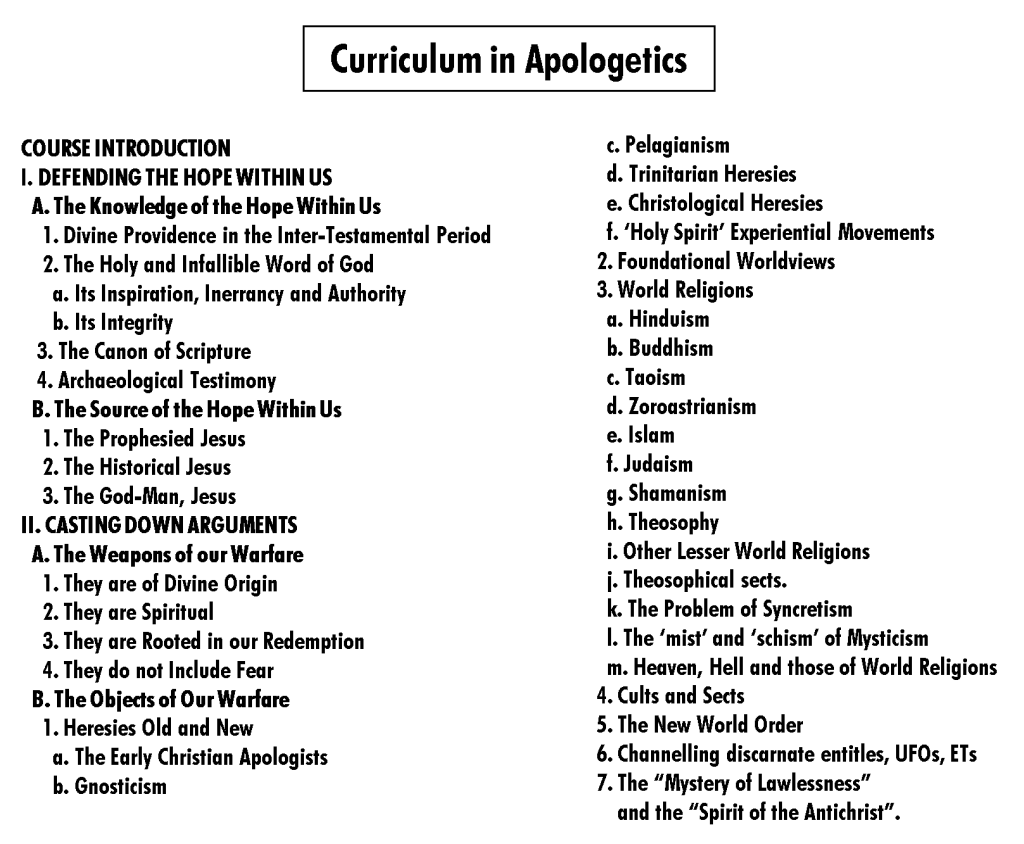
In the 1990s, I designed a 14-page outline document for a Curriculum on Apologetics which I intended to teach, but I was too busy with pastoral concerns and guest lecturing to fulfil it at the time. (I’ve attached the headings page of that Curriculum at the top of this article). I just nostalgically came upon that Curriculum in my archives and that is what has inspired this little piece. It is my belief today, just as much as it was then, that a great many Christians are not really equipped to give a defence for the hope which is in them, or to raise an offensive strategy to cast down arguments — to be “apologists” — though Peter and Paul commend us to do so in the above two Scriptures in stringent terms. A key thinking behind the development of that curriculum course was that it should not consist merely in the gathering of intellectual knowledge on philosophies, or in the bare identification of various schools of Christian Apologetics — as so often occurs in scholastic, ‘ivory-tower’ courses. Rather, it should be immensely practical in its outworking. In keeping with the Great Commission, the aim and substance of the course was, therefore, designed to provide a useful framework for successful evangelistic enterprise.
In that curriculum, I proposed a twofold biblical strategy designed to enhance the apologetic status of the people of God and equip them for the needs of the day: The first strategy, in accordance with Peter’s dictum in 1 Peter 3:15, is to be primarily defensive — defending the hope that is within the Christian. The second strategy, in accordance with Paul’s dictum in 2 Corinthians 10:5, is to be primarily offensive — casting down arguments which set themselves up in opposition to God and His Christ. This twofold strategy means first and foremost ‘Defending the Hope Within us’ — in which the infallibility, authority and integrity of the Scriptures, as the body of Christian Truth, is upheld, and the Person and ministry of the Lord Jesus Christ is defended against His detractors. Second is the offensive strategy of ‘Casting Down Arguments’, in which the weapons of the Christian’s warfare are discovered, while familiarising oneself with the extensive catalogue of heresies, world religions, cults and the worldviews which undergird them.
I do believe that it is well-nigh impossible to be a credible proclaimer of truth today without making oneself a knowledgeable apologist, to a greater or lesser degree. We all have different capacities so not all will be as extensively equipped, but that’s okay. However, this takes study — and few are willing to study these days. This is partly due to the invasion of the visible church by the very superficial, happy-clappy, subjectively-experiential, entertainment-oriented, mentality of so many professing Christians. It has come to the point where any loose combination of ideas pass as “Christian”. For example, the US president and his cronies. What kind of apologetic would they raise? Due to their heretical eschatology, they are too busy cheering on Israel to bomb Iran, believing that it will hasten their equally-dumb “Rapture”! Their hope is full of so many false agendas that they are not at all credible witnesses to truth. The same is true of all the many millions who want to zap people with phony experiences as evidence of the hope that is in them.
Anything more than a paragraph or a soundbite is a “put-off” for most professing “Christians” these days. Those who write in-depth are regarded as unspiritual dinosaurs. If I was to try and set up that Apologetics Curriculum today (free of charge, of course), how many people do you think would subscribe? Rhetorical question. Answer already known. I doubt I could count any applicants further than on one hand, if there were any at all. 😊 [Just in case anyone wanted to counter that with an application to prove me wrong, I am going to be too busy to run such a curriculum anyway as I am considering creating a commentary on Matthew chapter 24, amongst other things. I should also add that a good deal of what is in that Curriculum is now in the 1050-page Second Edition of my book, “The Serpent & the Cross”, which should be available in late August, though few will read that too 🫣]. I used to run weekend conferences in the UK in the 1990s in huge centres at cost price with up to 100 people physically attending and having to turn people away or we would be overbooked. How many do you think I would get today? Rhetorical question. 😊 We live in interesting times. The lack of a desire to study has now become universal. It is all part of the dumbing-down in both the secular world and the visible church — though many would claim that it is because people are more interested in what I would call “experiential religion” than in what they would call “rationalistic discourse”. I could also add that very few regularly read the articles I put here, but I have become content with that. These are the times in which we are living. I happily write for those few. 💝🙏
.
.
.
© Copyright, Alan Morrison, 2025
[The copyright on my works is merely to protect them from any wanton plagiarism which could result in undesirable changes (as has actually happened!). Readers are free to reproduce my work, so long as it is in the same format and with the exact same content and its origin is acknowledged]
.
 Diakrisis Project
Many of us need your “course.”
LikeLiked by 1 person
Hi Alan,
As Stacey wrote, there are so many distractions. The word I use is “noise.” I have probably wearied the Lord with all my whining and opining about noise. “So much noise, Lord; so much noise! How to escape so much noise? The world is joined house to house and laid field to field and there is nowhere to find quiet and to be alone” (Isaiah 5:8).
To celebrate his retirement, my husband and I just returned from what we tried to make a month-long respite in the mountains. From Glacier National Park, I texted a short video of a beautiful roaring river, and a friend responded, “Wow, that was noisy!” His comment made me think.
https://www.dropbox.com/scl/fi/y9xabd9r3u7gc5i6q2l80/2025-06-14-Glacier-National-Park-3.mp4?rlkey=ktz65s2kiir65drl0jlgj4ikc&dl=0
So, this morning, I looked up the word “noise” in Webster’s 1828 dictionary and this is what I found: “Sounds of any kind or proceeding from any cause…outcry; clamor; loud; importunate; continued talk expressive of boasting, complaint, quarreling; frequent talk…much public conversation…to spread by rumor or report…to disturb…”. Noise! So much noise! In our day we can add to these definitions all that is technology and social media, from phones, to GIFs, to memes, to podcasts, blogs and vlogs. Noise! Noise! Noise!
I agree that it’s well-nigh impossible to be a credible proclaimer of truth without making oneself a knowledgeable apologist, which takes a lot of study and which few are willing to do these days. It’s easy for serious writers to become disheartened in these times, especially when there is so much ear-splitting, thundering, tumultuous, vociferous, and uproarious noise coming from so many directions out drowning truth at every turn. When I get discouraged, it comforts me to remember that Christ’s sheep hear his voice and follow him and that so long as there is one hungry sheep out there, a writer’s labor is not in vain.
Keep doing what God constrains you to do and take heart. As a friend often reminds me, “It will all be worth it when we see His face.”
Love, Jan
“And the serpent cast out of his mouth water as a flood after the woman” (Revelation 12:15)
“The floods have lifted up, O Lord, the floods have lifted up their voice; the floods lift up their waves. The Lord on high is mightier than the noise of many waters, yea, than the mighty waves of the sea.” (Psalm 93:3-4)
LikeLiked by 2 people
Thank you Alan and you are right. Not sure if I could qualify to be an apologetic but I do want to be a defender of the Word of God. I know I don’t always get it right and I certainly am not a very good with memorizing things that I read. I do notice however that when I have a thought of scripture it can be confirmed by another. I don’t follow the crowd either. I am in the midst of reading your article “Tested by Fire”. Being in my position and condition has been very difficult. And it actually seems worse and yet here I am still plugging away and sometimes with much difficulty breathing and in physical pain. And in spite of all that I am still reading the Bible and praying and going to this place that takes care of my medical needs and having some fellowship with other people. Alan? Sometimes I cry because I can’t believe I went down so fast after that one Hurricane Helene hit these mountains. I can assume all kinds of things but I can’t pinpoint anything but to surrender to God and keep going one day at a time until the finish line. I am eager to read Tested by Fire because I can relate to it. Or I am learning of course that it is not always a happy clappy life in which for the most part it really never had been for me although I did try to seek it. But gave it up because it seemed all fake. I am still having to learn when to speak and when not to speak and that in itself is kind of difficult. Anyways, just letting you know I am still here and reading. I do have the older Serpent and the Cross but haven’t even begin to start that book. Still need to finish the other. So much distractions. Thank you for being patient with me. God bless you Alan and your wife.
Love, Stacey
LikeLiked by 1 person