
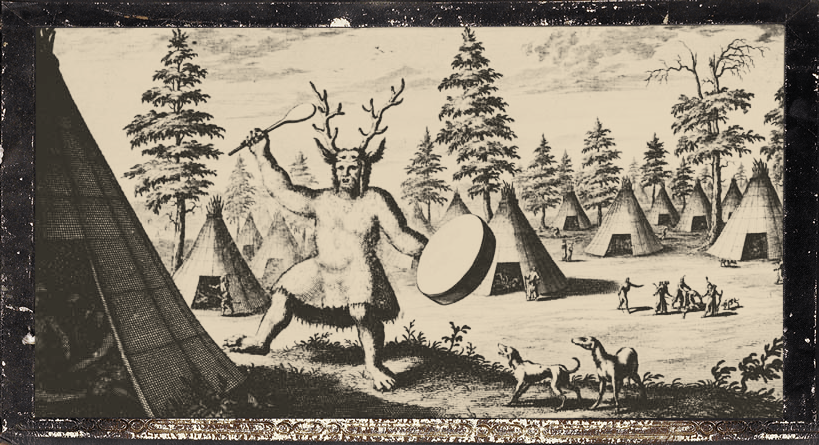
Another notable feature of satanic strategy in his development of the New Gnosticism is the Old Serpent’s indulgence in what can only be termed as “overkill”, for he is not merely content to provide just a few avenues of corruption in any particular area, but instead he uses an all-embracing pincer-movement in which a dazzling array of apparently differing systems are really selling the same idea. Thus, not content merely to encourage the concept of a ‘new religion’ with many ‘new’ spiritual techniques at its disposal, he has also created a romantic attraction for one of the most ancient of all religious phenomena, Shamanism. Ancient Shamanism can be defined, in its most basic form, as “the religion of North Asia, based essentially on magic and sorcery” (Chambers English Dictionary, Chambers & C.U.P., 1988, p.1351). At the centre of this tradition is the “shaman”, who can be defined as a person who: “is able, at will, to enter into a non-ordinary state of consciousness in order to make contact with the spirit world on behalf of members of his or her community” (Fritjof Capra, The Turning Point: Science, Society, and the Rising Culture, Flamingo, 1982, p.334).
Another source speaks of the shaman as “One whose supernormal powers…are attributed to contact with spirits when in an ecstatic state” (John R. Hinnells, ed., The Penguin Dictionary of Religions, Penguin Books, 1984, p.293). This ancient religious phenomenon has greatly captivated the minds and hearts of those involved in creating the neo-Gnostic world in which we are currently living. A number of different but complementary factors have contributed to the neo-Gnostic attraction to Shamanism. I think it would be helpful if we examined these factors more closely in order to give us a clear understanding of this facet of satanic strategy today.
First, the growth of the drug culture originating in the United States has opened up new avenues of experimentation. The intensity of interest in Shamanism can be traced directly back to the experimentation with mind-altering drugs in the 1960s. Psychedelic ‘trippers’ from California discovered that what they were doing had already been done for millennia by shamans in Alaska, Central and South America, and, nearer to home, the North-American Indian ‘witch-doctors’, through the use of hallucinogenic fungi, dance, rhythmic drumming, and other techniques to alter their states of consciousness.
A second factor which has contributed to the neo-Gnostic attraction to Shamanism is the ability of the shaman to alter his consciousness, either with psychotropic drugs or through trance-inducement via the use of hypnotic rhythmic sounds. The neo-Gnostics see here a direct parallel with the attempts at consciousness-raising through their own multitude of techniques. The psychiatrist Stanislav Grof, who was one of the first to experiment with LSD therapy in the 1950s, had discovered that it is possible to create the same effects with a new form of psychotherapy which he calls Holotropic Therapy. This involves the use of hyperventilation (rapid breathing technique), which is “enhanced by the use of evocative music or sound technology developed by various cultures specifically for the purpose of changing consciousness—for example, shamanic drumming” (Gary Doore, ed., Shaman’s Path: Healing, Personal Growth and Empowerment, Shambhala, 1988, p.163).
Another attraction of Shamanism for the neo-Gnostics of today is the fact that shamans set out to make deliberate contact with the spirit world, an activity of which the New Age technique of Channelling is more than reminiscent. The ‘channellers’ of today are the neo-Gnostic equivalent of the shamans of yesterday. According to Joan Halifax, a New Age anthropologist and former director of the Ojai Foundation on the infamous Mount Shasta in California: “communication with creatures and spirits…is effected in the shamanic seance; the sacred medium in trance is possessed by gods or spirits who use him or her as a means of divine transmission” (Joan Halifax, Shaman: The Wounded Healer, Thames & Hudson, 1982, p.13).
The kindling of global interest in the environment and nature during the past few decades — what one could call the arousal of “Gaia Consciousness” — has also found a close kinship with Shamanism’s association with the elements of nature, nature spirits, and an ‘Earth-as-Mother’ paradigm. Similarly, the worldwide surge of interest in alternative healing has encouraged people to turn to ancient lore and the old religions for new cures. A number of healing techniques used in the ‘alternative medicine’ community can be traced back directly to shamanistic practices. One Polynesian shaman states that: “Shamanic healing methods…include all faith-healings, verbal and visualisation therapies (including hypnosis), Neurolinguistic Programming affirmations, guided imagery, placebos, dreamwork, and the use of amulets and talismans” (From the chapter, “Seeing is Believing: The Four Worlds of a Shaman” by Serge King, in Gary Doore, ed., op. cit., p.50).
In other words, the use of suggestion, hypnosis, sorcery, straight ‘con-artistry’, and the superstitious use of symbolic artefacts lie at the heart of many alternative healing methods.
Thirdly, the romanticisation of ancient heathen religions has led to the great popularity of Shamanism today. The idea has been fostered that the older a religion is, the closer it is to ‘the Source of all Being’ or to ‘the spirituality of Atlantis and Lemuria’, and the further away it is from the descent into the materialist consciousness of the present day. Therefore, to train in the ancient arts of Shamanism will supposedly increase one’s spirituality.
A little-known fact is that there are a great many residual elements of ancient Shamanism in Western culture today. Some aspects of psychotherapy have been derived from the ancient way, as I will show in a later chapter on the ‘mind-sciences’ in this book you are now reading. Also, most people will be totally unaware of the fact that the acting profession and a large number of modern entertainments (e.g., juggling, acrobatics, conjuring, etc.) are derived from ancient shamanistic practices. [See Rogan Taylor, The Death and Resurrection Show: From Shaman to Superstar, Anthony Blond, 1985. This book is the result of the author’s doctorate in psychology and religion at Lancaster University’s Religious Studies Department].
One of the most passionate advocates of Shamanism, Mircea Eliade (1907-1986), was a scholar of Comparative Religion and the editor of Collins’ much-praised multi-volume Encyclopedia of Religion (1987). His book, Shamanism: Archaic Techniques of Ecstasy (1964) set the tone on anthropological excursions into Shamanism for decades to come. Mircea Eliade, however, has some interesting antecedents which throw considerable light on the arcane connections in the world of the New Gnosticism.
Early in his life Professor Eliade had spent an influential six months on an Indian ashram at Rishikesh, and in the 1930s he wrote a number of novels which “were the center of a transcendental movement” (James Webb, The Occult Establishment, Open Court, 1976, p.397). In the 1960s, he took over from the late Gnostic psychologist Carl Jung as the main speaker at the Eranos Conferences in Ascona in Switzerland, which had originally been set up in the 1930s by a wealthy Swiss woman as “a Summer School for the study of Theosophy, Mysticism, the esoteric sciences and Philosophies and all forms of spiritual research” (Ibid., p.396). The main speaker for the first three years of these conferences had been none other than Alice Bailey of the occult outfit, the Lucis Trust. Here we see the clear cross-currents between neo-Gnosticism and Shamanism — the blending of which creates the neo-Shamanism so beloved in this movement.
This neo-Shamanism contains radical differences from the traditional tribal phenomenon. Whereas ancient Shamanism looked to a single shaman within its community, the new shamanism believes that anyone today can become a shaman, hence the growing list of workshops and seminars at which one can undergo such training. The writer on parapsychology, Brian Inglis, (better known as the former television presenter of Granada Television’s “All Our Yesterdays” and “What the Papers Say”) believed that a change came about at the time of Pentecost (as recorded in the Book of Acts, chapter 2) which represented an opening-up of the shamanic experience for all. After asserting that Moses and the Old Testament prophets were shamans, Brian Inglis claims that, “The Christian Church had grown from shamanist roots and as described by the gospel writers, Jesus is the most accomplished diviner-magician of them all” (Brian Inglis, Natural and Supernatural: A History of the Paranormal, Prism, 1992, p.75). According to Inglis, the experience at Pentecost offered the possibility of “instantaneous transition from man to shaman”, with Paul the Apostle as “the most influential of the new style shamans” (Ibid. p.77). And he makes the observation that “for Paul, Christianity was shamanist, relying on inspiration rather than doctrine” (Ibid. p.78). From here on, it can then be demonstrated by them that simple ‘Gospel Christianity’ is but a pale shadow of its former shamanistic glory, to which it is allegedly being restored by the neo-shamans (and, as we shall see in a later chapter, by neo-Pentecostalists and Charismatics). Thus, according to the neo-Shamans, not only is Christianity a Gnostic religion, but it is a shamanistic one too. That is satanic overkill alright!
Essentially, Shamanism is witchcraft in its most unrestrained and extreme form. The Bible clearly shows that witchcraft, spiritism, soothsaying, and sorcery are in total opposition to Jehovah-Christ and His people (Deuteronomy 18:10-22). It is highly significant to this context that the prophetic verses in Deuteronomy 18:10-22 actually contrast the sorceries of the nations with the work of the true Prophet, Jesus Christ (Deuteronomy 18:14-15), who would never have sanctioned the way of the shaman. It is a solemn fact that sorcerers and rebels and all who believe the (satanic) Lie will not be admitted into the true New Age: the New Jerusalem, the “new heavens and the new earth”, the kingdom of God (Revelation 21:8,27; 22:14-15; 1 Corinthians 6:9-10). The prophet and judge Samuel said that “rebellion is like the sin of witchcraft [soothsaying]” (1 Samuel 15:23). Why? Because they both deny the authority of God, the Master of the Universe, and put man on the throne in His place.
Moreover, there is a fundamental difference between genuine Divine revelation and shamanism: Shamans can bring revelations from the spirits at will, at any time, and in whatever manner they so choose; whereas true Divine revelation happens at the behest of God, at the times He appoints, and in the manner He chooses. It is vital to understand this. The spirits of the shamans are always at their disposal, but direct Divine revelation has only come to God’s people (i.e., breaks into human consciousness) when it has been a necessary part of His cosmic plan. Consequently, one discovers that there have been vast periods when “the word of the LORD was rare, and visions were scarce” (1 Samuel 3:1). Sometimes the Lord even withdraws any possibility of Divine revelation, so as to fulfil the purposes of His judgement (e.g., Amos 8:11-14). At the present time, now that the Messiah has come to fulfil His kingdom and revelation has been given in the New Testament scriptures, there is no fresh revelation, no prophecy necessary any longer (Zechariah 13:1-3). However, in opposition to this, there has never been a time when shamans have been unable to practise their dark arts and receive their purported revelations. They are ‘full of it’, and can turn it on at any time.
All this spells out the fundamental difference between the satanic religion and true spirituality: The giving of Divine revelation is controlled by the will of God, whereas the receiving of satanic oracles is determined by the volition of man.
Shamanism is really all about deception and the use of what Scripture calls τέρασιν ψεύδους, terasin pseudous, “lying wonders” or “pseudo-miracles”, which will be one of the leading characteristics of the Antichrist when he is revealed (2 Thessalonians 2:9). For example, when a writer says of the black magician, Aleister Crowley, that “he certainly possessed shamanist powers — once, for instance, making himself invisible when attacked by muggers in Calcutta” (The Independent Magazine, 27th November 1993, p.62), this allegedly shamanic ability to ‘make himself invisible’ is then explained by the fact that Crowley “later admitted that he had hypnotised the muggers so that they were unable to see him” (Ibid.). Do you see the significance of this? Crowley’s shamanic ability to “make himself invisible” was an illusion created solely by the use of human, hypnotic mind-power, rather than any miraculous abilities. Shamanism is really about rank deception. This is hardly surprising because Shamanism is really Satanism dressed up in a romantic ‘jungle-chic’ garb to deceive gullible people. Shamans are of their father the devil, and they do the desires of their father. It is through the use of just such hypnotic shamanist powers that the Antichrist, when he is revealed, will be able to deceive the world into believing his lies (2 Thessalonians 2:9-12). And, as I am sure readers will be well aware, when someone hardens their heart through lies and untruth, God hardens it even further in judgement. This is like a spiritual law. It happened to Pharoah when he refused to let the children of Israel depart from Egypt (Exodus 7:13, 22; 8:19). It will happen to those who believe the lies of the Antichrist and who revere him (2 Thessalonians 2:11-12).
There are those who set themselves up as shamans today, running workshops through the drug Ayahuasca in Peru and other South American countries. But this has led to a terrible madness and even suicides as they become absorbed into a hideous darkness. A noteworthy example was when Malcolm Rossiter, a leading self-styled shaman in Peru and an advocate of that toxic potion, coolly announced his impending suicide in November 2018 at the top of his Facebook page and then carried it through (See https://www.facebook.com/MalcolmRossiter1 ). Such tragic suicides and madness have been repeated many times among those who experiment with this shamanistic brew. [See https://www.dailymail.co.uk/health/article-14123089/ayahuasca-taken-millions-properties-KILL-just-hour.html ]. It has been well-shown that dabbling in the black arts can bring on these elements, and shamanism can certainly be classed as being among the black arts. As an adjunct sidenote, the renowned poet, Sylvia Plath, who committed suicide at the age of thirty, was a classic example of this. She was introduced to the occult and dark magic rituals by her husband, UK poet-laureate Ted Hughes, and the two of them would regularly use a Ouija board to contact an entity which went by the name of the horned-god, ‘Pan’. Please see the Guardian article, entitled “How Black Magic Killed Sylvia Plath”, https://www.theguardian.com/theguardian/1999/sep/15/features11.g2 and also the article “Sylvia Plath and the Occult” here: https://www.cunning-folk.com/read-posts/sylvia-plath-and-the-occult/ . All of this suicidal activity in relation to ayahuasca and the occult is hardly surprising considering the involvement of the demonic in these areas of life and the satanic desire of the demon to ensure that people die in their sins with no possibility of repentance.
In truth, the neo-Shamanism of today is simply ancient Shamanism come of age and Westernised so that people can be opened up to a massive infestation of demonic activity at a portentous period of history — and all in the name of comparative religious exploration.
.
[The above article is extracted from the upcoming 1,042-page Second Edition rewrite of the “The Serpent & the Cross”. It is taken from Chapter 4: “The Founding of the New Gnosticism – The Leaven in the Loaf”, which undertakes a substantial examination of some of the fundamental satanic strategies being used to take over the minds and hearts of the world’s population today through Satan’s ever-burgeoning neo-Gnostic strategies. Neo-Shamanism represents one of those strategies].
.
.
.
© Copyright, Alan Morrison, 2025
[The copyright on my works is merely to protect them from any wanton plagiarism which could result in undesirable changes (as has actually happened!). Readers are free to reproduce my work, so long as it is in the same format and with the exact same content and its origin is acknowledged]
.
 Diakrisis Project