

[I have prepared this article for publication here (more fully than any published previously) because I have become aware of a number of recent converts who have been seduced by the diluted doctrines of false teachers on this issue. I hope and pray that these words will sow some good seeds in the ground of the souls who read them. There are 5,774 words which will take around 30 minutes of your time].
There are two interesting issues which arise out of the final six verses of the Book of Revelation, chapter 20, which we are looking at in this section, verses 10-15. You may want to turn to them in your Bible. First, there is the identity of this “lake of fire and sulphur” and second, understanding the meaning of being “tormented day and night forever and ever”. For some reason, these have become controversies in Christian circles. There are many false teachers with internet ministers who either water down the true meaning of all this or they flatly deny it altogether and, of course, gather to themselves many followers who are only too willing to take on board their dilutions and falsehoods.
There are many who do not like the idea of ‘eternal torment’ as, for them, God is too nice to initiate something like that. So many want to “gather around them a great number of teachers to say what their itching ears want to hear” (2 Timothy 4:3), especially in relation to the subject of “hell”. They say that if the lake of fire and sulphur is symbolic, then why would being tormented day and night forever and ever also not be symbolic. I will go much more deeply into these issues further below in this article. That’s a promise, because it is the meat of the treat!
However, before that, I want to do a brief exposition of some salient points in these six verses in Revelation 20, verses 10-15. I have written earlier in this book that God is like:
“a ‘Cosmic Vortex’ in which there is no place for anything which is impure to continue as impurity. It will have to undergo a total transformation, for better or for worse. To try and put something impure into that vortex would be like throwing faeces into the Sun. It would instantly be neutralized”.
This is a rather inadequate description but it is meant to emphasise what happens when the absolute power and majesty of God is present. Throughout Scripture we find people filled with dread and even falling down as though dead when faced with the living God who is a consuming fire (Hebrews 12:29). Even John did so in the first chapter of the Book of Revelation. So the picture we are presented with in Revelation 20:11 is that the impure cosmos which we presently inhabit “fled from God’s presence, and no place was found for them”. Obviously, it has been impure from a very long time before this event, but now evil has come to its head, the very last person who would come to Christ has done so, and the moment is right for the judgement of the cosmos.
Incidentally, one must not imagine that the judgement will take place in front of an actual physical white throne, such as is illustrated in the image at the beginning of this chapter, though there are many who think this to be so. But this way of thinking is all part of what I call the ‘comic book view’ of these scenes in the Book of Revelation. One can understand a small child thinking this way. But we are not children and can put away such childish things, or we will miss out on the full blessing of understanding these images.
At this great white throne, we are plainly once more in symbolic territory. God is spirit and He does not need a big solid throne to sit on. I often get snide remarks from atheists saying to me things like, “So you believe in an old man with a long white beard in the sky, do you?” Truly, if we continue to employ the ‘comic book’ approach to such passages in the Bible which are plainly symbolic, then we play straight into these atheists’ hands. It is high time for those professing to be disciples of Christ to grow up!
Really, the starkness of this image of judgement is quite shattering. Try to imagine it. The cosmos has been vaporised into nothingness. All that is left of it is a vast host of souls ready for judgement concerning their lives as to what will be their futures. They will have been resurrected by that point, all of them, whether they are disciples of Christ or not. This is more than implied in verse 13, “The sea gave up its dead, and Death and Hades gave up their dead, and each one was judged according to his deeds”. As we have seen earlier, the sea is the symbol of the nations. Hades, of course, is a symbol for the place of the dead.
So both all those alive at the time of Christ’s return and all those who have died will be “judged according to their deeds”, as Paul confirms elsewhere, quoting Psalm 62:12, when he also says, “God ‘will repay each one according to his deeds’” (Romans 2:6). For even the unbelieving dead will be resurrected — not to life but to judgement — as well as all those who have followed the Lord from the beginning (John 5:28-29). This involves everyone who has ever lived on the earth — which is said to be between 120 and 150 billion souls. If that sounds like crazy logistics, I can assure you that it is more than manageable for One who is the Creator of a cosmos!
It is interesting that they are all described as being judged according to their deeds. To hang out with many people who call themselves “Christians” today, one would think that it is solely adherence to so-called “sound doctrine” which will guarantee one’s place in heaven — as if faithfulness to a confession or catechism will somehow clinch the deal. Firstly, the Greek words which have in times past been translated as “sound doctrine”, ὑγιαινούσης διδασκαλίας (hygiainousēs didaskalias), in the Second Letter to Timothy, should really be translated as “healthy teaching” (this can be checked in any concordance), which implies education which has an effect on one’s whole life — on one’s spiritual health. That is not so much about getting things right as about improving one’s sight (spiritually understood) and being illumined by the Light (of Christ). The Greek word “hygiainousēs” is from where the English word “hygiene” is derived. Healthy teaching; it is hygienic and it is a beautiful thing. It generates health in the soul. It bears fruit in the life of the one who is taught by it. It is expansive rather than repressive. It renders one open to multiple avenues of truth which will run like rivers through your soul. Healthy teaching is the equivalent of didacticism, which means wise instruction, training, tutelage, mentoring, education. But to get stuck in the pedantic minutiae of some manmade theological requirements is a path which Satan himself could have constructed. For, in the end, it is not merely what a person believes which evidences their salvation but how what they believe has made them behave. Think about that carefully.
This is not to say that all theology is bad. Not at all! But if one imagines that theological knowledge in itself evidences salvation, one is seriously deluding oneself. One will not be Divinely judged on mental ideation or intellectual prowess but one will be judged according to one’s deeds, insofar as they reflect our faith, heartfelt thoughts and beliefs. Discipleship to Christ means nothing whatsoever if it does not lead to a complete transformation of one’s inner being and a resultant sea-change in the way one relates to this world-system and those who inhabit the world. Discipleship to Christ — if one does not resist its inevitable surges of Spirit — will powerfully change a person at a very deep level, not only providing spiritual epiphanies but also undoing the psychological patterns which make them behave in neurotic, egocentric, or psychologically abusive ways.
Unfortunately, many of those in the Christian scene, despite their claim to be “a new creation”, doggedly cling onto psychological patterns of old, disguising them with pious platitudes, worn-out clichés, or the classic happy-clappy Christian camouflage. This is also why there is so much abuse in church circles — the result of a refusal to be inwardly changed at a spiritual and psychological level. I have even had pastors telling me that such ideas are satanic psychobabble and completely unnecessary for the believer, who is now a spiritual being. Until they understand that the spiritual encompasses the psychological, they will remain in their fragmented world of mental disturbance in which they will be far less than they should be and cause immense pastoral disturbance wherever they go. Discipleship to Christ, if it is pursued seriously, will enable you to become who you are really supposed to be — the real you in the fullness of soul that you are meant to be — rather than a clone to manufactured belief-systems and artificial behaviour patterns (which is sadly what many churches fall into).
That the final judgement at the end of the age does not depend on what doctrines one has embraced in life but on the way one has behaved — especially in relation to one’s fellow disciples — is vividly portrayed in the parable of the sheep and goats (Matthew 25:31-46), which finishes with the line: “And they [the goats] will go away into eternal punishment, but the righteous into eternal life”. I will be looking more deeply at this seminal verse in my discussion further below in this section.
In verse 14, we read that Death and Hades were thrown into the lake of fire (which I will identify below). Obviously, those two elements cannot literally be thrown in there in the same way that humans can, so it is a manner of speaking. But what is being pictured here is the fulfilment of this text: “When the perishable has been clothed with the imperishable and the mortal with immortality, then the saying that is written will come to pass: ‘Death has been swallowed up in victory’” (1 Corinthians 15:54). In other words, at the resurrection, physical death — the consequence of the ‘first death’ (See §2 of chapter 1 for details about the meaning of the ‘first death’) — will have been done away with, “swallowed up”, through the victory of Christ on the cross. Similarly, there will be no more need for Hades as the place of the dead after the general resurrection. [Remember that we identified in §5 of chapter 3 what Sheol/Hades represents as the place of the dead for both those who are followers of God and those who are not, though in two separate parts of it]. All that will remain for all those who have refused Him is “the second death” — the lake of fire — eternal separation from God. Which is precisely what verse 14 in our text in Revelation 20 says: “This is the second death—the lake of fire”.
In verse 15, we read how if the name of anyone appearing before God in judgement is not “written in the Book of Life, he was thrown in the lake of fire”. This Book of Life has already been referred to earlier as “the Book of Life of the Lamb who has been slain” (Revelation 13:8). It is also called “the Lamb’s Book of Life” (Revelation 21:27). The Book of Life, which is obviously not to be thought of as a literal physical book, is clearly referring to the heavenly record of all those who have life as a result of their being “in Christ”, who is life personified (John 14:6). That is how we become “partakers in the divine nature” (2 Peter 1:4). This identification with Christ is the foundation of our salvation. He overcame the two enemies of Satan and death through His own death and resurrection. Through our identification and union with Him, we also partake in His resurrection and have life.
The Identity of the “Lake of Fire” & the Meaning of “Tormented Forever”
Now we turn to the ‘issues’ which I mentioned above, which I promised to deal with, before those paragraphs of exposition of the verses: Namely, the identity of this “lake of fire and sulphur” and understanding the meaning of being “tormented day and night forever and ever”. So, what is this “lake of fire and sulphur”? Well, that is identified for us in our text. It is “the second death” (see verse 14). This is reiterated in chapter 21, verse 8: “the lake that burns with fire and sulphur, which is the second death”. We have already identified ‘the second death’ in an earlier chapter of this book as referring to separation from God and everything which comes from Him.
I have tried to imagine that separation on an eternal level, but I can’t even begin to get my head around it; just as I can’t get my head around the idea that a situation can exist which is devoid of God’s presence when He is omnipresent. One has to conclude that the second death does not involve a geophysical location but is a state of soul in which God’s presence can never be experienced by those whose chosen fate is the eternal fire of judgement in eternal destruction — the most barren wilderness imaginable.
I say “chosen fate” because that is what it is, humanly speaking. One has a choice in this life. Eternal life through union with Christ or eternal separation from God forever. This life is where the choice has to be made. It could not be clearer. If a person repeatedly and finally scoffs at that idea, with no end to the scoffing, then they will have brought their future destiny on themselves. When I have spoken to people about all this, most have scoffed at me or looked pityingly at me, and a few have reacted as if this was music to their ears. The choice was made. Obviously, so long as they remain alive, they can continue to make a choice. But, from a human standpoint, it is a chosen fate rather than something unfairly imposed on a desperately reluctant soul.
The symbolic “lake of fire” known as the “second death” also has a number of other parallel names which all amount to the same thing. For example, one of those parallel names is “eternal destruction” (2 Thessalonians 1:9). But that does not mean being vaporised into nothingness or completely obliterated, annihilated. For the eternal destruction is qualified there as pertaining to being “separated from the presence of the Lord and the glory of His might”. That is a form of destruction. It does not mean obliteration but, rather, a state of permanent devastation, ruination, desolation — the very opposite of what life should mean: A state of eternal death, separated from God, lived consciously and fully experienced to a greater or lesser degree, depending on how life on earth has been lived. (I will explain what I mean by those “degrees” later on in an excursus). To those who stubbornly say that “eternal destruction” really means that one is simply annihilated, then how can it be explained when Christ says: “It is better to enter into the kingdom of God with one eye than to have two eyes and be thrown into Gehenna, ‘where their worm never dies, and the fire is never quenched’” (Mark 9:47-48). That is not annihilation or vaporization. I take no pleasure in saying this, but it is some kind of neverending desolation or distress because of separation from God. Other parallel images are used to describe the post-death state of those who have refused to submit to God and the authority of Christ and become His disciple. One notable image is when the Christ says that those who are not His true disciples will be “thrown out into the outer darkness, where there will be weeping and gnashing of teeth” (Matthew 8:12). The implication is surely that of being eternally lost in “outer darkness”, the equivalent of “destruction” and desolation, where there is a consciousness of that alienation which causes “wailing and gnashing of teeth”. This “gnashing of teeth” carries an image of extreme defiance and rage — an expression of contempt for the Divine, the same contempt which has been bubbling beneath the surface throughout the lives of those who utterly despise the idea of a higher being to whom they are answerable.
That “gnashing of teeth” is the wordless articulation of the words: “No one has the right to rule over me!” Ah, but they do. Your Creator does have that right; and this whole theatre of life on earth down through the ages has been a demonstration of that right of God to rule and of its rejection. What about the wailing? The Greek word translated here as “wailing” actually means:
“A bitter grief that springs from feeling utterly hopeless. This ‘wailing’ is usually accompanied by shrieks, brought on by uncontainable emotional (psychological) pain” (From “Helps Word Studies” in Strong’s Concordance on the word κλαυθμός, klauthmós, translated here as “wailing”).
This is serious stuff, my friends. People for centuries have tried to waffle this all away, to dilute it, to melt it down and make it into something more acceptable to the lily-livered liberal “woke” mindset. I have wrestled with it myself over the years, seeking to get to the marrow of truth. Many have similarly wrestled. But I cannot pour cold water on that fire and I cannot put ‘eternal destruction’ in a time machine to make it go away or mean something other than what it plainly means. John the Baptist said of Christ: “His winnowing fork is in His hand to clear His threshing floor and to gather His wheat into the barn; but He will burn up the chaff with unquenchable fire” (Matthew 3:12). To me, it seems as plain as a pikestaff. It is “inextinguishable fire” in “outer darkness” in which one undergoes “eternal destruction”, ruination, desolation, Divine forsakenness, which is as “lost” as one can be. As I said earlier, ‘destruction’ does not mean utterly obliterated as if there is nothing left. If you are told that your house has been destroyed in a gas explosion, that house still exists but in a state of ruination. So it is with eternal destruction. What that actually involves one can only imagine in this life but never really capture its full significance and awful reality. One can have an inkling of it because Christ underwent that desolation on the cross, as can be seen in His terrible exclamation, “My God, why have you forsaken me!” (Matthew 27:46).This He did as part of His vicarious experience for all those He would gather to Himself in His Ekklesia, so that they would not be subject to that forsakenness if they unite with Him in His victory over death and Satan. To understand the atonement of Christ and what He experienced on the cross is to understand what “hell” is really all about. One usually finds that those who try to undo the poignant horror of “hell” and water it down or negate it entirely have a defective idea of what Jesus’ atonement was all about. Understanding the atonement will enable one to understand “hell” in all its genuine fullness.
So many want to water down everything connected with the afterlife in order to make it palatable to the masses and to themselves; but there is nothing palatable about this subject, and in fact there is not supposed to be. In regard to the outer darkness which seems to confuse so many, we read in context a parable about a wedding party crasher, which finishes like this:
“But when the king came in to see the guests, he spotted a man who was not dressed in wedding clothes. ‘Friend,’ he asked, ‘how did you get in here without wedding clothes?’ But the man was speechless. Then the king told the servants, ‘Tie him hand and foot, and throw him into the outer darkness, where there will be weeping and gnashing of teeth’. For many are called, but few are chosen” (Matthew 22:11-14).
Now, this is a parable in which the wedding feast refers symbolically to an event which we have already looked at in the previous chapter: The return of Christ for His people. There are those who claim that the “outer darkness” referred to by Christ three times in Matthew’s gospel is simply about the shame and inconvenience of being refused entry to the banquet and having to stand outside the wedding hall at night in the dark. I have never heard such claptrap in my life! Does that honestly sound like the kind of situation being referred to in this parable? Impenitent rebels against God are, as the apostle Peter said, “springs without water and mists driven by a storm. Blackest darkness is reserved for them” (2 Peter 2:17). This is serious stuff, my friends! In another parable plainly designed to picture His return to judge the world, Christ said that the master of the evil servant:
“will come on a day he does not expect and at an hour he does not anticipate. Then he will cut him to pieces and assign him a place with the hypocrites, where there will be weeping and gnashing of teeth” (Matthew 24:50-51).
This is the same weeping and grinding of teeth which Christ mentioned in relation to the “outer darkness”. Does this really sound like someone who is somewhat miffed to be put out of the wedding feast having to stand outside at night? In another parable, it is said: “So will it be at the end of the age: The angels will come and separate the wicked from the righteous, and throw them into the fiery furnace, where there will be weeping and gnashing of teeth” (Matthew 13:49-50). The “fiery furnace” here is another parallel idiom along with outer darkness, eternal fire, the lake of fire, eternal destruction, and so on. One cannot escape the fact that a refusal to submit to the Creator of the cosmos and a refusal to unite yourself with Christ and being in alignment with the satanic world-system (thereby having the ‘mark of the beast’, which has nothing whatsoever to do with a microchip in the hand or head, as I showed earlier) will lead after physical death to an everlasting experience that is unthinkably terrible in all respects. I can only tell it like it is. I am only interested in truth. I would far rather have uncomfortable and unpalatable truth than agreeable and seemingly pleasant lies, though many seem to disagree.
When Jesus says, in His parable of the sheep and goats, “Then He will say to those on His left, ‘Depart from Me, you who are cursed, into the eternal fire prepared for the devil and his angels’” (Matthew 25:41), those “many” who disagree say that the Greek word translated as “eternal”, αἰώνιος, aiónios, really only means ‘for the length of an age’ because it is derived from αἰών, aión, meaning age, therefore they say it cannot mean everlasting and is just temporary, until they have learned their lesson. But that brings a huge difficulty with it, because of this verse at the end of that parable, which states: “And they [the goats] will go away into eternal punishment, but the righteous into eternal life” (Matthew 25:46). For if the punishment is not eternal, then neither is the “eternal life” for the righteous, as the same Greek word pertains to each. If “eternal life” is not eternal for God’s people, then what happens after it? Do we go back to having an untransformed nature? That whole whitewash is ridiculous. Obviously, from our limited, three-dimensional perspective, we cannot properly perceive what ‘eternal’ really means. But if the same adjective pertains to both sides of the final judgement scenario, then that shows us with what we are dealing: Everlastingness.
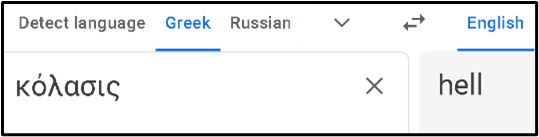
The word translated as ‘punishment’ there is κόλασις, kόlasis, which can also be translated as “torment”, as in the text: “There is no fear in love; but perfect love casts out fear, because fear involves torment” (1 John 4:18). It is surely no coincidence that the translation of kόlasis in modern Greek is, in fact, “hell” (see image, above, from Google Translate)! It is also used in Greece today in a colloquial manner, e.g., “ω, κόλαση! Πού θα τελειώσει όλο αυτό?” (“oh, hell—where will this all end?”). It is so obvious that we are dealing with something devastating and neverending.
You may say that the whole of eternity doesn’t leave room for learning the lesson. But the lesson was supposed to be learned now, in this dimension. That is what this life is for! This life of ours is a lesson-life! If the only thing which makes you want to “learn the lesson” (i.e., “Okay, God, I give in”) is discovering first-hand after death how bad the ‘second death’ is, then that is the wrong motivation altogether! The time for choice is now, and not based on fear but on realising the power and glory of God. Once death strikes, the die (pun intended) has been cast and the choice has been made. I am mindful of that fateful saying in Ecclesiastes, “In the place where the tree falls, there it will lie” (Ecclesiastes 11:3).
To try and mitigate these uncomfortable truths is the wrong approach. Instead, we should find a way of penetrating their mysteries and accepting them. In any case, even if the “outer darkness” was only ‘age-long’ (i.e. lasting for some thousands of millennia), it would still be a serious matter! But really, the afterlife will be outside of time as we know it. So even using a word like aiónios doesn’t really carry the full reality. Suffice it to say that it is something utterly dreadful and unthinkable. Yet, there is another purpose:
“What if God, intending to show His wrath and make His power known, bore with great patience the vessels of His wrath who are fitted for destruction? What if He did this to make the riches of His glory known to the vessels of His mercy, whom He prepared in advance for glory?” (Romans 9:22-23)
All those who are “fitted for destruction” are an example to the world that God gives salvation only to those who submit to Him. In fact, God shows immense patience with those who reject Him, when His fingerprints are smeared all over the whole creation. That patience alone demonstrates the glory of God. This is also why making it possible to ‘change your mind’ once the hammer of judgement has fallen on you would be so pointless (and why the concept of “purgatory” is so ridiculous). This present world and allotted lifespan is the time for the choice to be made. [I make no inference here about those who sadly die before they have even grown or who may have some debilitating intellectual impairment. I leave all that in God’s hands, who is just and righteous and perfect, regarding His elect. There are many mysteries in this whole complex subject area. My in-text observations are primarily about those who either consciously reject or willingly receive God’s warnings and promises]. For those who reject God, there is only outer darkness, eternal destruction, eternal fire, unquenchable fire, the lake of fire, which all signify tormentuous separation from the presence of God forever. The miracle is that in this life, even if one rejects God, one is still privy to His mercy and presence in so many ways (cf. Matthew 5:45).
I cannot tell you the precise mechanics of that “destruction” or “separation”. Such knowledge is way above my current pay-grade and yours too. I just cannot soften the blow. One cannot start thinking to oneself, “Well that’s not the way that I would do it!” Personally-speaking, I am just a fool who hardly has a clue. If God is infinitely wise and is the Creator of this whole show, and righteous and just and is love, and sees the end from the beginning, then I am very happy to leave all that judgement stuff up to Him! He knows best, and I trust Him completely. Trusting God leads to startlingly wonderful consequences in one’s life. Thinking one knows better than Him provokes a terrible fallout leading to a concatenation of deepening delusion, such as is laid out by Paul when he elaborates on the judgement which befalls those who align themselves with the Antichrist rather than the true Christ:
“… they refused the love of the truth that would have saved them. For this reason God will send them a powerful delusion so that they believe the lie, in order that judgment may come upon all who have disbelieved the truth and delighted in wickedness” (2 Thessalonians 2:10-12).
You can see there that this whole judgement thing is not about some capricious or arbitrary God bringing torment on people without good reason. For it will be the people themselves who will have wilfully “refused the love of the truth that would have saved them”. The more you reject God and His Truth, the deeper God allows you to fall into hopeless delusion, wallowing in deception and being entrenched in ‘The Lie’. Whatever happens in the afterlife is purely the result of personal choices in this life. From a purely human standpoint, the ball is in your court.
If you want to say, “But what if I am not one of the elect? Then I have no choice”. Yes, you do. Not being one of the elect means that you consciously chose to reject Christ and you rejoiced in it. Don’t worry, you will not be sitting around cursing that you are not one of the elect! All are dead in their trespasses and sins and no one can come to Christ unless the Father draws them (Ephesians 2:1; Colossians 2:13; John 6:44). And if you still want to get on your hind legs and object, and say, “Then why does God still find fault? For who can resist His will?” the voice of God will reply to you, “But who are you, O man, to talk back to God? Shall what is formed say to Him who formed it, ‘Why did You make me like this?’ Does not the potter have the right to make from the same lump of clay one vessel for special occasions and another for common use?” (Romans 9:19-21)
Ultimately, it matters not one bit what we think about being “tormented day and night forever and ever”. It is all going to happen anyway. I find that so many want to do God’s thinking for Him. Personally, I do not believe He could have made it any clearer. But all these fancy-pants pastors, do-it-yourself theologians, and wannabe newbies with lily-livers want to try and explain away anything which offends their wishy-washy sensitivities to make it all more palatable and congenial and pleasantly mystical. The fact that they have written so many books which influence the gullible and ignorant is something for which they will have to pay a great price eventually. It is far worse to lead someone into sin rather than sin oneself (Mark 9:42).
Now, before you take up your torches and pitchforks to hunt me down and burn me at the stake, let me say that I do not make the rules, fortunately. I am just a little messenger-boy who is under oath, with a hand on the Bible, to report the truth as it is, the whole truth and nothing but the truth. So, do not shoot the messenger — just deal with the message! I cannot alter what the Scriptures say. I see symbolism where there plainly is symbolism. But what right do I have to waffle away the reality of being separated from the presence of the Lord “forever and ever”? Why would that be a symbol? How can “forever and ever” be a symbol? Now, you may want to say to me, “Read the book by so-and-so. He’ll soon put you right”. Dear friend, I’ve read ’em all and I’m not impressed. It all feels like desperation to me when people want to soften things up to make them more palatable to those who these days are rightly called “snowflakes”. The same sort of desperation pervades the language of those who want to take things in the other direction and make them more rigid than they are. Those who take away or add to these scriptures are under the sword of a curse which should make them halt in their tracks before they play cavalier with plain meanings (Revelation 22:18-19).
Whatever we say to try and explain it all away, or not, it will be what it is and that is that. At its most basic, it involves separation from the presence of God. This is a state of soul. Hell is not a location in the manner in which we understand location. Outside of this present cosmos of limited dimensionality, there must exist a whole different space-time continuum. The fact is that we cannot imagine in any deep and realistic way whatsoever what the afterlife entails. We can guess. We can surmise. We can imagine. We can speculate. But that is all. For here we only have symbols, images, and suggestions.
Well that concludes my brief spiel about the ramifications of the final judgement and its implications. Now, as promised above, I am about to include an excursus on the fact that there will be varying degrees of condemnation and rewards. As we have reached a major turning point in the Book of Revelation — in the sense that chapter 20 is the final summation of the age and the judgement at the end of it, and chapters 21 and 22 deal primarily with the age to come — it seems good and right to provide this explanation after reading how John “saw the dead, great and small, standing before the throne… and the dead were judged”. That is all the dead, whether disciples of Christ and followers of God or not.
.
[Those wanting to know more can read my 640-page commentary on the Book of Revelation, “The Essential Apocalypse: Making Sense of the Book of Revelation”, from where the above has been extracted. This is available as a paperback book or an eBook in PDF format: https://diakrisis-project.com/2025/03/12/second-edition-of-the-essential-apocalypse-is-now-available-as-an-e-book-in-pdf-format/ ].
.
.
© Copyright, Alan Morrison, 2025
[The copyright on my works is merely to protect them from any wanton plagiarism which could result in undesirable changes (as has actually happened!). Readers are free to reproduce my work, so long as it is in the same format and with the exact same content and its origin is acknowledged]
.
 Diakrisis Project