
A Completely New Thing Created on Earth
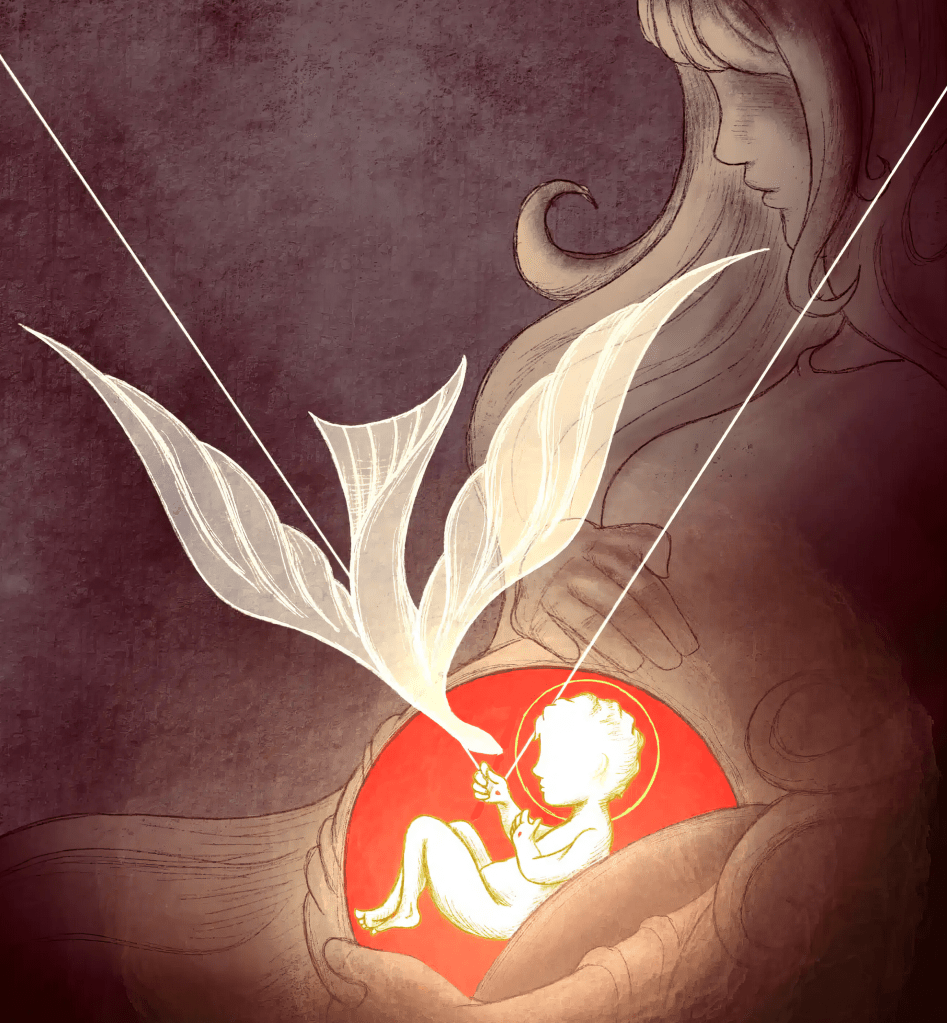
Long before the manger, in the context of a primary prophecy of the New Covenant in Christ, Jeremiah says: “For the Lord has created a new thing in the earth — A woman shall encompass a man” (Jeremiah 31:22). This is not just any woman or any man, for why would he mention it, especially in the context of the New Covenant in Christ which was still then to come to pass? This is rightly understood to be referring prophetically to the extraordinary encompassing by an extraordinary woman of an extraordinary Man. Christ encompassed in the womb. This is the virgin birth — a trinitarian event, if ever there was one! Just look at this trinitarian statement from Gabriel the angel to Mary: “The Holy Spirit will come upon you, and the power of the Most High will overshadow you. So, the Holy One to be born will be called the Son of God” (Luke 1:35).
So yes, a body had been prepared for Him long before the manger — eternally before! Now came the moment of its realization: A supernatural conception. It was the Holy Spirit who oversaw the conception of Christ in the womb: “This is how the birth of Jesus Christ came about: His mother Mary was pledged in marriage to Joseph, but before they came together, she was found to be with child through the Holy Spirit” (Matthew 1:18). And in v.20 of that same chapter, we read: “The One conceived in her is from the Holy Spirit”.
Not only was this birth personally brought to pass by the members of the trinitarian Godhead, but it had plainly been planned by Them too: “When the fullness of the time had come, God sent forth His Son, born of a woman, born under the law” (Galatians 4:4). This was a planned event. This is why the Lord Jesus Christ is called “the Lamb that was slain from the foundation of the world” (Revelation 13:8). His coming was built into this creation from the start, having been strategized beforehand. Thus, the Incarnation was just the beginning of a Divine life on earth that was planned, worked out between the members of the Godhead — Father, Son and Holy Spirit — from the creation of the world and before.
The Virgin Birth — A Vital and Neglected Teaching
The subject of the virgin birth is a vital and neglected teaching of the Christian Ekklesia. Yet, if you were to take a survey of every professing ‘Christian’ minister in the world, including those in all the mainstream denominations, containing the question: “Do you believe in the Virgin Birth of Jesus Christ?”, how many positive responses do you think you would get? Or if the question was “Do you believe that the Virgin Birth is a primary teaching of our faith?” how many would say a wholehearted “YES!”?
At one time, this teaching was considered to be worth defending to the hilt, as it was taken for granted to be a vital truth. For example, Ignatius of Antioch was a martyr for the faith who died around AD 107 and was reputed to have been a disciple of John the Apostle and Gospel-writer. He was even claimed to have been one of the babes who Jesus blessed (Luke 18:15-17). He wrote a number of letters to people and churches which, while not canonical, are very interesting and useful. In one part of his Letter to the Ephesians, to the church at Ephesus, on his journey to Rome for execution, not long after the Book of Revelation had been written, Ignatius wrote:
“Now the virginity of Mary was hidden from the ruler of this world, as was also her offspring, and the death of the Lord; three mysteries of renown, which were wrought in silence by God, but have been revealed to us” (Ignatius’ Epistle to the Ephesians, §XIX).
Ignatius was referring to the way that Jesus’ conception in the womb of a virgin, His birth from her, and the fact that His death would accomplish Satan’s downfall, were three precious mysteries which were hidden from the extensive knowledge possessed by Satan who, before Christ’s victory on the cross, was still accounted as “ruler of this world” — an anomaly which was set right by Christ who evicted him from that usurped position through His triumph via the cross, His resurrection and His ascension (cf. John 12:31). What we see here is that at that early time in the primitive church the virgin birth was a ‘given’, accepted as an absolutely true and vital teaching.
Three Reasons Why the Virgin Birth is So Important
The Early Church Fathers, from Augustine to Hippolytus, Jerome to Leo the Great, also recognised the signal importance of this teaching, and wrote great treatises against those who denied it. The Apostles Creed, which was produced in Gaul around the 5th century (which itself was based on an old Roman Baptismal Confession from AD 200) has those all-important words: “Conceived by the Holy Ghost; born of the Virgin Mary”. This was treated as a fundamental teaching in the Early Church. Converts before baptism had to include it in a confession of faith. No one would be admitted to a Christian assembly nor recognised as a genuine believer without believing in this teaching. How times have changed! Yet, without the teaching of the Virgin Birth, the entire teaching of the corpus of faith called Christianity falls. So, why is it so important?
Firstly, it is so important because it explains how the Eternal Word came into the material world. The very thought of the Son of God being “manifested in the flesh” — the Word becoming flesh and dwelling amongst us — is beyond our comprehension. As the hymn-writer put it: “The Incarnate Deity, our God contracted to a span — incomprehensibly made man”. How could that have happened?
The ordinary union between a man and a woman could not have produced such a unique Human Being who was both God and man. Instead, “God sent forth His Son, born of a woman” (Galatians 4:4) — rather than of both a man and woman. There is no other way that the incarnation of God the Son could happen than by that way declared by the angel: “The Holy Spirit will come upon you, and the power of the Highest will overshadow you” (Luke 1:35).
In fact, all three members of the Trinity were involved in the Incarnation of Christ. The Father prepared His physical body: “Therefore, when Christ came into the world, He said: “Sacrifice and offering You did not desire, but a body You prepared for Me” (Heb.10:5). The Holy Spirit was also involved, as He is in all Divine creative activity (Luke 1:35).
What happened was that Mary conceived without human fertilisation when God the Son not only entered her womb, but also the egg in her womb, under the superintending ministry of the Holy Spirit. Thus, “The Word became flesh and dwelt among us” (John 1:14). The eternal Word entered the world through fertilising an egg in the womb of a virgin. The only logical way for the Incarnation of the Word to have occurred was through the Virgin Birth.
Secondly, the Virgin Birth explains how the Lord Jesus Christ came to be human yet sinless. The One who was to come to redeem sinful people out of this world could not Himself be sinful, otherwise he, too, would have needed a redeemer! Had He been sinful, he would have needed someone to atone for His sins.
So, His entry into this world could not be through the ordinary union of a man and a woman. For that is how original sin is transmitted down through the human race, the uniting of human sperm with a human egg — the pathway of corrupted DNA. As the psalmist puts it: “Behold, I was brought forth in iniquity, and in sin did my mother conceive me” (Psa.51:5). Every human being born into this world is steeped in original sin. From the moment of conception one is guilty of the sin of Adam, the federal head of humanity. As Paul says in Rom.5:12: “Therefore, just as sin entered the world through one man, and death through sin, so also death was passed on to all men, because all sinned”. How have all sinned? Through that primal, original sin of Adam.
Sin and death came to reign “even over those who did not sin in the way that Adam transgressed” (Romans 5:14). So even if human beings never actually sinned themselves (which we know is impossible anyway), they still bear in themselves guilt for the sin of Adam. This teaching is known as the ‘imputed sin of Adam’. Like the teaching concerning the ‘imputed righteousness of Christ’ (about which there will be more below), it is a foundational Christian teaching, which heretics have tried to overthrow from the beginning — the devil knowing full well the importance of these matters.
[SIDEBAR: This teaching on original sin, along with the teaching about hell, is a stumbling block for many who have discovered Christianity in a superficial ‘easy-believist’ manner. This has been the case with many New Agers who have claimed to come to Christ. They were over the moon with it all to begin with — especially because churches made them into ‘celebrity conversions’ — until they realised that their New Age notion about the inherent good of all people was being challenged. The same with their confrontation with the teaching about the ‘second death’. “God wouldn’t do that to people!”, so they want to believe. This is where one can tell the difference between genuine conversions and false ones. Those who are for real will subdue their mistaken ideas and submit to the truths of Scripture. But so many want it all their own way, in a manner which suits them and does not offend them].
Consider this: If the Lord Jesus Christ is the normal product of sexual intercourse between a man and a woman, then He would be steeped in original sin like every other member of the human race and thus be unable to be the Redeemer. But because of the virgin birth, He ‘bypassed’ the manner in which original sin is transmitted. Thus, even though “He was in all points tempted as we are”, yet He was “without sin” (Hebrews 4:15). Are you seeing the fundamental importance of all this?
Thirdly, the Virgin Birth explains how the Lord Jesus Christ came to have two natures, human and Divine. The promised Redeemer who would provide atonement for human beings had to be both a human being and also God Himself. He had to be a human being, because it is the human race which has the problem of sin and must bear the penalty for it. Therefore, the Redeemer of human beings had to be, literally, God manifested in the flesh (John 1:14; Philippians 2:6-11; Colossians 1:15-20; Hebrews 1:3) — that ‘flesh’ part was vital. As Leo the Great puts it:
“A Victim had to be offered for our atonement, who should be both a partner of our race and free from our contamination, so that this design of God whereby it pleased Him to take away the sin of the world in the Nativity and Passion of Jesus Christ, might reach to all generations” (Leo the Great, Sermon 23, III).
The only kind of being who could be both “a partner of our race” (i.e. human) and “free from contamination” (i.e. without sin) would be a human being who was also Divine. The Virgin Birth guaranteed such a Being. As the Apostle John puts it: “And you know that He was manifested [i.e., supernaturally incarnated for real] to take away our sins, and in Him there is no sin” (1 John 3:5). How? Because of the Virgin Birth. There can be no other explanation. That is how important the virgin birth is to the essential elements of our faith.
Only a Divine being could have endured those three hours on the cross, when all the forces of darkness, at the instigation of the Father, were brought to bear on the whole being of the Christ. But He also had to be “made flesh” in order to be able to fulfil the atonement for the humanity aspect of it. So, the Redeemer of the human race had to be both human and Divine. But how did Jesus Christ come to have those two natures in one Person? The only thing that explains this properly is the virgin birth.
The Beautiful Exchange
Of course, the Fall of Adam did not take God by surprise. He knew very well that our first parents would succumb to the wiles of the devil. God did not just alter plans “on the hoof”, as it were, and bend according to events. Planning for that event of the Fall had already been accounted for in the Divine strategy. Therefore, among the members of the Divine Godhead there had been a plan worked out even before the creation of the world which would involve the Son coming in the flesh. So, in the fullness of time, God sent forth His Son, born of a woman. In other words, to put it more fully, “God the Father made God the Son, who knew no sin, to be sin for us, that we might become the righteousness of God in Him” (2 Corinthians 5:21). That is the beautiful exchange right there. He took the penalty for our sin on Himself (who was without His own sin) so that we could be partakers in His righteousness (when we had none of our own) and thereby be cleansed. Adam’s sin was imputed to us so we are steeped in original sin. But the promise is that Christ’s righteousness is imputed to all those who come to Him in faith and follow Him.
Truly the Incarnation is an utterly remarkable event — more so than any science fiction story! God Himself fertilises an egg in a virgin’s womb and there is a union of the Divine and human natures in the Man, Christ Jesus. The paradoxes which come out of that are many. Thus, He suffered, but He could also say: “Before Abraham was, I AM” — a mark of His Divinity. Men could spit in His face, but He could walk calmly through a murderous rabble at the drop of a hat without even being noticed. He could bleed, weep, and die, yet He Himself had the power to reverse the death process, forgive sins and make the blind see. Do you see the wonder in this — the beauty of it? Spiritual paradoxes are always most beautiful.
God and Man in Christ Jesus
“For what the law was powerless to do in that it was weakened by the flesh, God did by sending His own Son in the likeness of sinful man, as an offering for sin. He thus condemned sin in the flesh, so that the righteous standard of the law might be fulfilled in us, who do not walk according to the flesh but according to the Spirit” (Romans 8:3-4).
How important is that above little word “likeness”. Only the incarnation through a virgin birth could make it so. There always has to be a penalty paid for the transgression of the law of God. The wages of sin is death, physical and spiritual. But to deal with that, God Himself came in the flesh and took that penalty on Himself, so that all those who believe, who have been chosen in Him from the foundation of the world, would receive the gift of eternal life. As He said in His own words: “I have come that they may have life, and that they may have it super-abundantly. I am the good shepherd. The good shepherd gives His life for the sheep” (Jn.10:10). What amazing grace!
None of this would have been possible were it not for the Virgin Birth. It is a vital and indispensable Christian teaching. Without it, the entire foundation of our faith falls. For salvation rests on the mighty fact of a sinless Redeemer who is both human and Divine. And a sinless Redeemer who is both human and Divine is only possible when a man is born of a virgin through the superintending, overseeing power of the Holy Spirit.
Therefore, a Foetus is Not Just ‘a Bunch of Cells’
Now we can understand what the prophet meant when he said: “For the Lord has created a new thing in the earth — a woman shall encompass a man” (Jeremiah 31:22). A woman shall encompass a man. Jesus in the womb. And what a “new thing” that was! The only time a human being has been born into this world without the involvement of the sperm of the male. The false church and the world may scoff at these things, “However, if I were you, I would appeal to God and lay my cause before Him—the One who does great and unsearchable things, wonders without number” (Job 5:8-9).
So Mary conceived without any human fertilisation when God the Son not only entered her womb, but also entered the egg in her womb, under the superintending ministry of the Holy Spirit. There was no human sperm involved; but the Son of God Himself was, as it were, the “sperm” that entered the egg and exploded into life as the God-Man — the Messiah. Is that not a totally mind-blowing thought?!?
The eternal Word entered the world through fertilising an egg in the womb of a virgin. Thus, “The Word became flesh and made His dwelling among us” (John 1:14). Christ was in the womb of a virgin as a foetus! Incidentally, this in itself is a fine argument against abortion. For Jesus was not just “a bunch of cells” from conception. Right from the start, within the womb, He was Jesus the Christ every bit as much as when He lay in the manger or hung on the cross. Just as every other child is a human being within the womb as much as outside it. Let the lesson be learned.
So, the teaching of the ‘Virgin Birth of Christ’ is not some optional add-on to the corpus of Christian teaching. It is one of the fundamentals of the faith, without which many other teachings fall and our faith becomes humanistic and without a supernatural basis.
.
.
.
© Copyright, Alan Morrison, 2025
[The copyright on my works is merely to protect them from any wanton plagiarism which could result in undesirable changes (as has actually happened!). Readers are free to reproduce my work, so long as it is in the same format and with the exact same content and its origin is acknowledged]
.
 Diakrisis Project
I remember many years ago when I kind of questioned this and just happened to open the bible to Isaiah and just looked it up again to be sure that indeed I read it in Isaiah. Isaiah 7:14
14 Therefore the Lord himself shall give you a sign; Behold, a virgin shall conceive, and bear a son, and shall call his name Immanuel.
And I was amazed about this fact. It was truly a miracle! Thank you for being such a good teacher. I am actually halfway through reading what you sent out yesterday in which I will probably have it finished by Friday. God bless you Alan.
LikeLiked by 1 person
Amen. On this our faith depends and stands Peter
LikeLiked by 1 person