
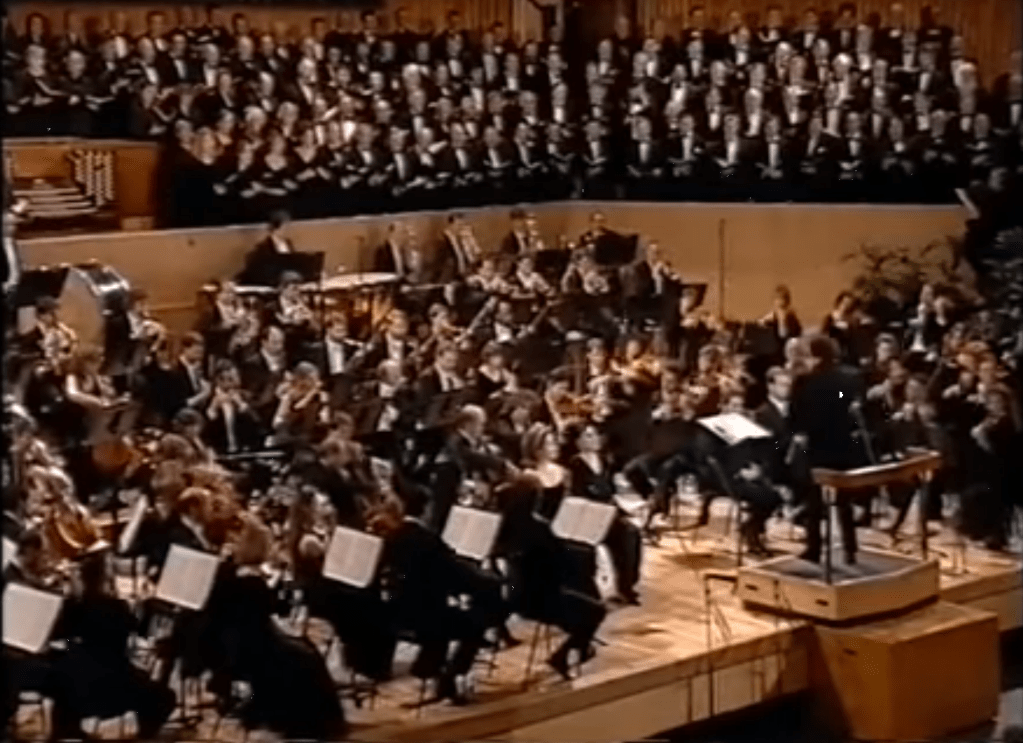
Continuing my sharing of favourite sacred works with you — especially because they offset the insanity of this fallen world — I have to include the “Requiem” by Giuseppe Verdi (1813-1901). It has been a while since I listened to this work. Having just listened to it again, I don’t know why it has been so long! It is an absolute musical and choral masterpiece. Verdi is best known for his operas, such as La Traviata, Aida, Rigoletto, La Forza del Destino, and Il Trovatore. But he excelled in his writing of this sacred work too.
His “Requiem” was written in 1874 after a writer who he admired had died. No one seems to know for sure what Verdi’s own spiritual views were. He once said that he was agnostic. He was very suspicious and even critical of institutional religion which, of course, was the Catholic church in Italy. He did build a chapel at Sant’Agata where his home was; but it is not known what his own relationship with that was. Nevertheless, his “Requiem” is a deeply-felt work which is extremely powerful and very moving. It just cannot leave its listeners untouched. He was definitely inspired.
A recurring theme throughout the Requiem is the section marked “Dies Irae” (the Wrath of God), which depicts in graphic manner the day of judgement. For that, a specially-made bass drum, which can be up to 60 inches (1 metre 50 cm) wide, is used to mighty effect. You can see it in the orchestra in the accompanying video at the back, middle-left.
I have scoured through many recordings to find what I believe is the most powerful and wonderfully performed and recorded. To my surprise, I found one which is from a performance in 1997 in the Royal Festival Hall in London with the Philharmonia Orchestra and chorus, plus the City of Birmingham Chorus, conducted by James Levine. The soloists are a ‘dream team’: Renee Fleming (soprano), Luciana D’Intino (mezzo-soprano), Roberto Alagna (tenor), Roberto Scandiuzzi (bass). None of them has that irritating over-emphasised vibrato which so many opera singers seem to have. They are just perfect for this work. Their gravitas for such a serious piece is spot-on — witness Scandiuzzi when he sings the word “Mors” (death) at 20:21. It is chilling through to the soul. The same when, shortly after that, D’Intino says “Nil inultum remanebi” (“Nothing will remain unpunished”), then emphasises that word “Nil” (27:39), there is that same extraordinary frisson. These are all singers who know how to get behind a text to express its true meaning. Renee Fleming and Roberto Alagna are also great in their renditions. The whole chorus of singers, too, give their all to this. It is altogether a massive event and presentation. I have listened to dozens of other performances and none of them get anywhere near the intensity and sincerity of expression, along with the great orchestral performance and well-chosen tempi. You will be on the edge of your seat. I should also add that the English translation subtitles from the Latin are very welcome.
Because this video is recorded from a television programme from almost 30 years ago, the visual quality is not what we are used to today, and there are a few blips where the picture goes weird for a few seconds. But the audio is fantastic. This video is stored on the tenor Roberto Alagna’s personal YouTube channel and was placed there five years ago, presumably as a nostalgic glance at his past roles. I should also add that the performance starts at around 10 minutes in. But the 10-minute radio introduction is fascinating to listen to and has some interesting thoughts from some of the performers.
This work has often been criticised because it gives what is almost an operatic setting to a sacred work. But I think that works very well. After all, the day of judgement IS dramatic — no doubt about that… witness the Book of Revelation’s treatment of it! So long as the singers are serious and sincere in their presentation, I think it all works really well. In fact, in the introduction, Roberto Alagna speaks about how much this music touches him in his soul. I believe that this performance will do the same for you, if you give it the chance. Click on the accompanying link to find out. If you can, try and listen to it on a decent system to get the full effect…
 Diakrisis Project
Just finished listening. That was very beautiful and I am thankful for having bluetooth capacity in my hearing aids to connect to the phone. I can hear the music so much clearer than on my laptop. Thank you for sharing this. God bless your day.
LikeLiked by 1 person
Really enjoy your musical insights Alan.
Thanks so much.
Mike
LikeLiked by 1 person