
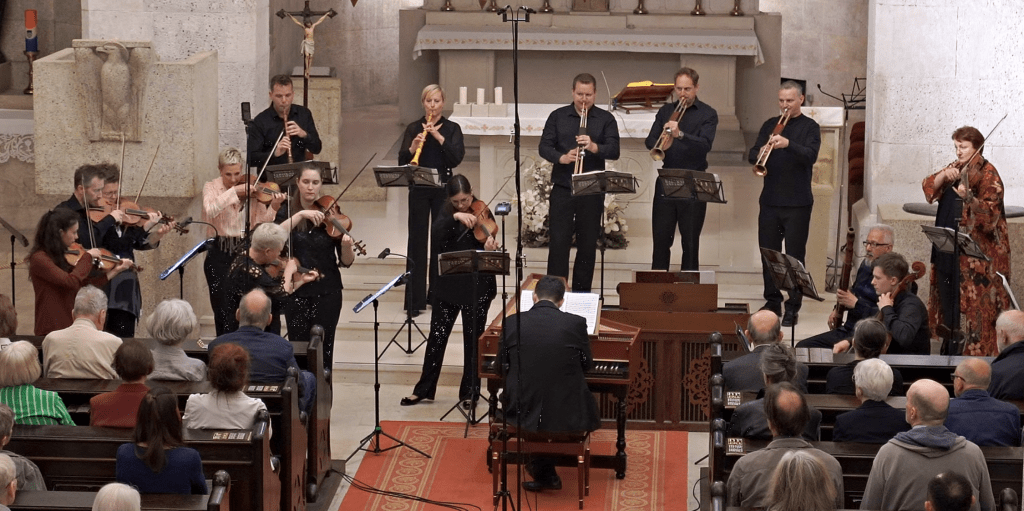
ON THIS SPRING DAY, I so much want to put a spring in your step and share with you something to uplift your soul. The music of Johann Sebastian Bach is one of the greatest ways to lift up your soul from any doldrums or just to drip-feed your soul with beauty and mellifluousness. His Third Orchestral Suite (first known score is from 1730) is full of life and movement. One part of it (the so-called “Air on a G-string”) is well-known to so many from a TV cigar advertisement, documentaries, etc., yet very few know this music in its whole context.
This version (see video below) is being played on instruments of Bach’s time period (or exact copies) and in the style and tempi of the time, which gives the music a glorious authenticity. Personally, I cannot tolerate listening to Bach played on modern instruments. One of the most wonderful developments in the world of music in the last century has been the rediscovery of period instruments and period playing-technique. This was pioneered in the 1960s with Nicolas Harnoncourt in Vienna with his Musicus Concentus Vien and David Munro with the Early Music Consort in the UK, and was then developed during the 1970s and 1980s by Reinhard Goebel with the Musica Antiqua Köln, Christopher Hogwood with the Academy of Ancient Music and Trevor Pinnock with his English Concert. Now, in the wake of this “early music revival” movement, there are a great many orchestras all over the world which have brought baroque and classical music to life with period instruments and style. Even with early 20th century music, there is a big difference between the instruments of that period and the present day. I heard a stunning performance of “The Planets Suite” (1915) by Gustav Holst on instruments of that time (the New Queens Hall Orchestra). It makes such a difference, and I love authenticity.
This particular performance of the third of Bach’s Orchestral Suite I regard as being the most ‘authentic’ of the live performances on YouTube today: The Croation Baroque Ensemble playing in a church in the capital Zagreb. (There are many fine baroque bands in the Balkans and in central European countries such as the Czech Republic and Slovakia). In this performance, you have not only Bach’s ravishing music but also its performance on instruments of the Baroque period. So you have strings made from catgut (intestines of sheep) on all the stringed instruments. Curved bows (rather than straight, as they are now). Cellos without a spike and held between the legs. Gorgeous oboes made from boxwood (which, having only three keys, function more like a recorder, unlike their modern counterparts which have many more keys). Long trumpets without valves which are more like hunting horns, and beautiful old timpani drums (out of sight in this video). Incidentally, it was Bach’s son, Carl Phillipp Emanuel (whose compositions I also love), who wrote the trumpet, oboe, and timpani parts. (There is a version which is sometimes played without those parts, but I prefer it with them).
The purpose of the Early Music Movement was not only to ensure that the instruments were of the time period when the music was written (either originals or exact copies) but much research was done into discovering what was good performance practice at that time too. The idea was for the music to sound as close to what it would have done at the time it was composed. So, you have very little vibrato (except for occasional ornamentation), faster tempi, that ‘squeezed’ sound on the strings, and the whole orchestra is tuned to the pitch A=415 Hz. (unlike today, when A=440 Hz.). The overall effect is very dynamic. On modern instruments and with modern musical practice, music from the Baroque period (17th and 18th centuries) sounds stodgy and laboured.
Apart from the gloriously-uplifting French overture as the noble first movement of this piece, the second movement is the beautiful and famous so-called ‘Air’ (which influenced the style of that well-known song, “A Whiter Shade of Pale”, 1967, by the group Procol Harum, the most played song on the airwaves ever). The other movements are in the Baroque ‘dance’ styles of Gavotte, Bourrée, and Gigue. Anyway, please enjoy the noble purity and lilt of this delicious music of Bach in a perfectly authentic performance — vibrant music from nearly 300 years ago! And remember, as Bach himself said, “All music should have no other end and aim than the glory of God and the soul’s refreshment; where this is not remembered there is no real music but only a devilish hubbub”. Amen! Please click on the video to view and listen…
.
 Diakrisis Project