
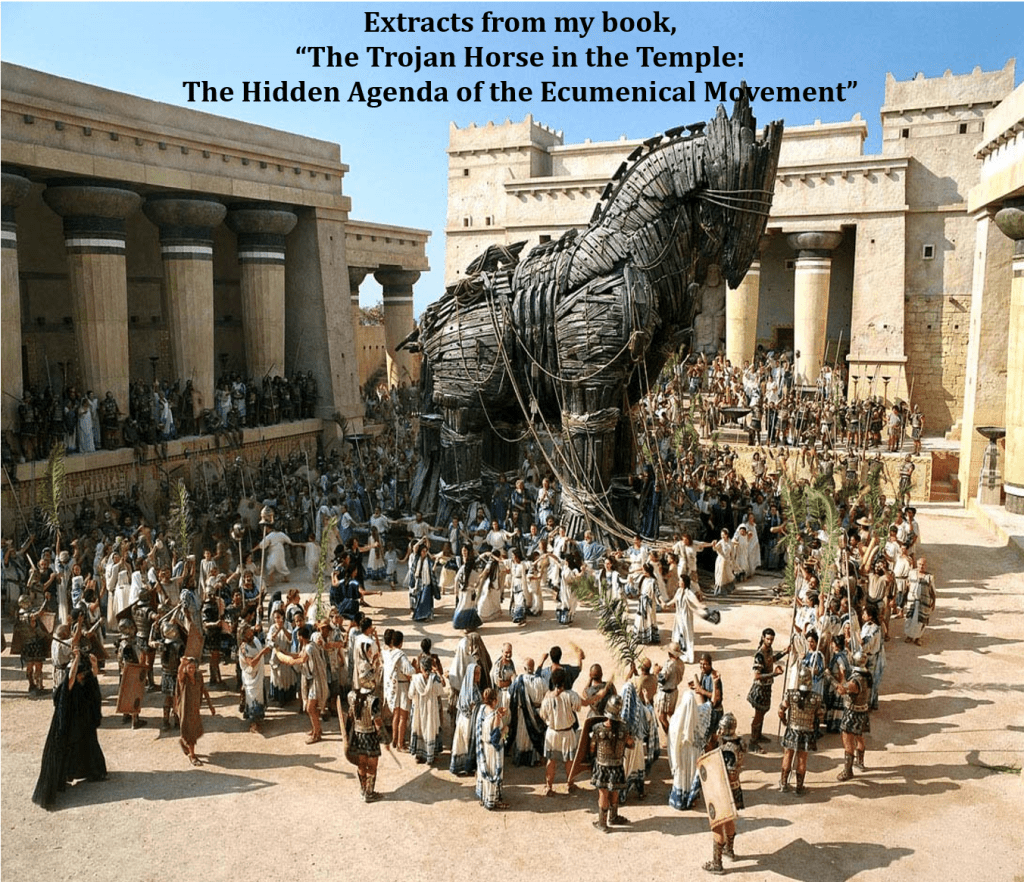
[Below is a sample extract of the Foreword, Introduction, and Epilogue from a booklet, “The Trojan Horse in the Temple: The Hidden Agenda of the Ecumenical Movement”, originally written in 1993 with a second edition in 1999. That was between 24 and 30 years ago. Tempus fugit! It is all still highly relevant today — if not more so. Very soon, I will be uploading the entire work in an improved, expanded, updated edition as a 120+ page eBook available for free download].
FOREWORD
In recent years, many genuine disciples of Christ have expressed disquiet with what is popularly known as the Ecumenical Movement. In response to biblical calls for ‘Christian unity’, this movement — operating at both formal and informal levels — seeks to bring all Christian denominations and organisations into a single universal conglomerate. If the prime objective of those behind this movement was to unite all believers in the cause of God’s truth and to proclaim the fullness of the Gospel with love and power to a spiritually corrupt and needy world, I would be the first to gather with them. I would not want to oppose Jesus’ prayer, in His last great discourse, for believers to manifest their unity as an evangelistic model to unbelievers (Gospel of John, chapter 17, verses 20-23).
I can fully identify with those in the Ecumenical Movement who have a heartfelt desire to see an end to sectarianism and unbiblical divisiveness. But the knowledge that there is a hidden agenda of global proportions behind the work of the modern Ecumenical Movement has motivated me to expose its historical and developmental roots.
Among the more prominent characteristics of the many deceptions which have plagued the Church from its beginnings are the subtlety of their origin and the stealth of their development. Never has there been such a need for Christ’s disciples to discern that when Satan-inspired movements are at work in the Church, they never appear to be malevolent but, rather, present themselves as being highly desirable and so filled with spiritual integrity that they are capable of deceiving the Lord’s own people, if such a thing is possible (cf. Gospel of Matthew, chapter 24, verse 24). The Lord Jesus was referring to this mode of deception when he described false prophets as “wolves in sheep’s clothing” (Gospel of Matthew, chapter 7, verse 15). Similarly, Paul the Apostle warned that Satan cleverly disguises himself as an “angel of light” in order to conceal his darkness (Second Letter to the Corinthians, chapter 11, verse 14). As that discerning early Church father, Irenæus of Lyons (c.AD 130-200), has put it:
“No false teaching desires to offer itself to our view openly, lest such exposure should lead to conviction; but, craftily putting on a plausible dress, makes itself by its outward form appear to the simpler sort to be truer than Truth itself”.
Irenæus of Lyons, “Against Heresies or A Refutation of Knowledge Falsely So-Called”, Intro. §2. This work is a great rebuttal of the second-century heresy of Gnosticism
It is my belief that the Ecumenical Movement, in spite of its professed aspirations, falls into just such a category. I acknowledge that there are a great many sincere and well-meaning professing ‘Christians’ who support this movement, and it is chiefly for their information that this book has been written. Once we have obtained a full grasp of the vast network of intrigues to which the Ecumenical Movement belongs, this will remove all remaining vestiges of the sheep’s clothing and will reveal it for what it is: A Trojan Horse within the temple of the Lord.
INTRODUCTION
Although we can speak in terms of the bare letter as being ‘dead’ when compared with the full bounties of the Spirit (Second Letter to the Corinthians, chapter 3, verse 6), it cannot be denied that words themselves carry a powerful charge which will often determine our responses to them, for better or for worse. Sometimes, words are ‘hijacked’ from their biblical roots in the name of a particular cause. A classic modern example is the word “charismatic”, which, simply considered from Scripture, means divinely gifted — a term which really applies to every true believer rather than the limited sense in which it has come to be used in some ‘Christian’ circles today.
Another such ‘hijacked’ word is “ecumenical”. Although this word has come to have a tendentious association, it is derived from an innocent biblical pedigree. The words ‘ecumenism’ and ‘ecumenical’ come to us from a Greek word, οἰκουμένη, oikoumené, meaning ‘the whole inhabited earth’ or simply ‘the world’. In a primary scriptural example, we are told that “the Gospel of the kingdom will be preached in all the world as a witness to all the nations, and then the end will come” (Gospel of Matthew, chapter 24, verse14). This meant that all the nations were to be evangelised by the Gospel, which the Lord Jesus Christ announced when He said: “The time is fulfilled, and the kingdom of God is at hand. Repent, and believe in the gospel” (Gospel of Mark, chapter 1, verse 15). No longer were God’s people to be primarily confined to the Old Covenant nation of Israel. A remnant of that people would constitute the firstfruits of the New Covenant people, the Ekklesia, the true Church; but the nations of the whole inhabited world would thereafter be brought within the sphere of the proclamation of the Gospel — exactly as forecast by the Old Testament prophets (e.g. Book of Isaiah, chapter 11, verse 10; chapter 66, verse 19; Book of Malachi, chapter 1, verse 11). This does not mean that everyone from those nations will be saved. Only those who obey the Gospel, repent of their sinful lives and have faith in Christ for salvation will be grafted into the true Church and receive the gift of eternal life (Letter to the Romans, chapter 11, verse 16-17; Second Letter to the Thessalonians, chapter 1, verses 7-8; Gospel of John, chapter 3, verse 36).
This Church is revealed by Paul the Apostle as the ‘body of Christ’ in which all the parts have been “made to drink into one Spirit”, the Holy Spirit of God, and in which there should be no schism but only love and care for one another (First Letter to the Corinthians, chapter 12, verses 12-27). In the midst of a fallen world, the Church is exhorted to function as ‘the salt of the earth’ and the ‘light of the world’, in order to fulfil a vital evangelistic purpose (Gospel of Matthew, chapter 5, verse 13-16). Jesus echoed this when he gave a new commandment, that disciples are to love one another as He has loved them, so that they will be recognised as His disciples (Gospel of John, chapter 13, verses 34-35).
Shortly after this, He prayed that there would be a oneness among believers which would be so manifested to the unbelievers of the world that they would know without a doubt that Christ has been sent by the Father (Gospel of John, chapter 17, verses 21-23). It is clear from this prayer that the unity within the Ekklesia being referred to by Jesus is intimately linked to the unity which exists within the Triune Godhead. True ecumenism, therefore, lies in the spiritual unity which exists on the basis of the mutual indwelling Holy Spirit in all genuine believers throughout the world. This is a far cry indeed from the now prevailing false ecumenism, which is founded instead on a very limited and compromised ‘confession of faith’. Those advocating such false ecumenism have failed to recognise that the Church is not as all-inclusive as they would imagine. For the same Apostle who recorded the mighty intercessory prayer of the Lord Jesus in John’s Gospel, chapter 17, verses 21-23, also wrote the following words to some fellow-believers to warn them about false teachers:
“Anyone who runs ahead without remaining in the teaching of Christ does not have God. Whoever remains in His teaching has both the Father and the Son. If anyone comes to you but does not bring this teaching, do not receive him into your home or even greet him. Whoever greets such a person shares in his evil deeds”.
Second Letter of John, verses 9-11
This highlights the exclusive aspect of the true Church founded by Jesus Christ — a fact which was emphatically endorsed by the Lord Himself (Gospel of Matthew, chapter 7, verses 13-14; Gospel of Luke, chapter 13, verse 24). The unity in the Ekklesia depicted in the Bible embodies a spiritual organism which is gathered out of the world by the grace of God through Jesus Christ, in the power of the Holy Spirit (Gospel of John, chapter 10, verses 4,14-16,26-17; Letter to Titus, chapter 3, verses 4-6). That unity in the Ekklesia does not consist of an earthly organisational alliance of professing believers which is rooted in the politics of human effort. Such pseudo-ecumenism began to pervade the Church almost a century ago, and has today caused much confusion among the churches of Christ.
The Three Phases of Ecumenical Development
I fully appreciate that there are many well-meaning people who support the Ecumenical Movement because it is their heart’s desire to see an end to sectarianism. But their efforts are based on a profound ignorance of the global influences which have sought to take things far beyond the original intentions of those who first advocated ecumenism among the churches. One of the primary reasons for the confusion in the Church today is the fact that the word ‘ecumenism’ has come to be given a very different meaning from that with which it is associated in the Bible.
In the historical growth of the Ecumenical Movement we can trace a three-phase development in ecumenical thinking. In the first phase, the emphasis was on creating some genuine unity among all those throughout the world who professed faith in Jesus Christ. In the second phase, the emphasis shifted to include all those who were members of any denomination or religion. In the third and most recent phase, the concept of ‘ecumenism’ is being widened to its ultimate possibility — that every human creature should be included in the idea of the Church: the whole inhabited world in its absolute universal sense, rather than in the potential universal sense of the Gospel offer. In other words, phase one of the Ecumenical Movement epitomised the Church in terms of a universal brotherhood of Christian faith; phase two stylised it as a universal brotherhood of religious faith; while phase three — of which the majority of Christians are entirely unaware — is emphasising the universal brotherhood of mankind as a whole, regardless of religious affiliations. Thus, religious syncretism and humanistic universalism have come to be realised within a movement which professes solely to represent the Christian Church and the interests of Jesus Christ. I shall now examine the development of these three phases in greater detail, so that we can gain an understanding of the dark power which lies behind it.
:::::::::::::::::::::::::::::::::::::::::
[Here would be the main body of the book, which consists of these chapter headings, which will all feature in the full edition to be published for free download on my website by the middle of June:
1: FROM REFORMATION TO ECUMENISM — ‘Christians of the World Unite!’
2: FROM ECUMENISM TO SYNCRETISM — ‘Religions of the World Unite!’
3: FROM SYNCRETISM TO UNIVERSALISM — ‘People of the World Unite!
4: THE VATICAN CONNECTION
Now, for the purpose of these extracts, we return to the text of the book in the Epilogue]
:::::::::::::::::::::::::::::::::::::::::
EPILOGUE
Here we conclude our brief exploration of the present-day Ecumenical and Interfaith Movements. Before we bring this chapter (and book) to a close, there are a few loose ends which need tying up. Firstly, many people may wonder what could possibly be wrong with the creation of a better world through ecumenical and interfaith cooperation. This is an understandable question in a world which is fumbling after solutions to its evils. Secondly, alongside this question — and perhaps even because of it — a number of professing ‘Christians’ may be genuinely perplexed about how to respond biblically to ecumenism and interfaithism. To provide answers in these two areas I will first show that there are some fundamental flaws in the ambitions of the institutions and organisations which make up the Ecumenical-Interfaith Movement, followed by a few brief thoughts to assist those who feel unable to withstand the pressure to capitulate to the new ecumenism and interfaith demands.
1. THE FATAL FLAWS OF INTERFAITHISM
1. The Rejection of the Bible as the Authoritative Word of God
The primary flaw in the aims and ambitions of the Ecumenical-Interfaith Movement is its deliberate denial of the authority of Scripture in all matters of faith and practice. This is the primary flaw because all the other flaws have their roots in this one. Indeed, every problem in the universe stems from that original questioning of the authority of God’s words at the outset of human history (Book of Genesis, chapter 3, verse 1). The situation ethics, theological reductionism, and undiscriminating inclusivism which pervade the many organisations which make up the Ecumenical-Interfaith Movement — and the many attempts at false peace and unity through being signatories to various formal documents — could only come about among those who have wilfully set their minds against the unique revelation which has been breathed into the world through His chosen agents (Second Letter to Timothy, chapter 3, verses 15-17; Gospel of Matthew, chapter 24, verse 35).
2. The Rejection of the Corruption of Human Nature
The second flaw in the aims and ambitions of the Ecumenical-Interfaith Movement involves the mistaken belief in the innate goodness of humanity — a belief which is expressly refuted in the Bible, e.g. Book of Genesis, chapter 8, verse 21; Book of Jeremiah, chapter 17, verse 9; Letter to the Romans, chapter 3, verses 10-18; Gospel of Matthew, chapter 7, verse 11a; Gospel of John, chapter 2, verse 25 — together with the failure to take into account the fact that we live in a world which has been ravaged by a Fall. The movement toward world ecumenism has ignored the biblical data which proves that there is a vast horde of evil spiritual beings which operates under the tyranny of a malevolent archangel, and which are continually working in opposition to their Creator (Letter to the Ephesians, chapter 2, verse 2; chapter 6, verses 11-12; cf. Gospel of Matthew, chapter 12, verses 22-29) — a situation which Jesus Christ has uniquely come to remedy (Gospel of John, chapter 12, verse 31; First Letter of John, chapter 3, verse 8; cf. Book of Isaiah, chapter 27, verse 1).
3. The Rejection of the Judgement to Come
The third flaw in the aims and ambitions of the Ecumenical-Interfaith Movement involves its wilful rejection of the testimony of the Bible that the world is now awaiting the full enforcement, on Christ’s return, of the devastating and renewing judgement from God for rejecting His Son when He came two thousand years ago to herald a spiritual kingdom (Gospel of John, chapter 12, verse 31; chapter 5, verses 22-24; chapter 3, verses 35-36). It appears to have escaped these people that the gentle Jesus, meek and mild who they so love will one day return as the One who “Himself treads the winepress of the fierceness and wrath of Almighty God” (Book of Revelation, chapter 19, verse 15; cf. chapter 14, verses 19-20). Meanwhile, the leaders and luminaries of the nations are under obligation to pay homage to Jesus Christ (Book of Psalms, 2, verses 10-12) and to give up the idolatry and sorcery of their religions — all of which they persistently refuse to do. Therefore, how can one fellowship with those who adhere to such religions? The fact is that the Bible does not depict the progress of history as leading to the founding of a kingdom of ‘peace and justice’ in this world in the condition in which it is presently constituted but only in a completely new creation to come after the final judgement. Of course, Christians everywhere should peacefully cooperate in promoting order and harmony in the world, but not at the expense of the unique truth which can only be found in Jesus the Christ. It is only in submission to Christ and His law that true peace can be found (Book of Isaiah, chapter 66, verse 12; Gospel of John, chapter 14, verse 27; Book of Acts, chapter 10, verse 36; Letter to the Romans, chapter 5, verse 1).
4. The Rejection of the Uniqueness of the Christian Faith
The fourth flaw in the aims and ambitions of the Ecumenical-Interfaith Movement involves its notion that Christianity is just another religion which arose in response to certain cultural and historical circumstances in Palestine two thousand years ago. Such a concept may be acceptable in the liberal comparative religion courses of the universities and theological seminaries of the world today, but it cannot be reconciled with God’s own revelation in the Bible. For Jesus Christ did not come to start a temporal world religion, but to establish an eternal spiritual kingdom (Gospel of John, chapter 18, verse 36; Book of Daniel, chapter 7, verses 15-27). Contrary to what the idolatrous, self-deifying faiths of the world believe, the faith which Christ came to establish is not encapsulated in a religion — it is the Truth (Book of Isaiah, chapter 45, verses 18-22; First Letter to Timothy, chapter 2, verse 5; Book of Acts, chapter 4, verse 12; Gospel of John, chapter 14, verse 6).
2. ANSWERING THE INTERFAITHISTS
What should be the response of the disciple of Christ to these things? How should he or she respond to the overtures of the Ecumenical-Interfaith Movement? There is an interesting precedent in the Bible. Over 2,500 years ago, the religious syncretists of the time offered to help the descendants of the Babylonian captivity in their rebuilding of the temple. Their offer was wisely rejected by the leaders of Israel (Book of Ezra, chapter 4, verses 1-5). In view of the fact that all the major deceptions with which the Church has been plagued have emerged from such seemingly innocuous beginnings, should we not also exercise the same discernment when faced with the missionary zeal of the ecumenists of today who wish to seduce the Church into ever-deepening compromise? Therefore, to be equal to this task, we must develop a biblical apologetic — a response which we know will be honouring to God and faithful to His word.
Our apologetics towards world-religionists is no new thing. The true Ekklesia, from its earliest days, has been continually confronted with the spectre of syncretism. We explored this in relation to Gnosticism in an earlier chapter. Even as early as A.D.134, the Roman emperor Hadrian, in a letter to Servianus states that in Alexandria, “there is no ruler of a synagogue there, no Samaritan, no Christian presbyter, who is not an astrologer, a soothsayer, a quack” (J.H. Srawley, trans., The Epistles of St. Ignatius, S.P.C.K., 1900, p.51n). Even if such a remark is only partially true, it shows the extent to which the early Church had been corrupted by false doctrine. So how are we to respond to the flood of false doctrine which has engulfed the churches today and the syncretistic practices which such corruption breeds?
Three biblical texts provide us with a model of how to respond to these things — of how to function effectively as a disciple of Christ in the midst of a ‘pluralist’ culture. The first of these can be found in the Second Letter to the Corinthians, chapter 10, verses 3-5; the second in the First Letter of Peter, chapter 3, verse 15; the third in the Book of Acts, chapter 17, verses 16-34. The first shows us what should be our first concern in any area of our lives; the second shows us what should lie at the back of any interaction we have with ecumenists and interfaithists; the third gives us a model of how to conduct ourselves when we are functioning as apologists. Let us look at a few of the hints these texts give to us. First, Paul’s advice:
“For though we live in the flesh, we do not wage war according to the flesh. The weapons of our warfare are not the weapons of the world. Instead, they have divine power to demolish strongholds. We tear down arguments and every presumption set up against the knowledge of God; and we take captive every thought to make it obedient to Christ”.
Second Letter to the Corinthians, chapter 10, verses 3-5
Here we are shown that it is our duty to be apologists for the true faith in the face of any ideology which dares to set itself against the knowledge of God and the obedience of Christ. However, the resources we have been given to handle these things are spiritual. The disciple of Christ standing in the face of the philosophical and ideological ‘genius’ of the world is like David standing before Goliath. By himself, he was powerless, as “There was no sword in the hand of David” (First Book of Samuel, chapter 17, verse 50). He relied on God’s power to destroy the giant. Indeed, the very reason he went into battle against Goliath was so that “all those gathered here will know that it is not by sword or spear that the LORD saves; for the battle is the LORD’s” (First Book of Samuel, chapter 17, verse 47). That is why Paul tells us to “be strong in the Lord and in the power of His might” (Letter to the Ephesians, chapter 6, verse 10), rather than to imagine that we can engage in spiritual warfare (for that is what we are speaking of) in our own strength.
Then, we have Peter’s advice:
“in your hearts sanctify Christ as Lord. Always be prepared to give a defence to everyone who asks you the reason for the hope that is in you. But respond with gentleness and respect”.
First Letter of Peter, chapter 3, verse 15
The context of this passage involves the response of disciples to persecution for the sake of the Gospel. Peter’s advice is clearly designed to eliminate any thoughts of fear and to encourage us to view such a situation as an opportunity for evangelism. This tallies with the advice given by the Lord Jesus in relation to similar circumstances (see Gospel of Luke, chapter 21, verses 12-15). We must always be ready to confess Christ before people and to give a defence (Greek, ἀπολογία, apologia) for the hope which is in us — that is, eternal life.
But notice that Peter gives an important rider to his counsel: he says our ‘apologia’ must be given ‘with gentleness and respect’. Although we are encouraged to be eager to demolish every presumption that sets itself up against the knowledge of God (Second Letter to the Corinthians, chapter 10, verses 4-5), this must be tempered by the knowledge that we should conduct ourselves in a way which is fitting to our calling. We tread firmly but delicately, knowing that we too have lived in darkness, and must approach other creatures in a spirit of compassion, speaking the truth in love, rather than generating caustic enmity towards the Ecumenical Movement or the adherents of world religions. The disciple who confronts the world with a carping, finger-pointing, siege-mentality will never achieve much in the way of evangelism.
In the third of our texts which has a bearing on responding to those caught up in world faiths, Book of Acts, chapter 17, verses 16-34, we discover Paul’s missionary Gospel preaching in Athens. This passage is often put forward by ecumenically-minded people to show that because Paul spoke courteously to polytheists, therefore ‘Christians’ should never say anything which may be spiritually offensive to non-Christians. But Paul’s sermon was not a bashful or tentative reference to his faith. Let us not forget that he preached in the first place because “he was deeply disturbed in his spirit to see that the city was full of idols” (Book of Acts, chapter 17, verse 16). Unlike the Pope of Rome, Paul did not attempt to ingratiate himself to the sophisticated Athenians by telling them about their wonderful “cultural heritage and religious diversity”. Unlike the Archbishop of Canterbury, Paul did not waffle about the necessity for “mutual respect and understanding between different faith communities”. Instead, he recognised the spiritual poverty of the Greeks and preached “Jesus and the resurrection” (Book of Acts, chapter 17, verse 18). He “reasoned in the synagogue with the Jews and with the Gentile worshippers, and in the marketplace daily with those who happened to be there” (Book of Acts, chapter 17, verse 17). Finally, he stood up in the heartlands of Greek philosophy and told them something which the world finds a foolish joke but which the Spirit reveals to be the truth.
And we should do likewise. There is no need for us to be equivocal when we are presenting Gospel truth to those enslaved to world religions. When Jesus said, “Go into all the world and preach the gospel to every creature” (Gospel of Mark, chapter 16, verse 15), He knew that the vast majority of those creatures would have world-views ranging from the outright weird to the hardened worldly-wise. We do not need to feel intimidated by the weapons of so-called ‘scholarship’ ranged against the Ekklesia and its unique teachings. Our only concern should be to plant and to water; for it is God who gives the increase to that (First Letter to the Corinthians, chapter 3, verses 6-7). Let us remember that some of the greatest scholars have had their eyes opened by the Lord to the fullness of His simple truth. One of those scholars, the Oxford Professor of Sanskrit, Sir M. Monier-Williams (1819-1899), in an address at the Annual Meeting of the Bible Society in 1886, brings out the essential difference between Christian spirituality and the religions of the world:
“In the discharge of my duties for forty years as professor of Sanskrit in the University of Oxford, I have devoted as much time as any man living to the study of the Sacred Books of the East, and I have found the one keynote, the one diapason, so to speak, of all these so-called sacred books, whether it be the Veda of the Brahmans, the Zend-Avesta of the Parsees, the Tripitaka of the Buddhists — the one refrain through all — salvation by works. They all say that salvation must be purchased, must be bought with a price, and that the sole price, the sole purchase money, must be our own works and deservings. Our own holy Bible, our sacred Book of the East, is from beginning to end a protest against that doctrine. Good works are, indeed, enjoined upon us in that sacred Book of the East; far more strongly than any other sacred book of the East; but they are only the outcome of a grateful heart — they are only a thank offering, the fruits of our faith. They are never the ransom money of the true disciples of Christ. Let us not shut our eyes to what is excellent and true and of good report in these sacred books, but let us teach Hindus, Buddhists, Mohammedans, that there is only one sacred Book of the East that can be their mainstay in that awful hour when they pass all alone into the unseen world. It is the sacred Book which contains that faithful saying, worthy to be received of all men, women, and children, and not merely of us Christians — that Christ Jesus came into the world to save sinners”.
Bible Society Monthly Reporter, June 1986, pp.91-95. Quoted in Christian News, September 6th, 1993, p.14, coupled with a reference in Christian News Encyclopedia (Missourian Publishing Co., n.d.), Vol.IV, p.2528
So let us not lose heart or confidence in the Bible, imagining (as Satan desires) that the ground on which we stand has been muddied into quicksand by higher criticism, comparative religion or scientific theories of various kinds.
We are now living in an extraordinary period of Church history and standing on the threshold of what will surely prove to be a testing time for all genuine disciples of Christ. In this chapter, we have only skimmed the surface of the syncretistic developments within and without the professing Church today. The hidden agenda of the Ecumenical-Interfaith Movement will one day be exposed for what it is — a movement which plays a major role in the satanic strategy designed to destroy the unique witness of the Christian Gospel. For with their global ‘superchurch’, the interfaithists are bringing in the earthly kingdom of Antichrist, in an attempted opposition to the building of the spiritual temple of God, the Body of Christ, which is the real Church.
While the Gospel of Christ, under increasing tribulation and ridicule, gradually calls in the true Church — scattered throughout all nations — the universal Satanic appeal to ‘oneness’ floats enticingly on a global tide of false peace and unity (First Letter to the Thessalonians, chapter 5, verse 3), progressively building the confederation of world religions in preparation for the ultimate Man of Sin (Second Letter to the Thessalonians, chapter 2, verses 3-12). In this way, the spiritual, political and economic bodies of the world will become united as “a habitation of demons, a prison for every foul spirit, and a cage for every unclean and hated bird” (Book of Revelation, chapter 18, verse 2). The (almost) perfect work of the devil is being brought to fruition within this present generation.
In spite of all that has been said in this book, the true believer has nothing to fear from these things and must hold onto the reality of the victory of Christ over all those who oppose the establishing of His true kingdom (Book of Psalms, 2, verses 4-6; Book of Daniel, chapter 2, verse 44; Gospel of Matthew, chapter 21, verses 42-44; Second Letter to the Thessalonians, chapter 2, verse 8; Book of Revelation, chapter 11, verse 15; chapter 13:10: chapter 14:12; chapter 17:17). But neither must the child of God be ignorant of Satan’s devices, lest the adversary seize the advantage (Second Letter to the Corinthians, chapter 2, verse 11). The existence of these developments demonstrates the necessary culmination of the ugly anomaly of sin in this universe, which must always come to its fullness to be ripe for divine judgement (e.g. Book of Genesis, chapter 15, verse 16; Daniel, chapter 8, verse 23; Gospel of Matthew, chapter 2, verse 32; First Letter to the Thessalonians, chapter 2, verse 16).
Whenever we think of the forces of evil in this world, let us remember that it is “God [who] has put it into their hearts to carry out His purpose by uniting to give their kingdom to the beast, until the words of God are fulfilled” (Book of Revelation, chapter 17, verse 17). We should rejoice in the omnipotence of our God in overruling the humanistic systems of man, in spite of all temporary appearances to the contrary. As G.K. Chesterton has so lucidly expressed it: “The Church has gone to the dogs at least five times — but each time it was the dog that died!” (G.K. Chesterton, The Everlasting Man (Hodder & Stoughton, 1924), pp.294-295). I love that quote.
The present days are times in which the people of God need patience and faith as they await the joyful moment when the King of Kings and Lord of Lords shall return in avenging wrath and judgement (Book of Revelation, chapter 19, verse 15) to establish the “New Heavens and a New Earth” (Book of Isaiah, chapter 65, verse 17; Second Letter of Peter, chapter 3, verses 11-13), in which righteousness dwells and in which there shall by no means be “anything that defiles, or causes an abomination or a lie, but only those who are written in the Lamb’s Book of Life” (Book of Revelation, chapter 21, verse 27).
When that time comes, the ‘great’ city of Babylon — that spiritual portrayal of everything in history which is opposed to Jehovah — shall “with such violence…be cast down, never to be seen again” (Book of Revelation, chapter 18, verse 21). All the Interfaith-Ecumenical ‘spiritual summits’, the ‘Parliaments’, the World Councils, workshops, rituals, meetings, meditations and dreams will be seen in their true perspective: the impotent product of human wisdom, destined to destruction (First Letter to the Thessalonians, chapter 5, verse 3). That will be the Lord’s verdict on the satanic deception of syncretism — the lie that puts the temporal ‘brotherhood of man’ above the eternal judgement of God.
Thus, the entire history of religious corruption will be brought to an abrupt and violent end, while the voice of God resounds across the universe:
“I am the LORD, and there is no other; there is no God but Me. I am the LORD, and there is no other. I form the light and create the darkness; I bring prosperity and create calamity. I, the LORD, do all these things”.
Book of Isaiah, chapter 45, verses 5-7
.
.
[The above is the Foreword, Introduction and Epilogue, which have been extracted from a new, updated edition of “The Trojan Horse in the Temple: The Hidden Agenda of the Ecumenical Movement”. The completed book of 100+ pages will appear in the first half of June on my Diakrisis Project website and will be available for free download].
.
.
Copyright © Alan Morrison, 1993, 1999, 2023.


DANKE!!! May I translate it into German ?? I am glad you brought it back!
LikeLiked by 1 person