
[This 8,500-word CyberSermon can either be read here on the page below, or you can download a free PDF of it in eBook format (22 pages in large-format paperback size) using the free download link at the foot of this page].
Christ’s Eternal Mission Inside & Outside History
A CyberSermon in Two Parts
Part 1: “Christ Before the Manger”
First Reading: John 1:1-18
Second Reading: Proverbs 8:22-31
Focus Text: John 1:9-10
“The true Light who gives light to every man was coming into the world. He was in the world, and though the world was made through Him, the world did not recognize Him”.
INTRODUCTION
How far back can you trace your life? You were once a baby. You lay in your cot as a new-born and uttered inanities which delighted your parents. But what about before that? Okay, you were in your mother’s womb; and the earliest point in your little history is the moment that an egg and a sperm had providentially collided in the intra-uterine darkness, and you were conceived. But what about before that? Anything?
Maybe you think that you were an Egyptian prince or Siberian shaman in a previous lifetime, or a Jonathan Livingstone Seagull wannabe or, if you suffer from poor self-esteem, maybe you believe that you were a cockroach! That’s the kind of thinking of many today. Reincarnation — the doctrine of the self-perpetuating ego — is de rigueur in the unbelieving world, courtesy of the popularization of Eastern mysticism by the Beatles and their flirtation with Maharishi Mahesh Yogi, the eventual respectability of the drug-induced explorations of 60s/70s hippies, and a trendy New Age synthesis of all of that nonsense with ‘New Thought’ and the whacked-out westernized guru types of Da Free John (aka Adi Da) and Baba Ram Dass.
Please do not fall into the featherbed flea-trap of reincarnation. Apart from being incompatible with the resurrection from the dead and the Divine judgement, there are many other reasons why it cannot be so and is the wishful thinking of satanically-influenced seekers (who only seem to be attracted to lies). You only have one life in this world. “It is appointed for men to die once, and after that to face judgment” (Hebrews 9:27). You live once and you die once and then you are judged; and your beginning was the moment you were conceived in your mother’s womb. Nothing before that. In short, your conception was your inception.
So why did you come into this world? What is your purpose in life? What are you here for? Those are questions to which we must find the answers. There was nothing of you before you were conceived. Whether you are a believer or unbeliever, you did not exist before you were conceived (although believers were certainly more than a twinkle in their heavenly Father’s eye, as we see here in Ephesians 1:4).
But one Man alone did exist before He was conceived as a Human Being. Our big question here is: “Where was Jesus before the manger?” [Manger = animal feeding trough, derived from the French word ‘manger’, pronounced monjay, meaning ‘to eat’].
So, where was Jesus before the manger? Firstly,
I. HE WAS GOD WITH GOD
“In the beginning was the Word, and the Word was with God, and the Word was God” (John 1:1)
We believe in a God who is One God in Three Persons : Father, Son and Holy Spirit. The Bible shows that the Man whom we call Jesus the Christ was also God the Son, or the Son of God, who co-existed with the Father from eternity. [Incidentally, if you have a problem understanding or believing in the Trinity as One God in Three Persons, please read my article, entitled “The Blessed Three-in-One“. Click on that title to go there]. For the fact that Christ co-existed with the Father from eternity, there are many Scripture proofs. For example, we suddenly find Christ plainly personified as ‘wisdom’ in the Book of Proverbs, saying in His own words:
“The Lord possessed Me at the beginning of His way, before His works of old. From everlasting I was established, from the beginning, before the earth began… I was there when He established the heavens, when He inscribed a circle on the face of the deep, when He established the clouds above, when the fountains of the deep gushed forth, when He set a boundary for the sea, so that the waters would not surpass His command, when He marked out the foundations of the earth. Then I was a skilled craftsman at His side, and His delight day by day, rejoicing always in His presence. I was rejoicing in His whole world, delighting together in the sons of men” (Proverbs 8:22-23 & 27-31).
Proverbs 8:22-23 & 27-31
One has to read that entire passage (Proverbs 8:22-36) to appreciate the depth and beauty of Christ’s eternal Sonship — the eternal generation of the Son — of how He was God with God from eternity. Such a concept is beyond our human understanding but it nevertheless speaks something to us about this teaching. If you deny that this passage of Scripture could be referring to Christ, let me tell you that He is known as “the Wisdom of God” (Luke 11:49; 1 Corinthians 1:24). And are not the words in the above passage from Proverbs 8 mirrored precisely in these words from the beginning of the Letter to the Hebrews: “The Son is the radiance of God’s glory and the exact representation of His nature, upholding all things by His powerful word” (Hebrews 1:3)? Not only those but also the first three verses of John’s Gospel:
“In the beginning was the Word, and the Word was with God, and the Word was God. He was with God in the beginning. Through Him all things were made, and without Him nothing was made that has been made”.
John 1:1-3
Before Christ was in the manger, He was God with God. Anyone who doubts this should take note of the Lord Jesus’ words: “‘Truly, truly, I tell you’, Jesus declared, ‘before Abraham was born, I am!’” (John 8:58). The stunning significance of that “I AM” was not lost on the Jews, who, upon hearing it, immediately “took up stones to throw at Him” (John 8:59; cf. Leviticus 24:16). They knew what He was claiming for Himself and they did not like it one bit. Christ was clearly claiming Godhood for Himself there, as can be seen in a comparison with Exodus 3:14: “God said to Moses, ‘I AM WHO I AM. This is what you are to say to the Israelites: I AM has sent me to you’”.
Yes, before the manger, the Son was with God and also was God. “In the beginning was the Word, and the Word was with God, and the Word was God. He was in the beginning with God”. This eternality of Christ — an eternality which puts the babe in the manger into true perspective — was even referred to by the Old Testament prophets:
“But you, Bethlehem Ephrathah, who are small among the clans of Judah, out of you will come forth for Me One to be ruler over Israel—One whose origins are of old, from the days of eternity”.
Micah 5:2
Truly, “in the beginning was the Logos, and the Logos was with God, and the Logos was God. He was in the beginning with God”. This is where He was before the manger. Enjoying glory with the Father in eternity:
“I have glorified You on earth by accomplishing the work You gave Me to do. And now, Father, glorify Me in Your presence with the glory I had with You before the world existed”.
John 17:4‑5
That same glory which He enjoys with the Father He desires us to enjoy with Him: “Father, I want those You have given Me to be with Me where I am, that they may see the glory You gave Me because You loved Me before the foundation of the world” (John 17:24). So where was Jesus before the manger? He was God with God — Wisdom personified, the divine Logos — even before the creation of the universe. Just what else was the Christ doing before the manger?
II. AMONGST MANY OTHER THINGS, HE WAS CREATING THE UNIVERSE
“Through Him all things were made, and without Him nothing was made that has been made” (John 1:3).
This is a rather remarkable statement. The Son was the Logos, the Word, through whom all things were created. When the Scripture says, “Let there be light”, light was created through the Divine fiat. It was God who said that. The Word of God. The eternal Word.
Before the manger, the Son had created the universe. We have already seen how — as Wisdom personified speaking in the first person — Christ was the co-Creator:
“I was there when He established the heavens, when He inscribed a circle on the face of the deep, when He established the clouds above, when the fountains of the deep gushed forth, when He set a boundary for the sea, so that the waters would not surpass His command, when He marked out the foundations of the earth. Then I was a skilled craftsman at His side, and His delight day by day, rejoicing always in His presence”.
Proverbs 8:27-30
This “master-craftsmanship” of Christ the Creator is echoed in the New Testament
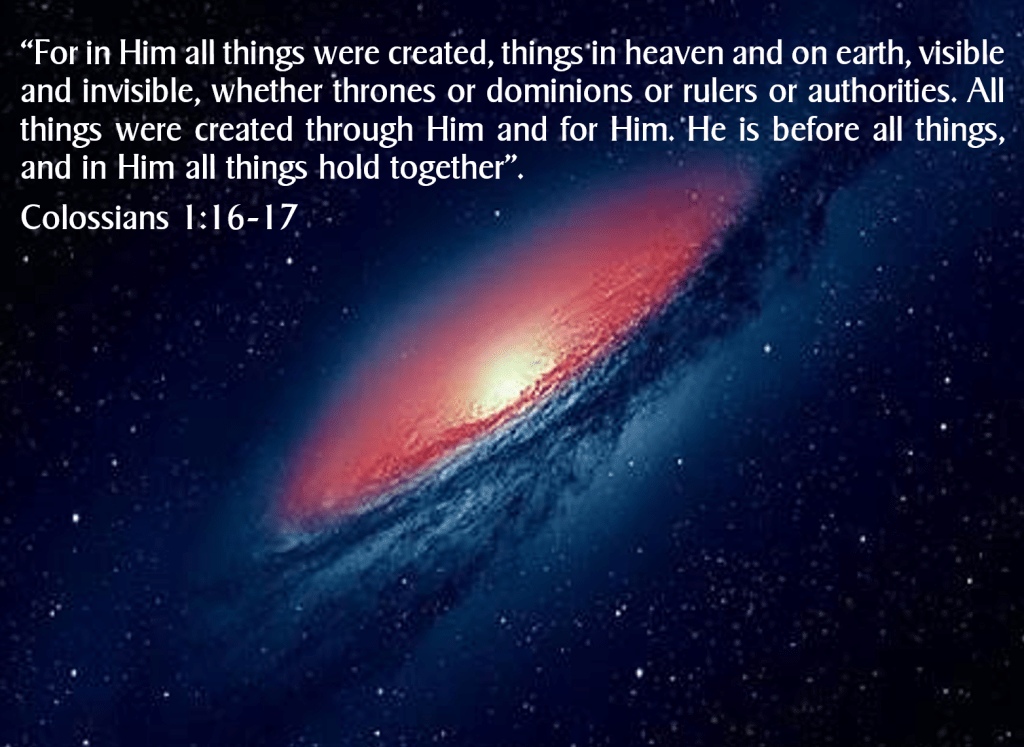
“For in Him all things were created, things in heaven and on earth, visible and invisible, whether thrones or dominions or rulers or authorities. All things were created through Him and for Him. He is before all things, and in Him all things hold together”.
Colossians 1:16‑17
So, not only creating the cosmos but also upholding it moment by moment. It is only “in Him” that “all things hold together” — from the smallest particle to the vastest galaxy. After the Incarnation of the Son of God as the Christ, people just did not realise who they were dealing with. They were oblivious to the fact that there standing before them was not just some ‘jumped-up’ rabbi from Nazareth (which is how most of the rulers in Israel saw Him) but the Creator of the universe — their own Creator! “He was in the world, and though the world was made through Him, the world did not recognize Him” (John 1:10). Is that not extraordinary?
So where was Jesus before the manger? Creating the cosmos and holding it all together. And He still is! So when you see a “manger scene”, do not limit the Lord Jesus to remaining as a cute little babe. So much of such sentimentality exists. That babe is the Creator of the universe who has come in the flesh!
Where else was Jesus before the manger, and what was He doing? Well, amongst other things,
III. HE WAS DIRECTING THE BUSINESS OF HIS PEOPLE ON EARTH
All the way through the Old Testament, the Son of God was looking after those who looked forward to His coming. Sometimes He was a pillar of cloud or fire leading them through the wilderness (Exodus 13:21-22). Sometimes He put in an appearance through what are known as ‘Theophanies’, where we see Him referred to as the Angel of God, the Angel of the Lord, the Angel of His presence and even on one occasion as the “Commander of the Lord’s army” (Joshua 5:14‑15). Although He had not yet reached the manger on His mission, throughout the Old Testament He still busied Himself in all the preparatory work for that. See examples of these ‘Theophanies’ — pre-incarnate appearances of Christ in the affairs of His people — in the following texts: Genesis 16:7–14; 18:1–33; 22:11–18; 31:11–13; 32:24–30; 48:15–16; Exodus 3:2–6; 23:20–21; 33:9–11; Numbers 22:21–27, 31–38; Deuteronomy 4:11–14; 5:4–5; Joshua 5:13–15; 6:2; Judges 2:1–5; 6:11–24; 13:2–23; 1 Kings 19:5–7; 2 Kings 1:15; Isaiah 63:8–11; Daniel 3:25, 28.
The fact that He was directing the business of His people on earth is also why He is known as “the Good Shepherd” (John 10:14; Psalm 23:1) and the “Great Shepherd of the sheep” (Hebrews 13:20). See also Genesis 49:24; Isaiah 40:11; Ezekiel 34:23; 37:24.
He made these appearances in the Old Testament era in order to set the stage for His actual coming in human flesh. The whole of the Old Testament was not about the aggrandisement of an everlasting Israel — as many mistakenly believe today — but the preparation for the coming of the eternal Son of God as the Man, Christ Jesus. Today more than ever, it needs to proclaimed from the rooftops that the Bible is not Israel-centred but Christ-centred. The same too with the true Church (the Ekklesia). It’s witness is not Israel-centred but Christ-centred. The temporary formation of the Old Covenant nation, Israel, was but one part of a vast plan of spiritual warfare arranged in eternity for enactment on earth and for the benefit of His people. The remnant of that Old Covenant nation was what formed the beginning of the Ekklesia in the New Testament, made up of Jews and gentiles, moving out from the confines of Jerusalem, through Judea and Samaria and to the ends of the earth. (Incidentally, if you have a problem with this understanding of Old Covenant Israel as being merely a temporary phenomenon leading to the formation of the worldwide Ekklesia, and you imagine that the modern state of Israel is still somehow “the vortex of the nations” and the “apple of God’s eye, you can freely download from my website this book, “Abraham Our Father: Jerusalem Our Mother”, which is now in its third edition. Just click on the title to obtain it).
The arranging of that plan is another aspect of what Christ was doing before the manger. For, before the manger…
IV. HE WAS PLANNING TO COME TO EARTH AS SAVIOUR OF THE UNIVERSE
Did you know that there was an arrangement within the Godhead for a mission to earth? Let’s just trace that mission through the Scriptures, right from a statement in the Garden of Eden…
Directly to the leader of the fallen angels, whom we know as the Devil or Satan, the Lord said in judgement for corrupting His human creation: “I will put enmity between you and the woman, and between your seed and her Seed. He will crush your head, and you will strike His heel” (Genesis 3:15). This is what is known as the “Protevangelium” — the first glimmering proclamation of the Gospel in prototype and the announcement of the coming of Christ to destroy the works of the devil. I want to go more deeply into this extraordinary announcement, and take each word apart, as it contains so much richness in terms of the Divine Plan and the way it has ricocheted down time from long before Christ was lying in a manger. So you’ll need to have it in front of you in your open Bible.
We see in this verse, Genesis 3:15, a range of mighty spores of all that was yet to come. It is an astonishingly profound and telescoped piece of Divine revelation. It begins with an “I” — the “I” of divinity. Suddenly the paradise of the earlier chapters is gone and there is the first appearance of open conflict. Who is the “you” in the verse? It refers to the power which lay behind the serpent, Satan. Who is “the woman”? We must realise here that, as in many other prophecies, there is more than just one reference point. In the first instance it refers to the first woman, Eve. One of the offspring of this woman, Eve, would deal the death-blow to Satan. But it goes much, much deeper than this. At a deeper level “the woman” refers to God’s people according to the revelation given in both the Old and New Covenant eras. For evidence of God’s people being portrayed as His “woman”, see Isaiah 49:14-23; 54:5-7; 60:1-4; Hosea 2:19,20; John 3:29; 2 Corinthians 11:2; Ephesians 5:25-27,32; and Revelation 12:1-2, 13‑17.
To whom do the words, “your seed”, refer? It must refer primarily to the fallen angels in terms of spiritual seed (remember, Satan was an angel). In that sense, the fallen angels have been spawned by Satan, for he led them in their fall (Revelation 12:4a). The Angels cannot produce actual offspring among their own kind, but there are many humans who can be said to be, from a spiritual standpoint ”of your father, the devil” (John 8:44) — the human spawn of Satan. It refers to all those creatures, human and angelic, who are at enmity with the seed of the woman, God’s people. The “children of the devil” is a biblical phrase (Acts 3:10; 1 John 3:10), and it is quite chilling. It refers to everyone who is not the “seed of the woman” — no matter how seemingly good they may appear to be on the outside (see also “brood/offspring of vipers”, Matthew 3:7; 12:34; 23:33).
Who is “her Seed”? Above all, “the Seed of the woman” refers to Jesus Christ Himself (who was descended, via Abraham and David, from Eve, cf. Luke 3:23-38) and was also, literally, born only of a woman (the virgin Mary) rather than from both a man and a woman (Galatians 4:4; cf. 3:16). On a secondary level, it refers to all those who are engaged in the struggle against Satan and his followers — those who are the offspring of the Ekklesia of God, as it were.
The phrase “enmity between…your seed and her seed” is a prefiguration of the spiritual battle which lies at the heart of the biblical message from the first page to the last. In fact, the Bible is the story of how that battle pans out. On a general level this battle is between 1) Christ with His Church (the seed of the woman) and, 2) Satan’s fallen angelic accomplices, together with those influenced by them on earth (the seed of Satan, Satan’s “church”, as it were). This is set to last for as long as there are “seeds”.
Theologians refer to this aeons-long warfare as the “Antithesis” — a spiritual battle of cosmic proportions which was set to last until the return of the Lord Jesus Christ at the last day. Thus, the Bible is the revelation both of this spiritual battle and the God-given antidote to the evil engendered by the Fall.
So what is the “bruising” and “striking” in Genesis 3:15 all about? “He shall bruise your head, and you shall strike His heel” — as was said directly to Satan. First, I believe that a better translation in this context would be, ”He shall crush your head, and you shall strike His heel”. The Hebrew word, שׁוּף, shuph, carries the meaning of “overwhelm” or “break”, especially here where it is the vulnerable head which is being assailed, thus guaranteeing termination. So surely it would be more in keeping with the tenor of the Scriptures to see Satan as being crushed. As it says in the parallel text, “The God of peace will soon crush Satan under your feet” (Romans 16:20a), where the Greek, συντρίβω, suntribó, certainly refers to crushing rather than merely bruising. Satan doesn’t get a bruising on the cross; he gets positively broken.
When God says to Satan, “You will bruise His heel”, note that although it is referring to what Satan did to Christ, only the heel is involved which, in comparison to the head, is more of an inconvenience than a crushing deathblow. This “bruising” of Christ’s heel by Satan refers to the events on the Cross, where Christ delivers a death-blow to the evil one (crushes him and his plans, in fact) but He would also suffer death Himself — albeit vicariously and only temporarily, hence, only the “heel” (see also Isaiah 53:5). It refers to the final conflict. Indeed, the work of Christ certainly dealt a death-blow to Satan, as foretold in the phrase said to him, “He [Christ] shall crush your head”. There is a sense also in which the New Testament Ekklesia actually participates with Christ in this crushing of Satan (Romans 16:20a) as “joint heirs with Christ” and co-conquerors (Romans 8:17,37), through “the word of their testimony”, and the yielding of their will to God (Revelation 12:11; cf. Luke 14:26).
The Lord’s prediction that Satan would bruise the heel of the woman’s seed also refers to both the general oppression of the Lord’s people by Satan, as well as the more particular affliction of Christ at His crucifixion.
So Satan heard it directly from his God and his Creator, in this saying in Genesis 3:15, that there was One coming who would devastate him; and the Old Testament reveals successive attempts by the would-be “ruler of this world” to destroy the Seed of the Woman whom he knew was the only one who could take his usurped rulership from him. Satan put all his energies into preventing the coming of Christ into incarnation by attempting to undermine the people of God in those Old Testament days, such as we see exemplified in these symbolic words: “The dragon stood before the woman who was about to give birth, ready to devour her child as soon as she gave birth” (Revelation 12:4). Satan’s “standing before the woman” is what caused such a hard time for the Old Testament saints, in his bid to flush out and destroy the promised Redeemer who would be born in order to overthrow him and his works. I have shared details of Satan’s campaign to destroy the bloodline leading to Christ many times before, but it would be fitting to do so again here, for it bears testimony to the manner of his response in anger and obsessive reactions down through history to what God said to him in Genesis 3:15. Let’s trace it through again, and also see how God dealt with Satan’s doomed strategies…
First, Satan sought to destroy Abel through his envoy, Cain (Genesis 4:8; 1 John 3:12); but God raised up Seth in his place (Genesis 4:25). Then, as things were coming towards the time of the flood, after the Fall, we find that the ungodly offspring fathered by Cain carried the torch of satanic opposition through to the time of the flood as the devil tried to pollute the godly line of Seth with an unprecedented outburst of demonic evil (Genesis 6:1-2). The wickedness of that time was so great that the Lord had to intervene with the judgement of the flood. However, God raised up Noah with his immediate family and drowned the rest of the world’s population (Genesis 6:8). The old serpent subsequently tried to have every male child in Israel killed at birth by the midwives; but God made provision to ensure that this would not succeed (Exodus 1:15-22). Later, he stirred up Queen Athaliah to murder all the royal heirs of Judah (from which ancestral line the Lord Jesus would come); but Jehosheba hid little Joash — the last royal heir in line — in the recesses of the temple for six years (2 Kings 11:1-3). Satan then stirred up Haman to destroy all the Jews (Esther 3:6); but they were miraculously delivered at the expense of their Gentile enemies (Esther 9:1-17).
In the fullness of time, when the Lord Jesus was born, Satan used his servant Herod to issue an edict that all the male babies under two years of age in Bethlehem and its environs should be killed (Matthew 2:16-18), so as to flush out the promised “Seed” from Genesis 3:15. But that too was an abortive measure. Finally, he attempted to destroy the Lord Jesus Himself by inciting his earthly agents to crucify Him (e.g., Luke 4:28-30; John 11:53; Luke 23:8-12; cf. Acts 4:27-28). However, it is a singular fact that every act of Satan in history has been an abortive failure, rebounding on himself, and such failure will ultimately lead to his own eventual judgement (Revelation 20:10).
So, long before the manger, from the very beginning (if ‘beginning’ has any meaning in this eternal context!), Christ was planning to come to earth as the Saviour, and Genesis 3:15 represents the initial Divine pronouncement of this fact to Satan and the world. For before the creation of the universe, the Father arranged with His Son that He should come into the world:
“For God so loved the world that He gave His one and only Son, that everyone who believes in Him shall not perish but have eternal life. For God did not send His Son into the world to condemn the world, but to save the world through Him”.
John 3:16-17
We see here that the Son was “sent”. It was a Divine mission strategized among the members of the Godhead. Two other biblical statements about this pre-manger arrangement are these :
“He (God the Father) chose us (who believe) in Him (God the Son, Jesus Christ) before the foundation of the world, to be holy and blameless in His presence. In love He predestined us for adoption as His sons through Jesus Christ, according to the good pleasure of His will”.
Ephesians 1:4-5
“When Jesus had spoken these things, He lifted up His eyes to heaven and said, “Father, the hour has come. Glorify Your Son, that Your Son may glorify You. For You granted Him authority over all people, so that He may give eternal life to all those You have given Him. Now this is eternal life, that they may know You, the only true God, and Jesus Christ, whom You have sent. I have glorified You on earth by accomplishing the work You gave Me to do. And now, Father, glorify Me in Your presence with the glory I had with You before the world existed”.
John 17:1-5
The Lord Jesus often spoke about being specifically “sent” by the Father. Just to emphasise the point about Christ being ‘pre-manger’, the idea occurs more than forty times in John’s Gospel! An example there is in John 6:38-40:
“For I have come down from heaven, not to do My own will, but to do the will of Him who sent Me. And this is the will of Him who sent Me, that I shall lose none of those He has given Me, but should raise them up at the last day. And this is the will of Him who sent Me, that everyone who looks to the Son and believes in Him shall have eternal life; and I will raise him up at the last day”.
John 6:38-40
Everything that springs out of that mission has been recorded in the Bible. Where was Jesus before the manger? Planning to come to earth as the Saviour of the universe. The incarnation of God the Son was a planned event, with the salvation of His people in mind, “those He has given Me”. “[You were redeemed] with the precious blood of Christ, a lamb without blemish or spot. He indeed was known before the foundation of the world, but was revealed in these last times for your sake” (1 Peter 1:19-20). This was a planned event — worked out between the members of the Godhead. This was the mega-plan to end all mega-plans. As the Scripture says in Hebrews 10:5-7:
“Therefore, when Christ came into the world, He said [to the Father]: ‘Sacrifice and offering You did not desire, but a body You have prepared for Me’. In burnt offerings and sin offerings You took no delight. Then I said, ‘Behold, I have come to do Your will, O God: It is written about me in the scroll’”.
Hebrews 10:5-7
So the Son says to the Father: “A body You have prepared for Me”. It was perfectly arranged, as only God could do. And that physical body which was so miraculously prepared for Him — the very body that people look at in the manger — came into being inside the womb of a virgin. So, where else was Christ before the manger?
V. HE WAS IN THE WOMB OF A VIRGIN
Yes, a body had been prepared for Him long before the manger — eternally before! Now came the moment of its realization: A supernatural conception. It was the Holy Spirit who oversaw the conception of Christ in the womb: “This is how the birth of Jesus Christ came about: His mother Mary was pledged in marriage to Joseph, but before they came together, she was found to be with child through the Holy Spirit” (Matthew 1:18). And in v.20 of that same chapter, we read: “The One conceived in her is from the Holy Spirit”.
A Completely New Thing Created on Earth
Long before the manger, in the context of a primary prophecy of the New Covenant in Christ, Jeremiah says: “For the Lord has created a new thing in the earth — A woman shall encompass a man” (Jeremiah 31:22). This is not just any woman or any man, for why would he mention it, especially in the context of the New Covenant in Christ which was still then to come? This is rightly understood to be referring prophetically to the extraordinary encompassing by an extraordinary woman of an extraordinary Man. Christ encompassed in the womb. This is the virgin birth — a trinitarian event, if ever there was one! Just look at this trinitarian statement from Gabriel the angel to Mary: “The Holy Spirit will come upon you, and the power of the Highest,the Son of God” (Luke 1:35).
Not only was this birth personally brought to pass by the members of the trinitarian Godhead but it had plainly been planned by Them too: “When the fullness of the time had come, God sent forth His Son, born of a woman, born under the law” (Galatians 4:4). This was a planned event. This is why the Lord Jesus Christ is called “the Lamb that was slain from the foundation of the world” (Revelation 13:8). His coming was built into this creation from the start, having been strategized beforehand. Thus, the Incarnation was just the beginning of a Divine life on earth that was planned, worked out between the members of the Godhead — Father, Son and Holy Spirit — from the creation of the world and before.
I am going to linger on this subject of the virgin birth somewhat more because it is a vital and neglected teaching of the Christian Ekklesia which has so much to tell us about ‘Christ before the manger’.
The Virgin Birth — A Vital and Neglected Teaching
If you were to take a survey of every professing ‘Christian’ minister in the world, including those in all the mainstream denominations, containing the question: “Do you believe in the virgin birth of Jesus Christ?”, how many positive responses do you think you would get? Or if the question was “Do you believe that the virgin birth is a primary teaching of our faith?” how many would say a wholehearted “Yes!”?
At one time, this teaching was considered to be worth defending to the hilt, as it was taken for granted to be a vital truth. For example, Ignatius of Antioch was a martyr for the faith who died around AD 107, and was reputed to have been a disciple of John the Apostle (who wrote the Gospel). He was even claimed to have been one of the babes who Jesus blessed (Luke 18:15-17). He wrote a number of letters to people and churches which, while not canonical, are very interesting and useful. In one part of his Letter to the Ephesians, to the church at Ephesus, on his journey to Rome for execution, not long after the Book of Revelation had been written, Ignatius wrote:
“Now the virginity of Mary was hidden from the ruler of this world, as was also her offspring, and the death of the Lord; three mysteries of renown, which were wrought in silence by God, but have been revealed to us”.
Ignatius’ Epistle to the Ephesians, §XIX
Ignatius was referring to the way that Jesus’ conception in the womb of a virgin, His birth from her, and the fact that His death would accomplish Satan’s downfall, were three precious mysteries which were hidden from the extensive knowledge possessed by Satan who, before Christ’s victory on the cross, was still accounted as “ruler of this world” — an anomaly which was set right by Christ who evicted him from that usurped position through His triumph through the cross, His resurrection and His ascension (cf. John 12:31). What we see here is that at that early time in the primitive church the virgin birth was a ‘given’, accepted as absolutely true.
Three Reasons Why the Virgin Birth is So Important
Similarly, the early church ‘Fathers’, from Augustine to Hippolytus, Jerome to Leo the Great, recognised the signal importance of this teaching, and wrote great treatises against those who denied it.
The Apostles Creed, which was produced in Gaul around the 5th century (which itself was based on an old Roman Baptismal Confession from AD200) has those all-important words: “Conceived by the Holy Ghost; born of the Virgin Mary”. This was treated as a fundamental teaching in the early church. Converts before baptism had to include it in a confession of faith. No one would be admitted to a Christian assembly nor recognised as a genuine believer without believing in this teaching. How times have changed! Yet, without the teaching of the virgin birth, the entire corpus of faith called Christianity falls. So, why is it so important?
Firstly, it is so important because it explains how the Eternal Word came into the material world. The very thought of the Son of God being “manifested in the flesh” — the Word becoming flesh and dwelling amongst us — is beyond our comprehension. As the hymn-writer put it: “The Incarnate Deity, our God contracted to a span — incomprehensibly made man”. How could that have happened?
The ordinary union between a man and a woman could not have produced such a unique Human Being who was both God and man. Instead, “God sent forth His Son, born of a woman” (Galatians 4:4) — rather than of a woman and a man. There is no other way that the incarnation of God the Son could happen than by that way declared by the angel: “The Holy Spirit will come upon you, and the power of the Highest will overshadow you” (Luke 1:35).
In fact, all three members of the Trinity were involved in the Incarnation of Christ. The Father prepared His physical body (Hebrews 10:5). The Holy Spirit was also involved, as He is in all Divine creative activity (Luke 1:35).
What happened was that Mary conceived without human fertilisation when God the Son not only entered her womb, but also the egg in her womb, under the superintending ministry of the Holy Spirit. Thus, “The Word became flesh and dwelt among us” (John 1:14). The eternal Word entered the world through fertilising an egg in the womb of a virgin. The only logical way for the Incarnation of the Word to have occurred was through the virgin birth.
Secondly, the virgin birth explains how the Lord Jesus Christ came to be human yet sinless. The One who was to come to redeem sinful people out of this world could not Himself be sinful, otherwise He, too, would have needed a redeemer! Had He been sinful, He would have needed someone to atone for His sins.
So His entry into this world could not be through the ordinary union of a man and a woman. For that is how original sin is transmitted down through the human race, the uniting of human sperm with a human egg — the pathway of corrupted DNA. As the psalmist puts it: “Surely I was brought forth in iniquity; I was sinful when my mother conceived me” (Psalm 51:5). Every human being born into this world is steeped in original sin. From the moment of conception one is guilty of the sin of Adam — another vital teaching which is denied by so many who find it repugnant. As Paul says in Romans 5:12: “Therefore, just as sin entered the world through one man, and death through sin, so also death was passed on to all men, because all sinned”. How have all sinned? Through that primal, original sin of Adam.
Sin and death came to reign “even over those who did not sin in the way that Adam transgressed” (Romans 5:14). So even if human beings never actually sinned themselves (which we know is impossible anyway), they still bear in themselves guilt for the sin of Adam. This teaching is known as the ‘imputed sin of Adam’. Like the teaching concerning the ‘imputed righteousness of Christ’, it is a foundational Christian teaching, which heretics have tried to overthrow from the beginning (the devil knowing full well the importance of these matters).
For if the Lord Jesus Christ is the normal product of sexual intercourse between a man and a woman, then He would be steeped in original sin like every other member of the human race, and thus be unable to be the Redeemer. But because of the virgin birth He ‘bypassed’ the manner in which original sin is transmitted. Thus, even though “He was in all points tempted as we are”, yet He was “without sin” (Hebrews 4:15).
Thirdly, the virgin birth explains how the Lord Jesus Christ came to have two natures, human and Divine. The promised Redeemer who would provide atonement for human beings had to be both a human being and also God Himself. He had to be a human being, because it is the human race which has the problem of sin and must bear the penalty for it. Therefore the Redeemer of human beings had to be, literally, “God manifested in the flesh”. That ‘flesh’ part was vital. As Leo the Great puts it:
“A Victim had to be offered for our atonement, who should be both a partner of our race and free from our contamination, so that this design of God whereby it pleased Him to take away the sin of the world in the Nativity and Passion of Jesus Christ, might reach to all generations”.
Leo the Great, Sermon 23, III
The only kind of being who could be both “a partner of our race” (i.e. human) and “free from contamination” (i.e. without sin) would be a human being who was also Divine. The virgin birth guaranteed such a Being. As the Apostle John puts it: “And you know that He was manifested [i.e. supernaturally incarnated for real] to take away our sins, and in Him there is no sin” (1 John 3:5). How? Because of the virgin birth. There can be no other explanation. That is how important the virgin birth is to the essential elements of our faith.
Only a Divine being could have endured those three hours on the cross, when all the forces of darkness, at the instigation of the Father, were brought to bear on the whole being of the Christ. But He also had to be “made flesh” in order to be able to fulfil the atonement for humanity aspect of it. So the Redeemer of the human race had to be both human and Divine. But how did Jesus Christ come to have those two natures in one Person? The only thing that explains this properly is the virgin birth.
The Beautiful Exchange
The Fall of Adam did not take God by surprise. He knew very well that our first parents would succumb to the wiles of the devil. Planning for that event had already been accounted for in the Divine strategy. Therefore, among the members of the Divine Godhead there had been a plan worked out even before the creation of the world which would involve the Son coming in the flesh. So, in the fullness of time, God sent forth His Son, born of a woman. In other words, to put it more fully, “God the Father made God the Son, who knew no sin, to be sin for us, that we might become the righteousness of God in Him” (2 Corinthians 5:21). That is the beautiful exchange right there. He took the penalty for our sin on Himself (who was without His own sin) so that we could be partakers in His righteousness (when we had none of our own) and thereby be cleansed.
Truly the Incarnation is an utterly remarkable event — more so than any science fiction story! God Himself fertilises an egg in a virgin’s womb and there is a union of the Divine and human natures in the Man, Christ Jesus. The paradoxes which come out of that are many. Thus, He suffered, but He could also say: “Before Abraham was, I am”. Men could spit in His face, but He could walk calmly through a murderous rabble at the drop of a hat without even being noticed. He could bleed, weep, and die, yet He Himself had the power to reverse the death process, forgive sins and make the blind see. Do you see the wonder in this — the beauty of it? Spiritual paradoxes are always most beautiful.
“For what the law was powerless to do in that it was weakened by the flesh, God did by sending His own Son in the likeness of sinful man, as an offering for sin. He thus condemned sin in the flesh, so that the righteous standard of the law might be fulfilled in us, who do not walk according to the flesh but according to the Spirit”.
Romans 8:3-4
How important is that above little word “likeness”. Only the incarnation through a virgin birth could make it so. There always has to be a penalty paid for the transgression of the law of God. The physical and spiritual. But to deal with that, God Himself came in the flesh and took that penalty on Himself, so that all those who believe, who have been chosen in Him from the foundation of the world, would receive the gift of eternal life. As He said in His own words: “I am the good shepherd. The good shepherd lays down His life for the sheep” (John 10:10).
Without the Virgin Birth the Foundation of Our Faith Falls
None of this would have been possible were it not for the virgin birth. It is a vital and indispensable Christian teaching. Without it, the entire foundation of our faith falls. For salvation rests on the mighty fact of a sinless Redeemer who is both human and Divine. And a sinless Redeemer who is both human and Divine is only possible when a human is born of a virgin through the superintending, overseeing power of the Holy Spirit.
Therefore, a Foetus is Not Just ‘a Bunch of Cells’
Now we can understand what the prophet meant when he said: “For the Lord has created a new thing in the earth — A woman shall encompass a man” (Jeremiah 31:22). A woman shall encompass a man. Jesus in the womb. And what a “new thing” that was! The only time a human being has been born into this world without the involvement of the sperm of the male. The false church and the world may scoff at these things, “However, if I were you, I would appeal to God and lay my cause before Him—the One who does great and unsearchable things, wonders without number” (Job 5:8-9).
So Mary conceived without any human fertilisation when God the Son not only entered her womb, but also entered the egg in her womb, under the superintending ministry of the Holy Spirit. There was no human sperm involved; but the Son of God Himself was, as it were, the “sperm” that entered the egg and exploded into life as the God-Man — the Messiah who was called Jesus (Yehoshua). Is that not a totally mind-blowing thought?!?
The eternal Word entered the world through fertilising an egg in the womb of a virgin. Thus, “The Word became flesh and made His dwelling among us” (John 1:14). Where was Christ before the manger? He was in the womb of a virgin as a foetus!
Incidentally, this in itself is a fine argument against abortion. For Jesus was not just “a bunch of cells” from conception. Right from the start, within the womb, He was Jesus the Christ every bit as much as when He lay in the manger or hung on the cross. Just as every other child is a human being within the womb as much as outside it. Let the lesson be learned.
CONCLUSION
It will not be many months before mangers will be popping up near you, in the foyers of supermarkets, banks and other public buildings in which political correctness has not yet taken hold. There may even be one in your church! The problem is that most people get stuck in that manger, which very much suits the world. It suits the world because a mere manger-baby cannot be the divine Creator, Upholder and Judge of the universe. The world wants a sanitised, sentimental, emasculated, neutered, spineless, namby-pamby, mealy-mouthed manger. It wants a manger stripped of all possible power, glory and Godhead. It doesn’t really want that baby to grow up and become the Judge of the world. That would just be too offensive!
Why the World Loves Christmas More Than Easter
Have you ever wondered why the world makes such a huge fuss about Christmas, with all its mangerly sentimentality of “baby Jesus” and ‘nativity plays’ and tinsel, and mistletoe, and shamanistic pine trees bedecked with baubles, the benign godlike gift-giver of Santa Klaus, masses of material presents, and face-stuffing rituals of 3000+ calorie meals, but yet takes little notice of the time of year known as Easter, apart from some gross chocolate eggs, bunnies, and some waffle about “new life” in Springtime? Now you know. It is because that “baby Jesus” is for them wordlessly and non-threateningly encased in confining swaddling-clothes in a manger, whereas the Man on the cross will BURST out of His grave with a sound louder than the angels playing marbles, calling out at the top of His voice in a manner which will echo from one side of the cosmos to the other: “Without me you can do nothing!” (John 15:5).
Without the Cross and Resurrection, the Manger is Meaningless
Now, if you are Mr. or Ms. Autonomous, that is one scary thing to hear. But hear it you will, if we are doing our work. That is because one of the greatest evangelistic lynchpins is the fact that without the cross and resurrection, the manger is meaningless.
People prefer to think that Christ merely began with that manger. But if that is the case, then many serious elements come into play.
Two Final Reasons Why Christ Has to be Pre-Existent
Firstly, if He merely began in that manger (well, at birth), then He cannot be God. His deity absolutely hangs on the fact that the baby in the manger was pre-existent! So when we look on that manger, we have to say to ourselves:
“For in Him all things were created, things in heaven and on earth, visible and invisible, whether thrones or dominions or rulers or authorities. All things were created through Him and for Him. He is before all things, and in Him all things hold together”.
Colossians 1:16‑17
That is one extraordinary thing to say about a baby in a crib! But it is crushingly true.
Secondly, if He merely began in that manger, then He cannot be the Judge of the world. The Day of Judgement is not going to be directed from a manger! The folding up of this universe and morphing of it into another one is not going to be unleashed from a manger! This is why we see the manger scene in the prophetic Scriptures laden with such divine gravitas:
“For unto us a Child is born, Unto us a Son is given; And the government will be upon His shoulder. And His name will be called Wonderful, Counsellor, Mighty God, Everlasting Father, Prince of Peace”.
Isaiah 9:6
Yes. That child in the crib is “Mighty God” and “Everlasting Father”. Try telling that to the hordes scurrying past the manger effigy in the foyer of Tesco or Walmart! Try telling them that this is all true. That Christ as the Saviour is true and that the grace is in this: ”All we like sheep have gone astray. We have turned, every one, to his own way; and the Lord has laid on him the iniquity of us all” (Isaiah 53:6). Try telling them that about this baby in a manger. Tell them where He was everlastingly before the crib. Tell them why He not only came but HAD to come.
We’ll learn more about this in Part 2, when we look at the reasons why the Lord Jesus had to come to planet earth. He came to earth to save people — to draw people to Himself — people who know that their lives are spiritually empty — people who know that they keep on breaking God’s laws and who want to get back into a right relationship with God — people who know that their lives are a sham — people who know that Jesus came not for no one but for THEM!
When you hear about the Lord Jesus’ mission to earth, does it set you a little bit on fire? Do you think “Oh Lord, it was for ME that you came”, before throwing yourself on your face and thanking Him from the wellspring of your heart? If you’ve never done that before, well then now is your chance. Tell Him you are truly sorry for not recognising Him as your Saviour until now in your life. Ask Him to bring you into His spiritual kingdom. He loves to hear that and He loves to respond to it too.
Where was Jesus before the manger? He was always on the way here to reveal to you the truth about Himself:
“I AM… I am the Living Bread… I am the Door… I am the Good Shepherd… I am the Way, the Truth and the Life… I am a King… I have come as a Light into the world… I am the Resurrection and the Life… I have come down from heaven… Come to Me, all you who are weary and burdened, and I will give you rest…”
.

Coming sometime soon:
“Christ’s Eternal Mission Inside & Outside History”
A CyberSermon in Two Parts
Part 2: “Why Did Christ Come to Planet Earth?”
.
.
© Copyright, Alan Morrison, 2023
[The copyright on my works is merely to protect them from any wanton plagiarism which could result in undesirable changes (as has actually happened!). Readers are free to reproduce my work, so long as it is in the same format and with the exact same content and its origin is acknowledged]
 Diakrisis Project