
WHY DISCIPLES OF CHRIST WILL AND MUST SUFFER. SOME “UPSIDE-DOWN THINKING” FOR YOU TO CONSIDER…
THE OTHER DAY, I was doing some research on the Hebrew word, בָּכָא, baca, which occurs in Psalm 84:6 as בְּעֵ֣מֶק הַ֭בָּכָא, be-aymec habaca, “through the Valley of Baca”. Most translations do translate those words directly as “the Valley of Baca”. But there is more to that word than merely “Baca”. I think that the American Standard Version (as well as Robert Young’s Literal Translation, and the Brenton Septuagint Translation) got it right by translating it as “the valley of weeping”. It has also become immortalized in the devotional phrase, “the Vale of Tears”.
The verses in question in Psalm 84 are:
“Blessed are those whose strength is in You, whose hearts are set on pilgrimage. As they pass through the Valley of Weeping, they make it a place of springs; even the early rain covers it with blessings. They go from strength to strength, until each appears before God in Zion” (vv.5-7).
I think that “Valley of Weeping”, or “Vale of Tears”, is the best translation of the Hebrew words there. It dovetails perfectly with the idea of springs and rain which are also in the same verse. In fact, Strong’s Exhaustive Concordance actually states that “baca” (#1056) comes from the word “bakah” (#1058), which means weeping.
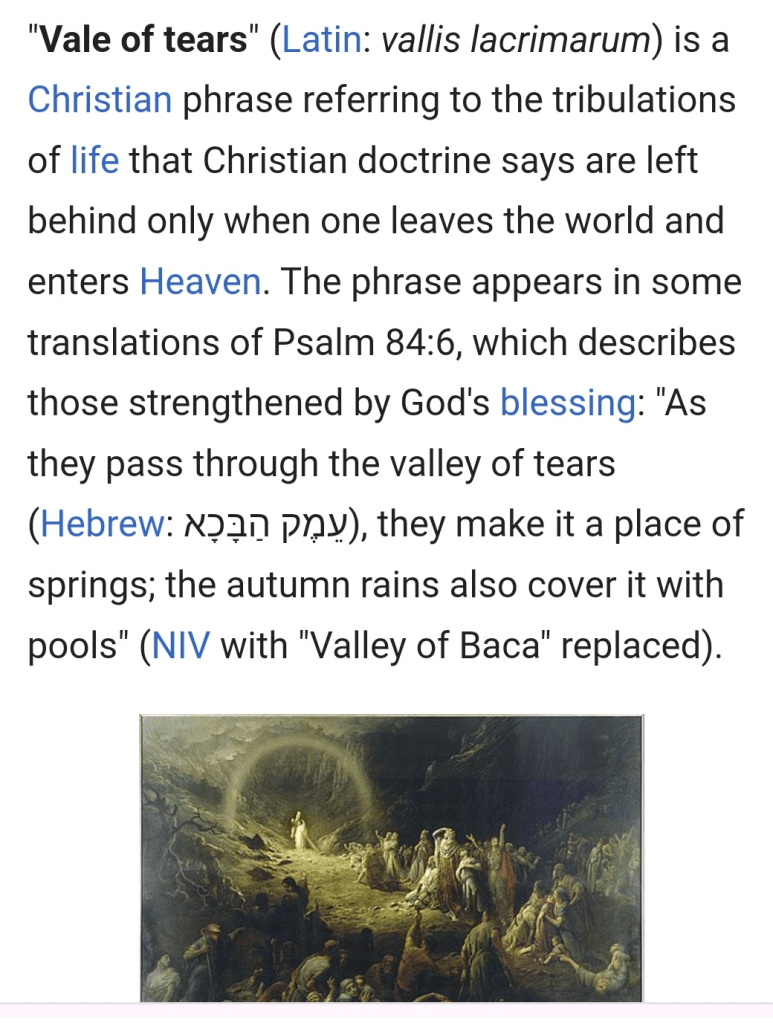
While I was doing that research on the word, Baca, I came upon this little piece by chance in Wikipedia (see attached image). Yes, “The Vale of Tears” has its own little article in Wikipedia! I found that quite touching. It says that “Vale of Tears is a Christian phrase referring to the tribulations of life that Christian doctrine says are left behind only when one leaves the world and enters heaven”.
In that psalm (#84), especially in verses 5-7, the ‘sons of Korah’ (who wrote eleven of the one hundred and fifty psalms) are showing how those whose strength is in the Lord, whose hearts are in ‘pilgrimage-mode’ in this world (i.e. merely passing through it rather than having their feet comfortably ‘tucked under’ the table of it), will be blessed. In fact, even during this life in which we pass through the Vale of Tears, they will transform those tears into a wonderful well (a place of springs), and they will go from strength to strength until the time comes for their resurrectional transformation. That is the meaning of those three verses. The true child of God transforms his or her tears into blessings. They are not really a burden but a disguised joy. This happens when they see how the chastening elements which caused those tears are there for our training (cf. Hebrews 12:4-11). In fact, “if you do not experience discipline [from the Lord] like everyone else, then you are illegitimate children and not true sons” (Hebrews 12:8). That is one amazing thing to know. If you never experience any hassle in this world as a believer in Jesus Christ, then it is doubtful that you are the real deal. An easy ride in this world is not for the child of God!
This world, for the believer, is indeed a Vale of Tears, a scene of sorrows and sadness. Only the believer can understand that. The believer looks around at the way that world society is developing, at the debauchery, degradation, bellicosity, immorality, amorality, aggression, rage, hedonism, mendacity in all walks of life (especially the political one), the hypocrisy, the ungodliness, the delinquency, the burgeoning number of so-called personality disorders, the corruption and all the ever-increasing sleaze and slime behind the powermongery of this world, and he or she is horrified daily.
The believer does not fit into this world, or belong in it, and constantly feels like a ‘square peg in a round hole’. This is not surprising, for Christ’s kingdom “is not of this world” (John 18:36). Believers are merely passing through this world because that is how and where we get saved, where we are ‘grown’ and matured, and where we are ‘reserved’ for the new world to come. Frankly, the believer cannot wait to be out of this world. “Beam me up, Scotty” (where Scotty stands for God!) are the words on his or her lips.
I have always remembered — continually borne in mind — a saying of Matthew Henry: “For the unbeliever, death is the end of all joys. But for the believer, death is the end of all griefs”. This is the truth, and this is how the believer thinks and feels. It is totally contrary to how the unbelieving world views life, and to think this way is regarded as madness by those who reject Christ and the Gospel. It is seen as “upside-down thinking” by the people of this world.
In John Bunyan’s book, Pilgrim’s Progress, this truth is borne out by the words, “Then Christian and Hopeful outwent them again, and went till they came at a delicate plain called Ease, where they went with much content; but that plain was but narrow, so they were quickly got over it”. This is the harsh reality of life in this transient world for those who are disciples of Christ. There is ‘ease’, but it does not last. The ‘ease’ only exists as a brief gift from God to strengthen us for the next bout of onslaught, affliction, oppression, or persecution. That is the flow of things in our lives: A bit of ease, a mass of challenge. A bit of ease, a mass of challenge. A bit of ease, a mass of challenge. And so on.
I say this is a ‘transient world’ because this ‘Vale of Tears’ is merely a testing ground, a gymnasium, on the way to the creation of a new world when the present fallen one has outlived its usefulness. Physical, emotional, and psychological ‘ease’, in a worldly sense, do exist for the believer, but they rarely last for long and we will quickly be brought past them. That is the nature of the reborn soul in the midst of a fallen world. Christ’s disciples do not seek those comforts (for transitoriness is not on their radar of desires), even though they would not object when they do occur by the grace of God. They take their spiritual ease from knowing what happened on the cross of Christ and how it affects them, personally. They also know that without the necessary detachment from any external, material comforts, they can be a potential snare whereby one could easily become entangled in the affairs of this world and thereby distracted from the true pathway of the devout soul.
For the unbeliever, on the other hand, this world is a wonderland of sensuality, distraction, and entertainment. The flesh is where it’s at. The unbeliever revels in nature in an almost pantheistic manner, making out as if “The Universe” is god and imagining that the beauty of this world is the ultimate for a human to experience. Unbelievers take this world far too earnestly, living in it as if it was permanently substantial, rather than realising that it has been formulated by its Creator as a temporary matter-bound theatre for continual testing and ultimately for judgement — the resurrection to life or to condemnation.
Unbelievers are wholly attached to everything that this world has to offer. They fix their eyes on what can be seen and take seriously whatever is transient, having no interest in, or consciousness of, that which is eternal (cf. 2 Corinthians 4:18). They count their riches in fiscal or material terms rather than transcendent spiritual ones. (Even New Agers, who claim to be so spiritual, love to “manifest” stuff — material elements, foolishly imagining that to be a sign of ‘blessing’ from ‘The Universe’ rather than the touch of Satan which is really is). Unbelievers push to the back of their minds the fact that death will soon come upon them (for life is short and quickly goes by), and they divert themselves with all manner of distractions, spectacles, amusements, and entertainments. Yes indeed, life is short. But they do not realise this until it overtakes them like a thief pouncing from behind.
Accepting that this world is really a ‘Vale of Tears’ through which one must pass with grace and gratitude is the special province of the disciple of Christ. The Lord Jesus said to His disciples, “In the world you will have affliction (Greek: θλῖψις, thlipsys)”; then He added, “but be encouraged because I have overcome the world” (John 16:33). Thus, our experience is inevitably one of affliction and Christological encouragement in the midst of that — grappling against sin and the forces of darkness while receiving succour from angels and their mutual Master. Behind the Greek word thlipsis is the idea of being hemmed in on all sides, crushed. That is an apt description. Our experience here would have to consist of affliction because, at the very least (especially if we are living the full life of discipleship rather than merely playing at it), we are actually hated by the world! (John 15:18-19). That is an afflictive burden alright, for no one enjoys being actively hated. What’s more, the fallen archangel, Satan, and his cohorts (human and angelic) are continually waging war against us! (Revelation 12:17; Ephesians 6:11-17; 1 Peter 5:8).
So, do not let yourself be overcome by sadness and despair because you live in a “Vale of Tears”. Follow the advice of the Sons of Korah and transform those tears into blessings. After all, they are proof that God loves you (Hebrews 12:6). Furthermore…
“Our fathers disciplined us for a short time as they thought best, but God disciplines us for our good, so that we may share in His holiness. No discipline seems enjoyable at the time, but painful. Later on, however, it yields a harvest of righteousness and peace to those who have been trained by it”.
Hebrews 12:7-9
And, finally, always remember this:
“Consider it pure joy, my brothers, when you encounter trials of many kinds, because you know that the testing of your faith develops perseverance. Allow perseverance to finish its work, so that you may be mature and complete, not lacking anything”.
James 1:2-4
Imagine that! Reckoning trials in this world to be pure joy! This is why we can “Rejoice in the Lord always. I will say it again: Rejoice!” (Philippians 4:4). When you begin to realise that this world is a Valley of Weeping or Vale of Tears because it is a temporary fallen creation in which the birth-pains of the age to come are being manifested, with even more pronounced contractions to come (cf. Matthew 24:8), then you have stepped wholly onto the pathway of faith, on which you are moving in sync with the Lord and are providing more to marvel at for His angels, who love to inspect the spiritual goings-on in human beings with great curiosity (1 Peter 1:12). Ω
.
.
.
.
© Copyright, Alan Morrison, 2023
[The copyright on my works is merely to protect them from any wanton plagiarism which could result in undesirable changes (as has actually happened!). Readers are free to reproduce my work, so long as it is in the same format and with the exact same content and its origin is acknowledged]
 Diakrisis Project
Sometimes I feel guilty for feeling persecuted, which is often, because I’m surrounded by those who see this world (as you put it) as a wonderland of sensuality, distraction, and entertainment. They call themselves believers but the last thing they want to talk about is Jesus Christ– unless they have a prayer request.
Love this.
Matthew Henry: “For the unbeliever, death is the end of all joys. But for the believer, death is the end of all griefs”.
Your article (like your other writings) reminds me I’m not alone. Thank you.
LikeLiked by 1 person