
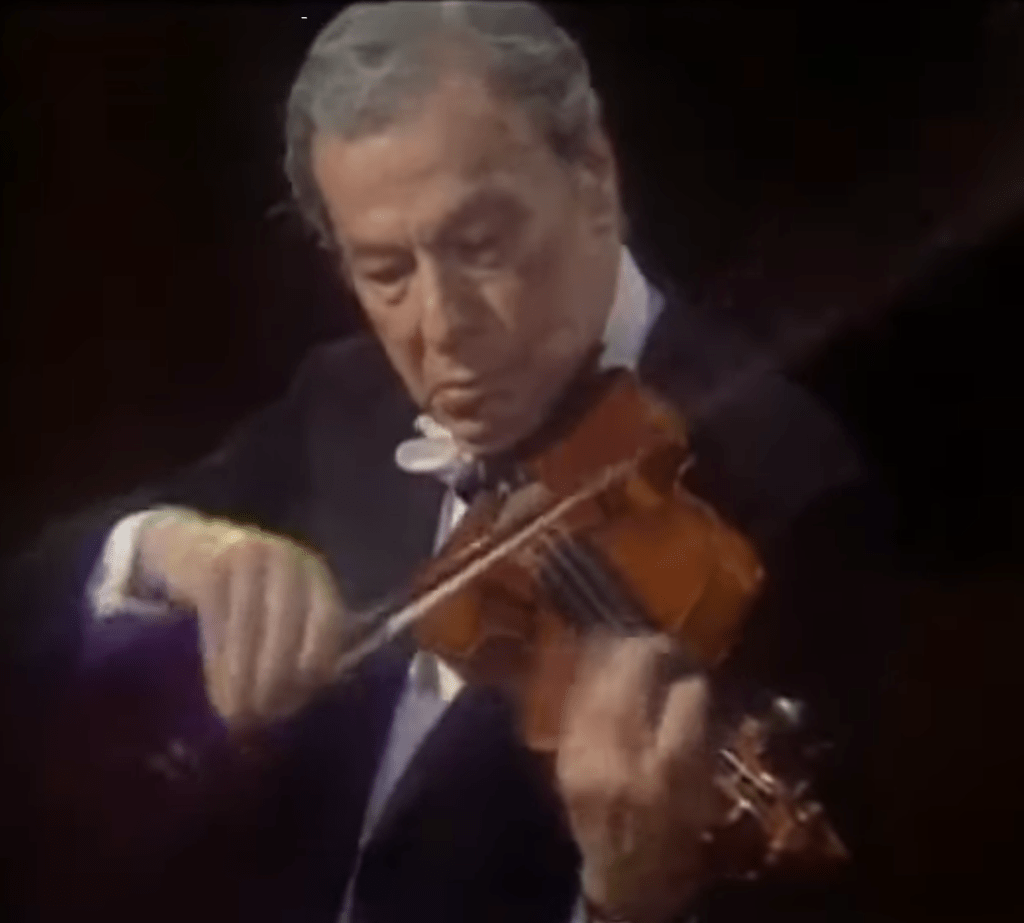
IT CAN GET A BIT HEAVY IN HERE sometimes, with all that is happening in the world and whatnot. So, starting with the video below, I’m going to do a sporadic series of pieces highlighting great music which is so good for the soul. Just like birdsong and the sounds of nature have been proven to act as an antidepressant, so can great music do the same. It can even have an effect on your DNA, as a study of Epigenetics reveals. So here, first, is a little piece which is of gargantuan stature.
When Johann Sebastian Bach (1685-1750) wrote the great Chaconne as the finale of his Partita no.2 in D minor for solo violin, he was more than likely grieving for his wife who had recently died while he was away. This was a man who knew grief. Both parents died before he was ten years old. He lost eleven of his twenty children — one as an adult and ten as infants or toddlers. Life was in the raw in those days. Death stared you in the face and hit you between the eyes every day. But this was not the later Romantic era when one could sob one’s heart out as a composer in music. Bach was part of the Baroque period when everything was more controlled and the idea of ‘pure music’ prevailed. Not only that, but especially in Bach’s case, the glory of God must be purveyed in one’s compositions over and above one’s own self-indulgence, even if grief was involved. So his Chaconne (composed circa 1718) is an outpouring of controlled grief. It is expressed within the confines of ‘pure music’ and there is nothing excessive or immoderate about it. But the bizarre thing is that a Chaconne is a dance and Bach chose to express his grief in a courtly dance which is akin to the passacaglia — a musical form that I love as it always reaches into the soul, despite its structured expression (cf. the heartrending passacaglia from Dimitri Shostakovich’s Violin Concerto and the one from Benjamin Britten’s equally poignant Violin Concerto — both of which I may share in the future).
The performance of Bach’s Chaconne which I am sharing with you here is that by the originally Russian (and eventually American) Nathan Milstein at the age of 82 years old in the Berwaldhallen in Stockholm, Sweden in July 1986 — a nearly 40 year old video recording. I have attended many stunning concerts in that hall with wonderful orchestras (including Mahler’s 6th Symphony when someone in the audience collapsed after the first hammerblow in the final movement!), but this solo performance of Milstein is exceptional. The audience knows that it is a historical event — witness its absolute silence and attention. When you see the audience it is as if it is made up of statues. In fact, it turned out to be Milstein’s last concert and performance ever as shortly afterwards he fell and severely broke his left hand, bringing his 75-year career to a close (his first concert was at the age of 11). He had recorded Bach’s sonatas and partitas for solo violin a number of times but nothing came close to this performance of the Chaconne in Sweden, which will have been played on one of his two Stradivarius violins made in 1710 and 1716. Performed entirely by heart as a humble elderly gentleman alone on a large stage in a huge auditorium, his vulnerability adds to the atmosphere. It is just under 13 minutes long but it embraces eternity. (Does he wipe a tear from his eye at the end?). Enjoy (if that’s the right word). Here is the video:
 Diakrisis Project
Superb!! One can feel the joyful memories contrasted with the sorrow. This is a true maestro! He is making love to his violin, and it is reciprocating. His fingers fly to the music in his head. No need to tell them what to do! His bowing is energetic, yet tender. How I wish I had had him as a teacher, and an instrument as worthy!!!
LikeLiked by 1 person