
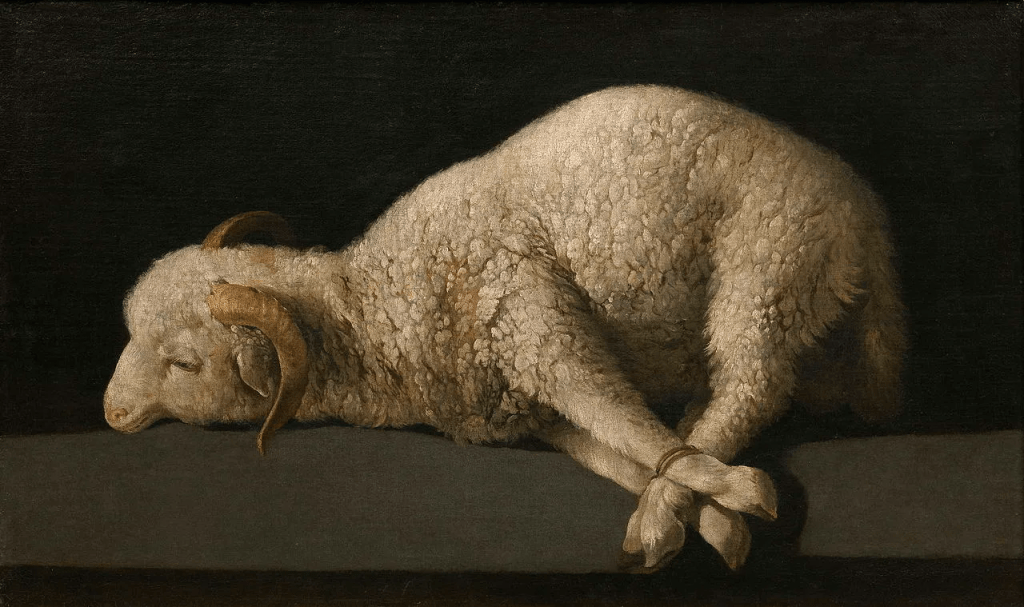
INTRODUCTION
My main intention in this piece is to address the increasingly popular claim that the whole idea of ‘sacrifice’ in the Bible, culminating in the atonement of Christ on the cross — coupled with the idea that those who are impenitent will be consigned to the “second death” in eternal destruction — implies that God is “bloodthirsty” and spiteful, and thus cannot be the real God who is love.
I could easily write a little book about this, for there are many parallel and equally important related issues spinning off from this which I could reference with some profit, and it is a fascinating subject of much depth. But I will try to keep this piece to a manageable length as I believe that the subject matter is too important to be ignored.
First, I have to declare what has sparked my interest in this subject. For it has not escaped my attention that a number of former so-called “New Agers” who had claimed to profess faith in Christ have eventually turned their backs on the biblical Christ and returned to some kind of modified New Age beliefs and practice with sprinklings of pseudo-Christianity (and a pseudo-‘christ’ to go with it) thrown into the mix. In almost all cases that I have heard of, their defection from biblical Christianity to this new outlook was triggered by an unwillingness to accept the Bible’s teaching (and the church’s historic acceptance) about what is commonly known as “hell” and what the Bible calls the “second death”. This defection usually occurred when they encountered one of the many internet teachers who virulently preach against the biblical teaching on these matters. Then one thing leads to another and they find more internet teachers who take the biblical teaching on the atonement to pieces. From there, it is a short trip to discover people teaching that the Bible has been tampered with and important writings have been removed and other things have been inserted — all so that people can be controlled by the Church (so they say) and division sown in the world. There is a definite pattern involved in that journey, which I shall attempt to open up in this introduction.
First, one has to realise that the vast majority of those “New Agers” who are alleged to have come to Christ were originally involved in a fashion which is not strictly New Age (in the Alice Bailey esoteric neo-Gnostic sense) but is the Cosmopolitan magazine version of it; by which I mean a boho way of dressing, lots of trendy activities such as yoga, tarot, aura readings, ecstatic dance, astrology, etc. When many of these folks are alleged to have come to Christ, what has really happened is that they have simply swapped one fashion for another. It is very fashionable for this kind of trendy New Ager to become a “Christian” for a while, especially when they see their friends going for it. You see, one has to realise that this fashionable type of New Ageism is rooted in narcissism — an obsession with self, self-help, self-worth, self-esteem, and so on. It provides a way of spiritually and psychologically bypassing truth and encasing its practitioners in a sort of protective ‘bubble of bliss’. When many of such folks are said to have come to Christ — or “New Age to Jesus” as it is trendily known — that then becomes another extension of their narcissism. Every time they place a post on social media, even if it is a Bible quote!, they still have to put a selfie there too, just like they did when they were New Agers. A big problem is that when they go to a church, they get made into “trophy conversions” and paraded in front of the congregation in celebrity style with their testimonies. They may even write a book, even though they have no real knowledge of the true faith and get much kudos from that too. They can feed off all of that for some time. Just as they set themselves up as some kind of celebrity coach when they were in the New Age scene, so they can do that in the Christian scene and set themselves up as teachers with an internet ministry and get lots of followers from their own fellow former New Agers. Kind of like the blind leading the blind.
But sooner or later, for many of these folks, the bubble bursts. Often, this starts with a realisation that they find the Bible’s teaching about the “second death” (hell) unacceptable, so they start teaching annihilationism or some other watered-down stuff. Then they run into some level-headed biblically-literate people who start to challenge them and they get offended and overreact, because they just want to be loved in the bliss of spiritual/psychological bypassing (which is what this Cosmopolitan style of New Ageism is all about). Most of these folks do not like what they call “organised religion” (by which they mean local churches), so they just interact with each other on social media or meet together to mash up the Bible — what I call “Fish ’n Chips Study”, i.e., they all fish around and everyone chips in, but no real advancement of learning takes place. However, they may try out a church which is more ‘old school’, only to find out that it does not treat them like celebrities. So that offends them too and they part company with it, claiming that it is too old-fashioned and they could not meet their ‘tribe’ there. Then there is the challenge of making a living. Prior to them switching fashions from New Age to Jesus, it was easy for them to make loadsamoney. Setting oneself up as a coach, therapist of one kind or another, yoga teacher, Akashic Records activator, chakra alignment mediator, aura adjustment facilitator, goddess counsellor, etc. is highly lucrative and it means one can go swanning off to Bali, Goa, or Tulum twice a year or more. But after switching fashions to “Jesus”, making a living becomes problematic if one does not want to do proper work, or if one cannot bag a rich believer as a spouse, or get on the celebrity circuit as an author. All of this contributes to the bubble bursting. I have seen it happen many times. So what happens after this?
Well, I would say that in a large number of cases of New Agers coming to Christ, there has been no real metanoia, no humble life-changing repentance, new creation transformation, and the turning round of their lives. Not from the heart. There has only been a superficial turnaround. A number change their fashion from New Age to Jesus after going to a charismatic church and undergoing some phony “deliverance ministry”, so there has not really been a genuine conversion. This is why it is so easy for them to “fall off the wagon” and flip. Also, they generally expect to be taken as a special case because they came from (Cosmopolitan-style) New Ageism and are always going on about it. It is like their obsession. They cannot just ‘sit in the back pew’ (metaphor) and learn quietly and humbly.
One particular featherbed for such falling folks has been the heretical book, “A Course in Miracles” (ACIM) — which is a sort of Gnostic gospel for the present day. This really appeals to them because it retains the kind of New Age language which they are used to, while also making its false “christ” appear to be personal and seemingly meaningful. Because they are not at all well versed in the deep things of God, they are sitting ducks for the sort of teaching which is in “A Course in Miracles”; and what is worse, the followers which they built up since switching fashions from New Age to Jesus are equally as vacant concerning healthy teaching and so they also fall for the new change of heart from the genuine Christ to “A Course in Miracles”.
I have already written a little piece about the true nature of “A Course in Miracles”, in which I showed how it was produced in the mid-1970s in a university by people who had worked for the Central Intelligence Agency’s Mind-Control programs (especially the one known as “Subproject 130”), and I advise you to read that (see https://diakrisis-project.com/2025/10/08/the-cias-new-age-bible-a-course-in-miracles/ ). That is what “A Course in Miracles” is: A huge mind-control psyop to take people away with the fairies. The very fact that the book was also allegedly “channelled” through a member of the university’s psychology faculty is another red flag regarding its demonic provenance. For all it does is re-programme the personality psychologically while leaving the soul unaffected. “A Course in Miracles” has a pseudo-christ who perfectly appeals to narcissists — people who do not want to deny themselves, who do not want to stop behaving immorally, who do not want to be answerable to a higher power, who reject accountability for their actions, who want a Jesus who strokes their egos rather than who “treads the winepress of the wrath of God” (Revelation 19:15).
The book, “A Course in Miracles”, was published by the “Foundation for Inner Peace”, which until 1975 had been the “Foundation for Parasensory Investigation”, which focused on consciousness research and parapsychology of which the president was Judith Skutch. Until her death in 2021, she was a big name connected with “A Course in Miracles”. She had other interesting connections too. Judith Skutch gets a special mention in the Department of Defense’s “Psychoenergetics Program: Replication Studies”: “We express our sincere thanks also to Earle Jones, Bonnar Cox, and Dr. Arthur Hastings, of SRI, and Mrs. Judith Skutch and Richard Bach, without whose encouragement and support this work could not have taken place” (see https://www.cia.gov/readingroom/document/cia-rdp96-00792r000600310001-7 ; although a more readable version is here: https://archive.org/details/CIA-RDP96-00792R000600310001-7/page/n17/mode/2up?q=Skutch ). This was the CIA/DOD’s research into what is called “remote viewing”, the psychic ability to acquire accurate information about a distant or non-local place, person, or event without using your physical senses, which has been part of the CIA’s research for many years, which you can learn more about here: https://www.cia.gov/readingroom/docs/CIA-RDP96-00789R002200070001-0.pdf . I also wrote about it in my book, “Discerning the Signs of the Times”, downloadable here: https://diakrisis-project.com/2022/09/14/new-book-discerning-the-signs-of-the-times/ ). So Judith Skutch, the publisher of “A Course in Miracles”, was also well connected with the CIA and government research, just like the actual creators of the book. This publisher of “A Course in Miracles” was also well-connected with Mossad agent, Uri Geller, who worked extensively with the CIA, and she funded research into his alleged psychic abilities: “Funding for the Geller work has come primarily from wealthy individuals, particularly from Judith Skutch, a wealthy Geller supporter in New York” (see page 11 of this document: https://www.cia.gov/readingroom/docs/CIA-RDP96-00787R000700110020-3.pdf ). So the book “A Course in Miracles” might as well have been published by the CIA as well as written by it, when one considers its authors and publisher! It is nothing more than a government psyop to inveigle gullible people into imagining they have found “enlightenment” while also completely undermining the biblical teaching on the atonement. Thus, I judge it to be satanic.
At the root of the new defection from the genuine Christ to “A Course in Miracles” is a refusal to accept the absolute sovereignty of God over them and their lives and a denial of the full seriousness of sin (moral failure) and how that affects our relationship with Him. This undermines their belief in the Atonement and they begin to speak about God as being “bloodthirsty” because of the Bible’s teaching about sacrifice and what is commonly called “hell” — on which the biblical Jesus expounds much but the ACIM “Jesus” expounds zero! [See my in-depth article “Is Hell Real?” here: https://diakrisis-project.com/2025/10/09/is-hell-for-real-the-identity-of-the-lake-of-fire-and-sulphur-and-the-meaning-of-being-tormented-day-and-night-forever-and-ever/ ]. Inwardly recognising the absolute sovereignty of God and seeing the full seriousness of sin and wholly recognising its part in separation from God is what marks out the genuine disciple and follower of the Christ. However, coming to the fullness of understanding of these mighty facts may not be synonymous with what we think of as our conversion. Our awareness of the absolute sovereignty of God and the fullness of understanding of the seriousness of sin and the vast panoply of knowledge which lies behind it can come in stages as part of our progressive sanctification. But a major part of this involves profound intimations of penitence, humility, a quiet eagerness to learn, and what I can only describe as a stillness of soul. This is why it is so important not to put certain ones of those who are coming to Christ on a pedestal, as if they are on some higher level than ‘ordinary’ Christians who may not have a dramatic outward change of lifestyle as part of their conversion. A witch who comes to Christ and gets a lot of fuss made of her is not more of a big deal to God than a toilet cleaner who quietly humbles himself or herself before the Lord in penitence. We are all God’s trophies if we have come before Him humbly. There is no two-tier Christianity.
Because of all this, that is what I want to go into here: Answering the question: Is the Lord of the Bible a “bloodthirsty God” because He put sacrifice in place? I will answer that question by asking two further questions: First, “What was the purpose of sacrifice in the Old Testament?” Second, “Is the atonement of Christ the result of bloodthirstiness?” So, here we go…
I. WHAT WAS THE PURPOSE OF SACRIFICE IN THE OLD TESTAMENT?
There are two key Scriptures which reveal the underlying reasons behind such sacrifice. First, one has to realise that the totality of the law in the Old Testament was to act like a tutor or trainer leading up to the coming of Christ. “The Law has become our trainer unto Christ, so that we might be justified by faith” (Galatians 3:24). The Greek word translated as “trainer” there is παιδαγωγός, paidagógos, which literally refers to “a servant whose office it was to take the children to school”. So the sacrificial system functioned as a way of training people. Training them in what? Training them to understand the seriousness of human sin, which has brought about separation from God, death, physical and spiritual, and to seek forgiveness. Thus, the second Scripture is “The wages of sin is death, but the grace-gift of God is eternal life in Christ Jesus our Lord” (Romans 6:23). For the expiation of sin, something has to die. The sacrifices of the Old Testament were a very graphic and gory physical demonstration of that. Shock value.
So we see here that the Old Testament law functioned as a servant to take them to school and it would teach them ultimately that the entirety of that law was to lead people to Christ, Messiah. Animal sacrifice in the Old Testament was not like that of the pagans, which was to appease the gods or an attempt to ameliorate some natural hardship (e.g., famine, flood, drought, etc.). Instead, it provided temporary forgiveness of sin, while at the same time training the people about the seriousness of sin and that it inevitably leads to death, which is why something had to die in sacrifice. “According to the law, in fact, nearly everything must be purified with blood, and without the shedding of blood there is no forgiveness” (Hebrews 9:22). It was all about revealing the necessity of purity and the forgiveness of sins. That is why in the Old Testament law, there were to be no mixed fabrics, no mixed types of seeds in fields, no offering of animals that had some kind of flaw, all the priests must wear clean garments, all the vessels of worship needed to be purified with blood before being used, one must not involve oneself in worship after touching unclean things like the skin of a leper or the bodies of the dead. They were all metaphors in action showing the need for the need for purity and the forgiveness of sins. So the Old Testament law was like a pedagogue demonstrating the need for purity and forgiveness from sin. It was, if you will, one vast metaphor about the relationship between sin and death. For physical death came into the world because of sin (Romans 5:12); spiritual deadness exists because of sin (Ephesians 2:1; 5:5; Colossians 2:13); and the “second death” (hell) exists because of the failure to repent of that sin (Revelation 21:8; 22:14-15; 1 Corinthians 6:9-10; Galatians 5:19-21; Matthew 13:41-42; 25:41; 2 Thessalonians 1:8-9).
Those who are repulsed by Old Testament sacrifices, thinking that they show that God is some kind of bloodthirsty tyrant, have not gone deep enough into the whole subject and only have a very superficial understanding. Many also tend to be selective in what they are willing to take on board, according to their own desires. The sign of a true disciple of Christ is a willingness to accept the truth of a Bible teaching even if their itching ears find it unacceptable (cf. 2 Timothy 4:3). This is why the persistent, assiduous discipling of new converts is so vital, lest they run away with the fairies due to an insufficient grasp of a subject. If they had ventured to question more deeply about Old Testament sacrifice, they would have come to the knowledge that those who were devout in Israel knew that sacrifice in itself, as a mere rote activity, was not eternally efficacious and would therefore seek something that was. As David said to God in one of his psalms:
“For You do not delight in sacrifice, or I would bring it; You take no pleasure in burnt offerings. The sacrifices of God are a broken spirit; a broken and a contrite heart, O God, You will not despise” (Psalm 51:16-17).
What David is expressing here is his realisation that God does not delight in sacrifice as a mere rote physical activity and that the real sacrifices are spiritual — the broken and contrite heart of a truly penitent soul. Remember that David wrote this psalm of penitence when Nathan the prophet came to finger him in the aftermath of his adultery with Bathsheba. That whole event is of signal importance in terms of the process of repentance. Please just read it in 2 Samuel 12:1-22. Nathan revealed to David the full horror of his actions yet, even though David repented, the child of his adultery died and David had many problems to deal with in his household thereafter. Just because one repents and is forgiven by God does not mean that there will be no more ongoing terrible earthly consequences as a result of the sins, depending on their severity.
This whole idea that physical sacrifice in itself is not ultimately where its at, but was a necessary stepping stone in redemptive history, is referenced elsewhere in the Old Testament. God Himself says emphatically: “For I desire mercy, not sacrifice, and the knowledge of God rather than burnt offerings” (Hosea 6:6). This Bible verse was quoted by Jesus both to His disciples and to the Pharisees to teach them a lesson about the difference between legalism and spirituality (Matthew 9:13; 12:7). When King Saul took sheep and cattle from the plunder of the Amalekites in order to sacrifice them to the Lord, Samuel fingered him and said this:
“Does the LORD delight in burnt offerings and sacrifices as much as in obedience to His voice? Behold, obedience is better than sacrifice, and attentiveness is better than the fat of rams. For rebellion is like the sin of divination, and arrogance is like the wickedness of idolatry. Because you have rejected the word of the LORD, He has rejected you as king” (1 Samuel 15:20-23).
Saul wanted to sacrifice, but he was doing it with plunder from battle which was not sanctioned by the Lord. So that rendered the sacrifice as utterly meaningless and, in fact, sinfully disobedient. Saul had failed to grasp what really lay behind sacrifices. Just as do all these folks today who say that God is “bloodthirsty” because He instituted sacrifice in the Old Testament. Like Saul, they miss the point entirely because they put their superficial personal desires and opinions above their need to grapple with the truths of God and His ways. As Samuel said: “Does the LORD delight in burnt offerings and sacrifices as much as in obedience to His voice?” For therein lies the key. Physical sacrifice was just a Divine pointer for immature and spiritually-bereft people — pointing to the seriousness of sin in terms of one’s relationship with God and also ultimately pointing to the culminatory sacrifice of Christ on the cross. For, above all, the whole system of the law was to point towards that sacrifice, that of Christ Himself, which would not provide merely temporary forgiveness of sin but permanent, for all eternity (Romans 6:23). Which brings us to our second question…
II. IS THE ATONEMENT OF CHRIST THE RESULT OF BLOODTHIRSTINESS?
This idea of the “bloodthirstiness” of God through Old Testament sacrifices and through the sacrifice of His Son could only come about because of a very shallow understanding of the Scriptures (not to mention a very superficial understanding of the seriousness of sin). A thorough reading of the letters to the Galatians, the Romans and the Hebrews should tell people all they need to know about these subjects. Especially useful in this respect is to be part of a local fellowship of devout believers which teaches authoritatively from those books. But if you regard all local churches as being part of the “institutional church” and claim that the Holy Spirit will guide you into the truth without the need ever to have any well-versed human teacher… well, we can see where that would take you by simply looking at the waywardness of the charismatic movement, which claims to have a double-dose of the Holy Spirit!
The atonement of Christ is the logical outcome of the Old Testament sacrifices. Many teach today (YouTube and social media are full of it) that God sacrificing His Son is “bloodthirsty” and a “primitive way of thinking” and must therefore be dismissed. The book, “A Course in Miracles”, (which audaciously claims to have been ‘channelled’ by Jesus Himself) redefines Christ’s atonement to be the process of correcting the misperception that we are separated from God. It teaches that there is no real separation but our ego merely perceives it as such. The “miracles” of the title involve “correcting” the many misperceptions which it is alleged that we have about Christ and our real state. Thus, it teaches that atonement is the acceptance of love and the sharing of forgiveness, not retribution or any kind of sacrifice. “A Course in Miracles” emphasizes that separation from God never truly occurred and that our perceived sins are merely psychological errors to be “corrected” and that there is an inherent innocence of all creatures. Truly, “A Course in Miracles” is a classic attack on the atonement of the Bible and on its teaching about sin, coming allegedly from a discarnate entity masquerading as Jesus — which is all the more ironic because Jesus is not ‘on tap’ for anyone to download a channelled transmission but He has been taken into heaven where He must remain “until the time comes for the restoration of all things” (Acts 3:21).
What is remarkable about “A Course in Miracles” is that it was clearly concocted by the CIA, after being “channelled” through the hapless psychologist, Helen Schucman, as part of its mind-control programme. But because the CIA is a thoroughly evil organisation which has engaged in many satanic activities, including necromancy (as I showed in my free eBook, “Discerning the Signs of the Times”, which you can obtain here: https://diakrisis-project.com/2022/09/14/new-book-discerning-the-signs-of-the-times/ ), it also functions like one of the Gnostic gospels or other extra-biblical works to undermine the Bible’s teaching on many subjects — the attack on the Atonement of Christ being its centrepiece. However, someone who has truly and thoroughly been convicted of their sin (which is a major sign of spiritual regeneration) and has truly understood the seriousness of it, would know the reality of the separation from God which is a result of it and would not be taken in by the deceptive teachings in “A Course in Miracles”. Someone who has truly and thoroughly been convicted of their sin and has truly understood the seriousness of it would read about Jesus crying out, “My God, My God, why have You forsaken Me”, and would know that it was the result of Him taking their place on that cross and undergoing all that hellish experience which should be theirs — that “God made Him who knew no sin to be sin on our behalf, so that in Him we might become the righteousness of God” (2 Corinthians 5:21). For that is what the atonement of Christ is really all about. Substitution. Just as it was in the Old Testament with the animal sacrifices, except Christ’s sacrifice is not temporary but permanent.
“A Course in Miracles” does away with the need for Christ as it teaches that we are all Christ, that all are Divine, and that the biggest miracle of all is realising that rather than having to be dependent on a God/Christ outside of ourselves which they style as a lower form of religion, just a husk of the real thing, which is them. This takes us right back to the ‘Satanic Initiation’ in Eden when Satan promised our first parents that they could “be like God” or be little gods themselves, possessing hidden knowledge. Because it takes a satanic teaching about us all being Divine and making it go viral, “A Course in Miracles” is therefore essentially satanic, and it is tragic that it is taking in so many spiritual seekers as well as unstable and untaught professing converts — especially ‘New Age’ alleged converts, to whom such teaching is very attractive. It just demonstrates the need for deep, consistent, healthy teaching as a follow-up to an alleged conversion experience. But so many of those folks are full of themselves and do not think they need any consistent teaching. They get their teaching piecemeal, according to what suits them and the bits of truth which they don’t like, they glibly reject.
The atonement of Christ on the cross in space, time and history is the very axis upon which this whole creation turns and is, in fact, its turning point. There can be no “new heaven and new earth” without it — no new creation in anyone or anywhere without it. Let us go even deeper into what the sacrifice of Christ was really all about, so it can be demonstrated that it has nothing whatsoever to do with a “bloodthirsty God” but with a sovereign God who infallibly saves through the sacrifice of His Son, upon whom all the massed forces of darkness were concentrated so that all those who Follow Him would not have to undergo such an experience after death. When one realises that Christ underwent all the pangs of hell in the place of His people, then one will not only realise that there really is a hell but one will also realise what the atonement of Christ was really all about, which is why I am writing all this. If only all those New Age alleged “converts” who went off the rails into “A Course in Miracles” or some other featherbed way of thinking for falling (phony) “Christians” could read these words, then they may come to realise how they have strayed. But, as I have discovered, they have hardened their hearts and refuse to read anything which is not aligned with their new-found ‘faith’ in phony “miracles”. Only God Himself can change their hearts now, thus determining whether they have backslidden or apostatised.
The Lord Jesus Christ came to this earth so that He could be treated as the scum of the earth who was betrayed by all and who even one of His closest disciples would deny. His humiliation had to be complete: crucified on a stinking rubbish dump, utterly forsaken — for out of that humiliation would come the pinnacle of redemption (for that always is the nature of the spiritual paradox). He was God manifested in the flesh, yet, in some extraordinary manner, He set aside the fullness of the power of that ‘Godness’ — emptied Himself of it — in order to perform the task which He came here to do. Thus, Christ,
“existing in the form of God, did not consider equality with God something to be held onto, but emptied Himself, taking the form of a servant, being made in human likeness. And being found in appearance as a man, He humbled Himself and became obedient to death—even death on a cross” (Philippians 2:6-8).
Theologians can argue about the minutiae of those amazing words if they are so inclined (which, of course, they are!). I will just leave them to it. There is much mystery here. Leave it at that! I have no idea how it was even possible for God to become a man, in terms of the physics and metaphysics. That in itself is a puzzle enough. But His becoming a man did not undo His ‘Godness’. Do not ask me how; but it obviously did not. I do not need some formula to try to make sense of that. I just accept it for the extraordinary mystery that it is.
When Christ said in the Garden of Gethsemane to the authorities who came to arrest Him (and ipso facto also to the demonic discarnate entities who lay behind their dastardly actions), “This is your hour and the power of darkness” (Luke 22:53), the mass forces of darkness and alienation from the Father were already beginning to assail Him in every possible way. Also, in the Garden of Gethsemane, a short time before saying those words to those arresting Him, it is noted in the Gospel of Luke that, “having been in agony, He [Christ] prayed more earnestly, and His sweat became like drops of blood falling to the ground” (Luke 22:44). That was evidence of those massed forces of darkness and alienation already assailing Him before He had even reached His trial or the horrors of the cross. You can see clearly here how the fullness of the power of His ‘Godness’ had been set aside in order for Him to have been able to be “in agony”. Truly, as the text further above says, He had “emptied Himself” of that fullness.
Those evil powers, both human and discarnate, concentrated their venom on that one innocent man, who even the Roman state had declared to be innocent of the charges (Luke 23:13-15) — a most important declaration. On Him, all the darkness of this fallen world in an evil age — human and discarnate — alongside the alienation from the Father, would amalgamate and congeal into an inconceivable mass of evil and force of destruction focused solely on that one innocent Man. No mere human can understand the full extent of that assailment and no mere human could withstand it; that is why only He could accomplish this task (the uniqueness of which can be seen in the account of the seven-sealed scroll opened exclusively by Christ in the first five verses of chapter 5 of the Book of Revelation).
So, for a time, Christ (from a human standpoint) was utterly crushed by those dark forces and raw alienation, the might of which cannot even be conceived by a mere human mind. Readers need to understand that the sheer malevolence, ferocity and ruthless barbarity of Satan and his demonic realm has no parallel even in brute human terms. No matter how many extreme horror or ‘snuff’ movies you were to watch, or war-crimes you were to witness, you could not even begin to grasp the horrific nature of what the Christ went through towards the end of His life at the tender age of thirty-three years when the massed cosmic forces of darkness descended on Him. What Satan can do to a soul in extremis is beyond human imaginings. If you want an image of one tiny part of the sort of suffering which the demonic realm can inflict, when the fifth trumpet is said to sound in chapter 9 of the Book of Revelation, the resulting demonic infestation was so horrific in its spiritual and psychological torment of humans that it is said, “In those days men will seek death and will not find it; they will long to die, but death will escape them” (Revelation 9:1-6). Try to imagine that multiplied an infernal amount in the attack on Christ on the cross. Bear in mind the glorious irony that the more suffering was inflicted on Christ, and the more He experienced separation from the Father, the more was being contributed to the salvation of the cosmos — not to mention the massive deception that was pulled on Satan and his minions through the atonement, thereby making a “public spectacle of them”, a laughingstock, in fact (Colossians 2:15).
This is what the Father had prepared for Him, and this is what He came to experience. On the cross, for all the world to see, the perfect Christ became the focal point of all evil, both human and demonic. Such forces would have crushed an ordinary man. Even the Christ, for an instant, knew what it was to experience a sense of complete separation from the Divine. We cannot conceive how this could be possible, but we have the proof of it in a couple of Christ’s terrible exclamations…
First, in the Garden of Gethsemane, He said, “My soul is engulfed in sorrow to the point of death” (Matthew 26:38). In many ways, Christ’s experience in that Garden tells us so much about the atonement — about Christ’s vicarious suffering in our place as He identified with the experience of humans. Here He is identifying Himself with all the anguish and despair which lies at the core of the human heart when it is not wearing its mask of respectability and is not immersed in diverting entertainments. When He says, “to the point of death”, he is not merely referring to physical death but to the pangs of spiritual death, which He was on the cusp of suffering in full — again, as part of His vicarious experience on our behalf. God in the flesh entered into all the experience of humanity as forsaken and alienated from God. He was not actually forsaken and alienated but He totally underwent the terrible experience of it. Remember that this was not God the Father being “bloodthirsty”, as is claimed by many. This was something to which the Son was in complete agreement and in fact willingly volunteered to do it (John 10:17-18; 18:11; Matthew 20:28; 26:39)!
The second saying which proves Christ’s experience of separation from God is this: “My God, My God, why have you forsaken me!” (Matthew 27:46). In other words, He knew what it is to experience the pangs of “the second death” — that utter desolation of soul which will be the experience of all those who die having wilfully chosen to reject completely any desire for a relationship with the Creator or with His Son, the Christ. [See my excursus on the ‘second death’ in §2 of chapter 1 in my commentary on the Book of Revelation, https://diakrisis-project.com/2025/03/12/second-edition-of-the-essential-apocalypse-is-now-available-as-an-e-book-in-pdf-format/ ]. In those words — which involved so much more than merely quoting the first verse of Psalm 22 — He was expressing in extremis that separation which humans experience from God because of the Fall at the beginning of human history. He was not actually separated from God as that would be an impossibility as He was Divine Himself (now there’s a mysterious spiritual conundrum for you!). But He suffered that separation in His humanity as a necessary experience of atonement on our behalf. All this is so much more profoundly spiritual and salvific than the mere superficial reprogramming of the mind which is the so-called “atonement” in “A Course in Miracles”!
The big question which arises here is this: Why did He undergo all this hellish experience? The answer is that it was a vicarious act. He experienced this on behalf of all those who would be His disciples, so that they could become such and be released. It was not for Himself or on His own part. But “God made Him who knew no sin to be sin [like a sacrificial sin-offering in the Old Testament] on our behalf, so that in Him we might be accepted as righteous by God” (2 Corinthians 5:21). The same idea is written here: “He became a curse for us” (Galatians 3:13; see also Romans 8:3). That completely sinless, perfect Being was treated as if it were He who was guilty of our moral failure. But it was all so that we who follow Him would be regarded as being righteous. He took the blast of the “second death” on our behalf, so that we who become His disciples would not have to experience it. Do you understand what is being said here? This is life-saving stuff!
This is what the oft-heard saying means to be “washed by the blood of Christ” or by “the blood of the Lamb” (see for example, Ephesians 1:7; 2:13, 1 Peter 1:2 & 19; Revelation 7:14, 12:11). In the first chapter of the Book of Revelation, it is said that He “released us from our sins by His blood”. “The blood of Jesus” or of Christ or of the Lamb is a ‘buzz-phrase’ in the Bible referring to His vicarious experience on the cross, though it does need explaining if it is to be understood by those not familiar with it, or it will just become another unintelligible cliché which only preaches to the choir. He was the sacrifice on our behalf. He took upon Himself what should really have been our experience at the hands of the demonic realm and in the afterlife of what we can call the ‘Cosmic Vortex’ of Divine ‘fury’. [This is discussed in full in §10 of chapter 6, in my commentary on the Book of Revelation, in an excursus about what is known as “the wrath of God” or “God’s fury”]. It is a hideous but beautiful exchange.
Because of what Christ has done — willingly sacrificing Himself to be treated venomously by all the forces of darkness and alienated from the Father as the moral failure that He was not, and undergoing the full sting of satanic oppression, plus experiencing the pangs of the ‘second death’ — those who follow Him as His disciples are therefore treated as righteous by God. “God made Him who knew no sin to be a sin offering on our behalf, so that in Him we might become the righteousness of God” (2 Corinthians 5:21). Our unrighteousness was accounted to Him (and He fully ‘paid’ the price for it), and His righteousness is thereby accounted to us who follow Him. Beautiful exchange, lovely contrast: He was treated as if He was the epitome of moral failure — which is exactly what we deserve — and, as a result of that, we who follow Him as His disciples are made righteous through His purity. This is the plain teaching of the Bible and all the way through it. We are made righteous in two senses: Firstly, we are regarded as righteous if we are bonded with Christ (see Romans 6:5), solely on the basis of what Christ did for us in exchange. Secondly, after we become His disciples, we have the Holy Spirit cleansing us and purifying us on a practical everyday basis. It is a win-win situation.
It is clear that there is a deliberate link between sacrificial offerings in the Old Testament and the sacrifice of Christ. But (and this has to be stated here again) we must not think that the purpose of sacrifice in the Old Testament was a human attempt to ‘appease an angry god’, such as it was with pagan religions. That would be “bloodthirsty”! But it was never about appeasement, as if a sacrifice would sort of ‘change God’s mind’ about us. The primary purpose of sacrifice in the Old Testament was to bring an awareness of one’s moral failure and a restoration of relationship with the Divine, while providing temporary forgiveness. This is precisely the purpose of Christ’s sacrifice also. Sacrifice was never really about bringing ‘satisfaction’ to God through ritual killing — implying that God’s mind can somehow be changed through the act — but about Divine restoration. God is NOT a bloodthirsty God! Many people imagine that God is some kind of invisible ‘dragon’ who is just itching for the moment He can ‘breathe fire’ on any hapless sinner. This is a very common delusion even among people calling themselves “Christians”. It is yet another example of people making God in their own image. For one very often finds that such folk are themselves somewhat censorious of others, always looking to spot other people’s ‘errors’ and are extremely hypocritically judgemental and have an extreme authoritarian idea of God. It is true that “our God is a consuming fire” (Hebrews 12:29), but this has to be correctly understood (and I do explain that carefully in that excursus on “the Wrath of God” in my commentary on the Book of Revelation which I mentioned above). This brings us right back to what happened to Christ on the cross where, as the sacred prophetic text says:
“He was pierced for our transgressions, He was crushed for our iniquities; the chastisement that brought us peace was upon Him, and by His stripes we are healed. We all like sheep have gone astray, each one has turned to his own way; and the Lord has laid upon Him the iniquity of us all” (Isaiah 53:5-6).
On that Cross, God permitted His Christ to be assailed by all the forces of evil, both human and demonic, as they all converged on Him with their lies and vituperation, compounding the experience of the “second death”, complete conscious separation from God — being “pierced” not because of His own transgressions but for ours! This was not bloodthirstiness but vicariousness! It was not tyranny but love! He was there in the place of all those who would be His true disciples. This is the truth about Christ’s atonement, not the psychological trick of “A Course in Miracles” which merely adjusts one’s thinking through the superficial reprogramming of the mind. “A Course in Miracles” is the CIA’s version of ‘atonement’ for dilettantes, superficial posers, who merely want an altered (brainwashed) mind instead of an utterly transformed heart and regenerated being.
ENDWORD
If you have been through all the teaching in the above essay, and have explored all the Bible quotes, references and links, then you must surely agree that “A Course in Miracles” is an entirely bogus document offering an entirely bogus experience which has no atonement in it at all. You must also surely see that the Bible’s presentation of atonement is the only one which has any authenticity.
Therefore, if you know anyone who has been deceived by that entirely spurious document, please will you try to reason with them with truth such as I have chronicled above. It will not be easy because “A Course in Miracles” is a form of brainwashing, in which the CIA is a foremost expert. Nevertheless, we rely on God to transform minds and hearts if it is in His will to do so. We are the waterers but it is God who provides the growth (1 Corinthians 3:6-9).
.
.
.
© Copyright, Alan Morrison, 2026
[The copyright on my works is merely to protect them from any wanton plagiarism which could result in undesirable changes (as has actually happened!). Readers are free to reproduce my work, so long as it is in the same format and with the exact same content and its origin is acknowledged]
.
 Diakrisis Project
Thank you for this helpful article Alan. I have come across ‘A Course in Miracles’ and recognised it as highly suspect but had no idea of its clear roots in gnostic and New Age philosophies. It is referenced quite a bit by false teachers in this pseudo-Christian mystical movement which is truly characterised by a re-interpretation of the atonement in the way you so clearly describe. Also prominent in this is Francois du Toit with his blasphemous ‘Mirror Bible’ that twists the words of Scripture to suit these ‘itching ears’. Ultimately, it seems to be classic self-worship, de-throning God and putting self at the centre… ‘because you are worth it.’
LikeLiked by 1 person
Thank you Alan for a very good eye opening teaching. Amen
LikeLiked by 1 person