
HAVING NOTICED how all the commercial Christmas (Kitschmas?) razzmatazz seems to begin earlier each year, I am going to climb on the ‘early Christmas’ bandwagon here, though from a somewhat different angle — a musical one.
At this time of year, for obvious reasons, people tend to listen to Georg Handel’s masterpiece, “The Messiah”. However, I am thinking along different lines this year. You see, I have never really been a ‘Christmas person’. There are far too many materialistic and unspiritual ‘add-ons’ and, besides, the incarnation of Christ was only ever about leading up to one thing — His death (then resurrection and ascension). Let me develop this a little…
At one stage, out of the blue, Jesus cried out: “I have come to ignite a fire on the earth, and how I wish it were already kindled! But I have a baptism to undergo, and how distressed I am until it is accomplished!” (Gospel of Luke, chapter 12, verses 49-50). That “baptism” (baptised with blood) was His passion, His suffering on the cross, to which He elsewhere referred to as “the cup I am going to drink” (Gospel of Matthew, chapter 20, verse 22). The Greek word in the Bible translated there as “distressed” is συνέχομαι, synechomai, from the verb root, συνέχω, sunechó, which implies being impelled, compelled, urged, compressed on all sides to do something. “Distressed” does not really express the totality of what Jesus was feeling there. For example, a ship which is sinking is described as being “in distress” but Jesus was not sinking as some kind of victim. He was in a kind of agony of soul to get the job done. He could hardly wait till He could do what He came on earth to do — what, in fact, He was born to do. This is why the incarnation is not the central focus of His (God’s) manifestation in the flesh. It is His death. And the reason why he was so burdened to get the job done was because of the “fire” that He wanted to see “ignited” on the earth, as the text above says. That fire involves the tearing apart of the fallen nature of this world, the salvation of many souls on it, and ultimately the creation of a new cosmos. He was fired up with a holy impetus to get all that done. In other words, He was born so that He could die the death that He underwent (commonly known as His ‘passion’).
So, accordingly, the piece of music which I want to bring before you today is the masterpiece known as the “Saint Matthew Passion”, a massive oratorio for choir, soloists and orchestra of 2 hours 40 minutes by Johann Sebastian Bach. It was originally written in 1727 and then revised by 1736 for a performance on Good Friday in St. Thomas’ church, Leipzig, in Germany. It is based on the 26th and 27th chapters of the Gospel of Matthew and is intended to be evangelistic — Bach himself having been a devout disciple of Christ. However, the work went into obscurity after Bach’s death but was fortunately revived nearly 80 years later in 1829 by the twenty-year-old composer, Felix Mendelssohn.
The Matthew Passion is not only a masterpiece musically, but it is deeply emotional and spiritual work. From the very first notes it will grip you with the bassline of a heartbeat for which Bach is well-known. The Herz (heart/soul) was always prominent as a subject in various places in Bach’s choral works. That persistent, insistent Dum-dum, dum-dum, dum-dum, dum-dum…
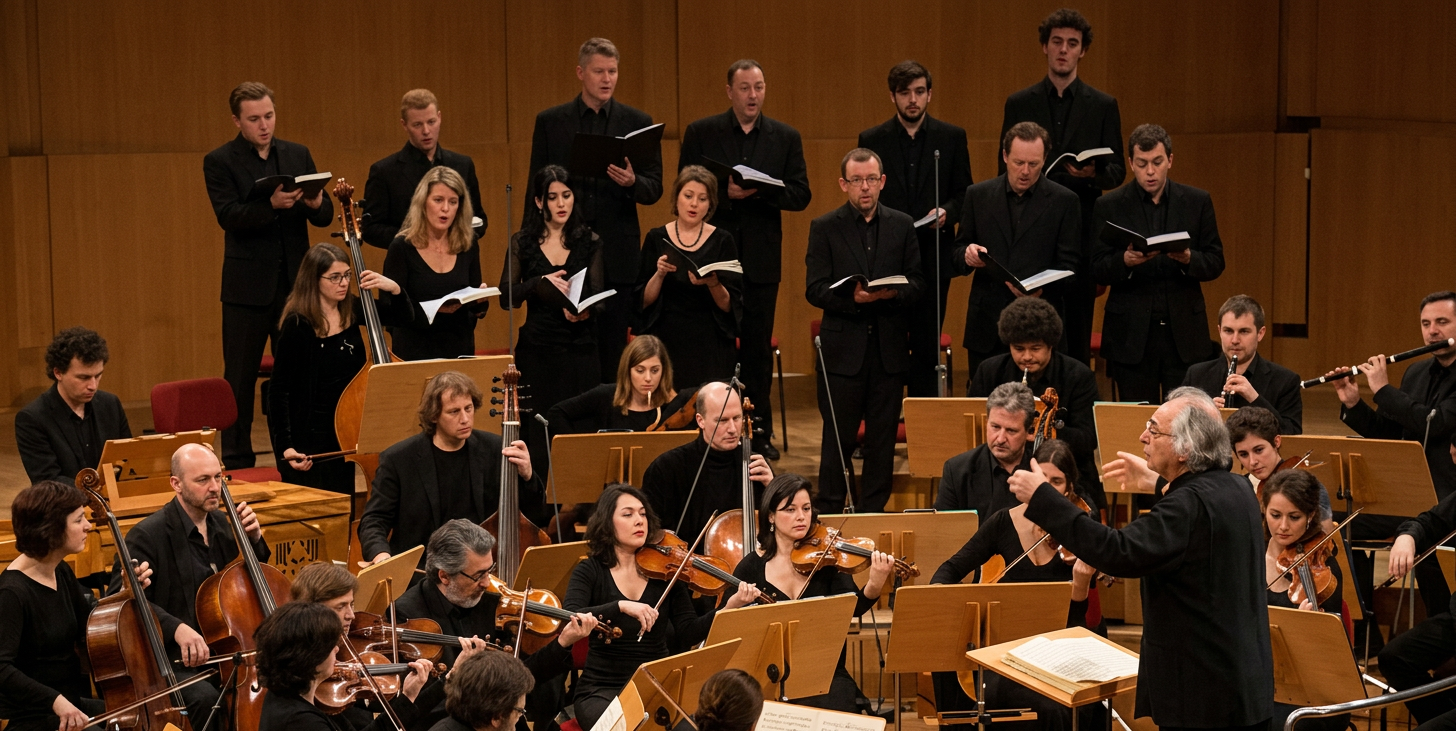
Having listened to many performances of this work, I have now come to regard the one I am bringing before you here (see below) as the deepest and most spiritual, notwithstanding other great period instrument performances that are on YouTube. You can sense that right from the first notes. Played on period instruments by the orchestra (and choir) of the Collegium Vocale Gent, conducted by Philippe Herreweghe at the Kölner Philharmonie (Cologne Philharmonic) in Köln (Cologne), Germany, on March 28, 2010. Herreweghe founded this band in 1970 when he was a student at the University of Ghent in Belgium. So they have grown together over many decades. As the Wikipedia article says about him: “Herreweghe is regarded by leading Bach scholars today as a founding father of the Baroque authentic practice, original-instrument movement”. What you will hear in this recording is as close as one can get to how it will have sounded in Bach’s day. An English translation of the original German text is running along the foot of the screen in this video. The orchestra, choir and vocalists are superb in all the parts. One of the many high spots is the aria, “Erbarme Dich” (Have mercy), with the most sensitive playing of the first violin and great songlines from the countertenor (at 1 hour 23 minutes into the piece). I would be very surprised if more than a few tears were not wrung from your eyes here and throughout the work.
So don’t get hung up on the cosy wintry seasonal notions about the incarnation of Christ — the “gentle Jesus meek and mild” schmaltz which keeps Him in His cradle wrapped up in swaddling clothes instead of letting Him loose to get that fire ignited on the earth. He was born in order than He would die the death that He died, so that He would save His people from their sins and would be resurrected and ascend into heaven paving the way for all His followers/disciples to join Him. I hope you will be uplifted and edified by this beautiful music to realise this. Please click on the video below to see and listen. Blessings to one and all… 💝

