
[Below this introduction, there is a link to download an interactive PDF eBook of this commentary]
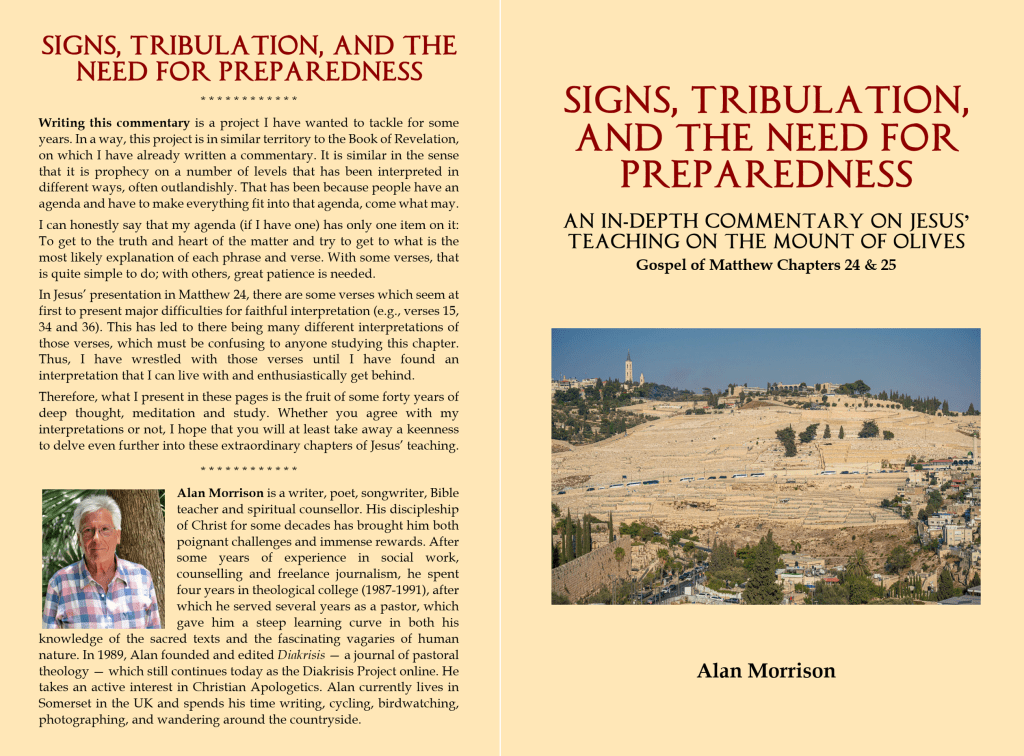
HERE I PRESENT a new commentary on the Gospel of Matthew, chapters 24 and 25 — which consists of Jesus’ address on the little rocky outcrop known as the Mount of Olives immediately after leaving the temple for the last time, just three days before His crucifixion. It currently has 89 pages containing over 34,000 words. The front and rear covers are attached to this post. This is being distributed as a free downloadable eBook in PDF format. The link is at the foot of this introduction.
One of the key elements in these two chapters, which I had not picked up before in all the fullness of its priority, is how much there is in them about the need to discern the difference between the true and the false on so many levels and thus avoid deception. True and false messiahs, true and false prophets, the true and false ‘Parousia’ of Christ and, above all, the differences between true and false Christians. Jesus shows how key differences between the elect people of God and the rest of the world is the facility to resist deception and also their love of the “brethren” (who are also Christ’s brethren), not to mention their preparedness for His return.
I have therefore come to see these two chapters not so much as merely an eschatological discourse (although there is much about the time of the end in them) but as a valuable multi-part lesson for disciples of Christ in discernment, the absolute need to be ‘undeceived’, and above all in how to validate the reality of your discipleship and thereby be prepared to meet your Maker either at death or at the end of the age, whichever comes first — for enduring to the end is another of the signs which Jesus provides so you can validate your discipleship. One thing I can guarantee: By the time you have finished reading this commentary, you should have enough evidence to know whether you are a genuine child of God and brother of Jesus, or not.
It is important to realise that the teaching in Jesus’ words on the Mount of Olives uses what I call “Prophetic Typological Stacking”, in which two or more historical events from the past and the future are reported on in the same breath, as it were — or in the same wording — because they involve the same spiritual principles repeated at key points throughout history — so that the whole discourse weaves its way in and out of multiple events of the past and future which are typologically connected. Sometimes, just one element is mentioned that typologically covers more than one historical event (e.g., the “abomination of desolation”). This is the nature of prophecy and typology. If one is not willing to grapple with and understand typology when reading such prophetic texts then one should not be reading them at all. There is a mosaic beauty in all this which is breathtaking.
In this commentary, in the course of the exposition, there is teaching about the far-reaching multiplexity of the extraordinary expression “abomination of desolation” (24:15), a profound understanding of what Jesus meant when He said, “this generation” (24:34), an explanation of the extraordinary interface between Jesus’ humanity and His divinity (24:36), a debunking of the common “left behind” teaching which so blights the church with its banality (24:40-41), what lies behind the seemingly ‘hard’ teaching of Jesus in 25:29, the real identity of Jesus’ “brothers” (25:40), and much more.
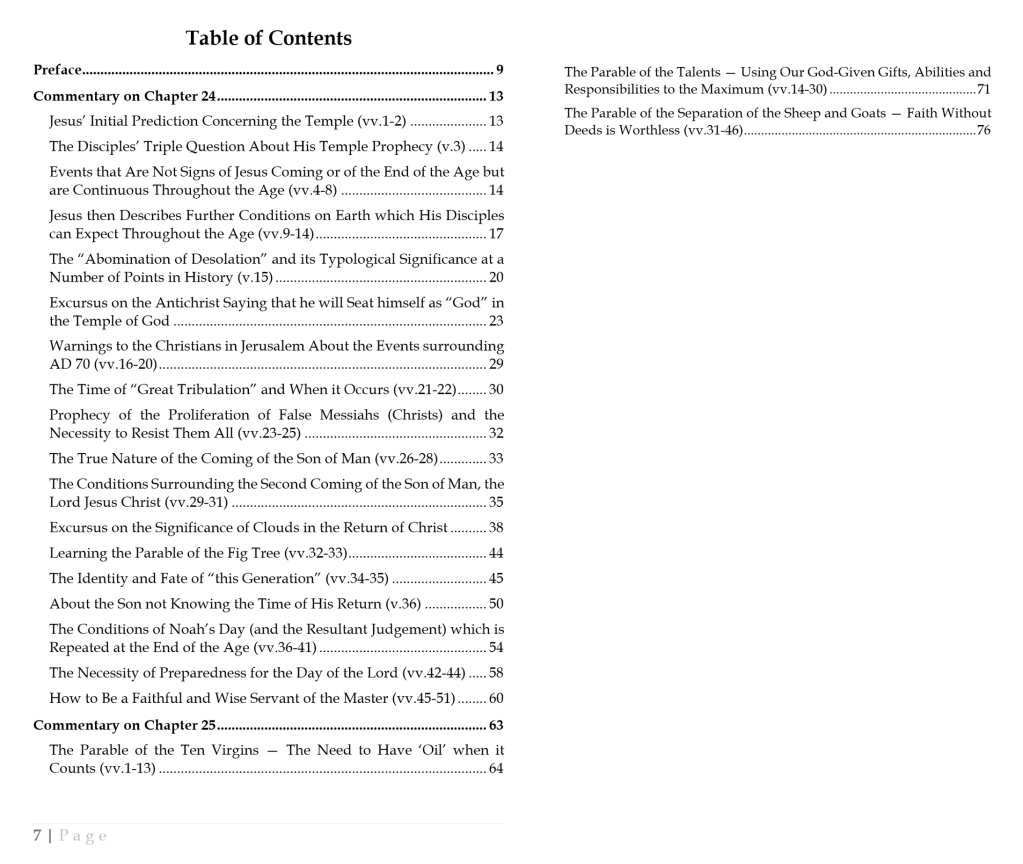
Here are the Contents pages:
Here is the link to freely download this interactive PDF file, with bookmarks and all links active. Just click on the word “Download”.

.
.


Really like the look of this- Thanks Alan
LikeLiked by 1 person