
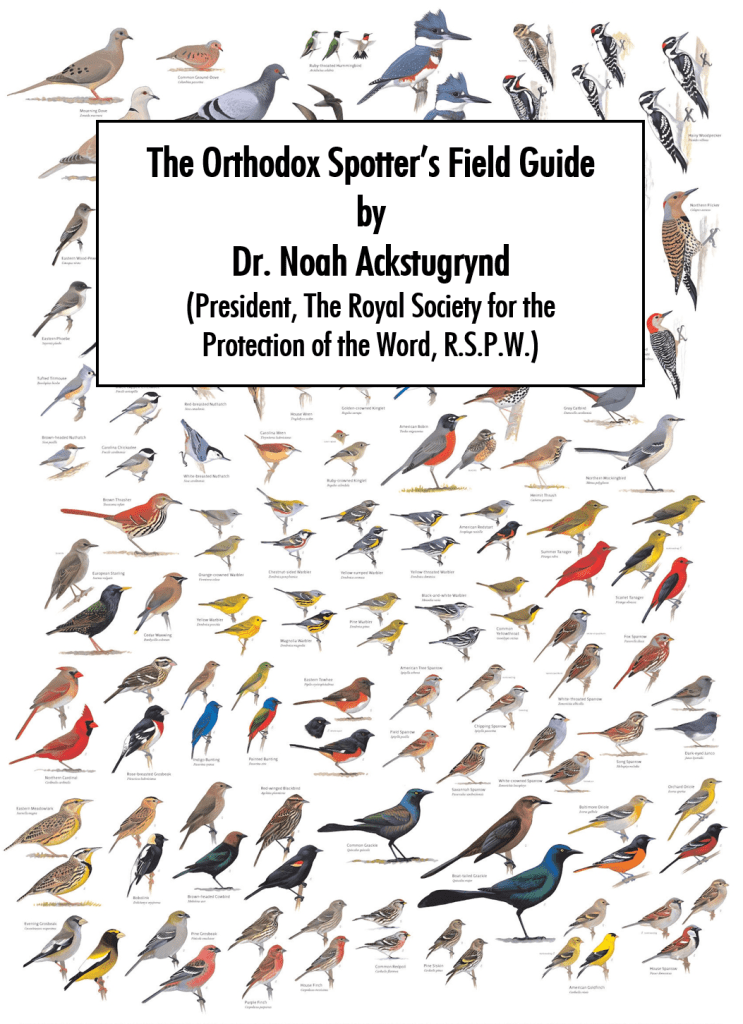
[I just came upon this piece which I wrote thirty years ago in 1996! I think it is just as relevant today as it was then, maybe even more so. It was written under the somewhat amusing pseudonym (nom de plume) I often used in those days, “Dr. Noah Ackstugrynd”. I should resurrect it and use it more often! Enjoy!]
An Extract from:
The Orthodox Spotter’s Field Guide
by Dr. Noah Ackstugrynd
(President, The Royal Society for the Protection of the Word, R.S.P.W.)
As a leading expert on orthodoxology, I am often asked: “How can I tell the difference between the Greater-Spotted New Evangelical and the Lesser-Spotted Old Evangelical?” This is a question which has vexed orthodoxologists for many years, as these two species can deceptively appear to be almost identical in size and plumage. To the inexperienced hobbyist, it is as difficult to tell them apart as it is to distinguish between a Yellowhammer and a Cirl Bunting. But after some basic guidelines have been implemented the difference between the two species will be as plain as that between a Cuckoo and its unfortunate host, the Meadow Pipit.
First we need to look at the preferred habitat of each species. Whereas the Lesser-Spotted Old Evangelical will stick to the safe territory that has been used by his species for millennia — the Greater-Spotted New Evangelical will almost wilfully choose to inhabit places where many predators lurk. This makes them subject to being preyed upon by species which do not have good intentions.
The second thing to consider is the walk. Whereas the Lesser-Spotted Old Evangelical walks in a very circumspect manner — looking about him in an eagle-like fashion, extremely careful where he places his feet, and frequently stooping to his knees — the Greater-Spotted New Evangelical struts confidently ahead ignoring the dangers about him. There are good physical reasons for this, as you will see if you manage to get close enough. For this purpose, I would heartily recommend the binoculars promoted in the manual issued by the Royal Society for the Protection of the Word (R.S.P.W.). Focus in on the Greater-Spotted New Evangelical’s face and you will notice that the eyes are set much nearer the front of the head than those of the Lesser-Spotted Old Evangelical, so that his field of vision is very limited indeed. This renders him extremely susceptible to the increasing number of predators which can creep in unawares from all sides, especially from behind.
Similarly, in his nesting habits the Greater-Spotted New Evangelical can be differentiated from the Lesser-Spotted Old Evangelical. Whereas with the Lesser-Spotted Old Evangelical one finds that the male is very much the dominant partner, in the Greater-Spotted New Evangelical species the female tends to be in the ascendancy (varying in degree from one pairing to another). However, in some cases, the female will even assume the leadership of an entire flock.
Another way you can tell these two species apart is by their feeding habits. Whereas the Lesser-Spotted Old Evangelical relied on a carefully chosen diet of wholesome feeding habits, the Greater-Spotted New Evangelical will forage and scavenge for anything which takes his fancy, which has made it thrive immensely while making it subject to all manner of diseases.
Another way you can tell these two species apart is by the manner in which they rear their offspring. Whereas the Lesser-Spotted Old Evangelical tends to keep a stricter eye on its offspring, the Greater-Spotted New Evangelical allows its young to roam far and wide, thus increasing the propensity for predation by raptor species.
Another way you can tell these two species apart is by their song. The Greater-Spotted New Evangelicals’ song consists of a series of very coarse, grating, often monotonous notes which can often be accompanied by twitches and a kind of death-feigning posture during the breeding season. On the other hand, Lesser-Spotted Old Evangelicals have a very melodious song which acts as a call to others join in. They also have a highly effective alarm-call when any predators are nearby.
Another way of telling these two species apart is by their temperament. Although Greater-Spotted New Evangelicals are very tolerant of other species being on their territory — even predatory ones — they become extremely hostile if there are any Lesser-Spotted Old Evangelicals within their sights, who they regard as being detrimental to their expansion.
Let us also not forget the difference in plumage which, to the untrained eye can be difficult to spot. The Lesser-Spotted Old Evangelicals have plumage marked with the whole spectrum of rainbow colours, whereas the Greater-Spotted New Evangelicals — although appearing to be the same at a distance — on closer inspection the colours seem all washed-out. One may almost say that it has wishy-washy plumage. An up-close look shows that one cannot really tell what colours they are.
So you see, readers, once you have looked into this matter it is really very easy to tell these two species apart. My advice to any budding orthodoxologists is to join the Royal Society for the Protection of the Word. When you enrol you are automatically provided with a 66-section handbook which is jam packed with information which will soon make you an expert in the field and help you to know which birds to follow (Psalm 84:3) and the predatory birds which must be avoided like the plague (Leviticus 11:13).
Happy field-spotting!
Dr. Noah Ackstugrynd
(President, The Royal Society for the Protection of the Word, R.S.P.W.)
.
.
.
© Copyright, Alan Morrison, 2026
[The copyright on my works is merely to protect them from any wanton plagiarism which could result in undesirable changes (as has actually happened!). Readers are free to reproduce my work, so long as it is in the same format and with the exact same content and its origin is acknowledged]
.

