
Reading: Galatians 5:16-26.
Focus Text: Galatians 5:22-23.
“But the fruit of the Spirit is love, joy, peace, forbearance, kindness, goodness, faithfulness, gentleness and self-control. Against such things there is no law” (Galatians 5:22-23).
INTRODUCTION
The idea of “bearing fruit” in metaphorical terms signifies the end result, effect or consequence of something. In this case, in Galatians 5:22, that end result, effect or consequence comes about as the result of having “the Spirit of Christ” (Romans 8:9) and being “led by the Spirit” (Galatians 5:18). In other words, if you have truly been “born from above”, been “born of the Spirit” (John 3:3-8), you will very naturally bear the fruit of the Spirit. This follows as surely as night follows day. This is why Jesus emphasised so powerfully to Nicodemus, “You must be born from above” (John 3:7). The “you” there in the Greek is plural, signifying that it applies not only to Nicodemus but to everyone.
I know that the common way of saying this is, “you must be born again”, but the Greek which is usually translated as “again” is ἄνωθεν, anōthen, which also means “from above”. The implication is being rebirthed by God who is metaphorically said to be “above”. But, interestingly, anōthen can also mean “from the start”, “anew” (a fresh start), as well as “above” — rather like the way that a musical director would say to a band or orchestra, “Let’s take it from the top”, meaning let’s begin playing the work from the beginning. So in the context of John 3:3 & 7, Jesus is saying, “You must be born anew” and “you must be born from above”. Take it from the top. A restart and a renewal — “born of the Spirit” (John 3:5 & 8). This is the background to the idea that when one is genuinely rebirthed by the Spirit, it will most certainly, without any doubt whatsoever, bear fruit.
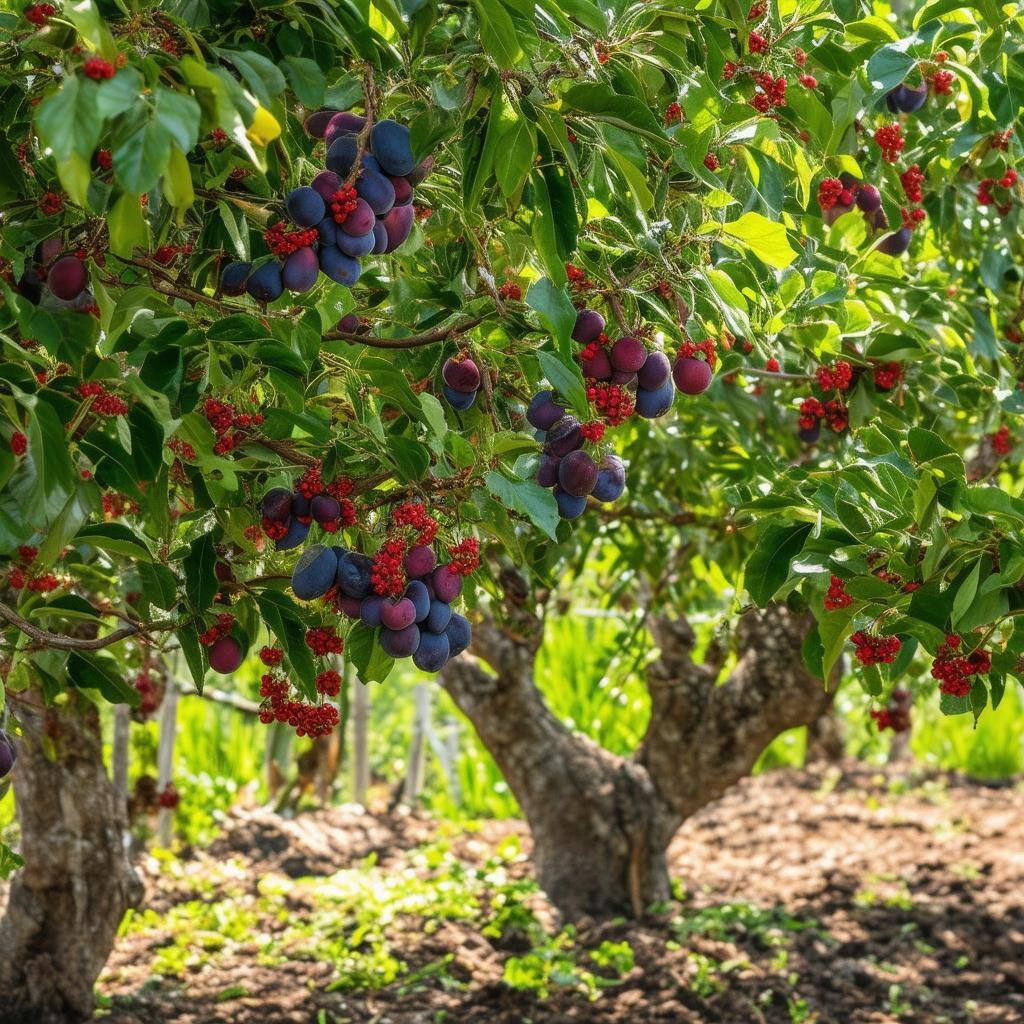
Notice that these are not called “fruits” of the Spirit but “fruit”, singular. There is a unified fruit which is made up of all these qualities. They stand or fall as one. You cannot say, “Yeah, I think I’ll just specialize in two or three as I’m not so hot on the rest”. These qualities which make up the fruit stand or fall as one. This is a fruit made up of love, joy, peace, forbearance, kindness, goodness, faithfulness, gentleness and self-control. They are all in one fruit which you either have in your orchard because you have been regenerated and indwelt by the Spirit, or you have none of those qualities because you are a heathen who knows nothing of the Holy Spirit because you have not been “born from above” (John 3:3) and are instead “of the flesh”.
[NB: The word “heathen” to describe those who do not “have the Spirit” is rarely used today because it is considered old-fashioned and maybe even in bad taste. But it is actually very apt. The word “heath”, from which “heathen” is derived, is defined as “A tract of level wasteland which is barren and uncultivated”. Metaphorically, this applies to those who are not “born of the Spirit”. It is a terrible thought, but to be without the Spirit is like being a barren wasteland — not merely in one but actually being one. Knowing this should spur us on to evangelise that wasteland with love and zeal. This bears a relation to the text which we are examining in Galatians 5:22. A barren wasteland obviously bears no fruit, in contrast to those who have the Spirit and are led by Him and therefore do bear fruit].
Jesus makes a major reference to the fruit-bearing of His disciples. At the start of John 15, Jesus describes Himself as “the true vine” and His Father as the “keeper of the vineyard”. He says that “The one who remains in Me, and I in him, will bear much fruit”. He says that the Father prunes the branches “to make it even more fruitful”. That can involve painful chastisement, but it is for one’s benefit. He says that “Just as no branch can bear fruit by itself unless it remains in the vine, neither can you bear fruit unless you remain in Me”. The killer line in there is when He says, “Apart from Me, you can do nothing”. He means nothing of any spiritual value. But the overall message in those first eight verses of that chapter is that “this is to My Father’s glory, that you bear much fruit, proving yourselves to be My disciples”. Yes, bearing fruit is certain proof that one is a disciple of Christ. Bearing no fruit whatsoever, such as the fruit that Paul describes in our text, yet claiming to be a “Christian”, means that one is a fake believer, of which there are and have been many (today more than ever). Such fruitless branches “are gathered up, thrown into the fire, and burned”. This is a clear reference to the day of judgement at the end of the age, when all is revealed for what it is. The upshot of this passage in John 15:1-8 is that it is impossible for a genuine disciple of Christ to bear no fruit whatsoever, and that the bearing or not bearing of fruit provides proof of whether or not one is a genuine disciple of Christ.
So let us look further into all this fruit-bearing business. In the text we are examining, human beings are either “of the flesh” (mesmerised and enslaved by physicality/materiality, as I wrote about in a recent message ) or “of the Spirit”. Those are the only two possible states of being in this life and world. Those ruled by the desires of the flesh are stuck in service to the self which they seek to gratify and they are ‘in hock’ to Satan (1 John 5:19). That is one huge morass of enslavement to a lost cause. The one who has been regenerated and is therefore “of the Spirit” has transcended service to the self and is now dedicatedly in service to others (Galatians 5:13) and “in-lawed to Christ” (1 Corinthians 9:21).
In our text, Paul lists a number of the “acts of the flesh” such as sexual immorality (which would include such things as adultery and sex outside of marriage), impurity (wide range of possibilities there), and debauchery (self-explanatory); idolatry (putting any created thing before God) and sorcery (relying on satanic occult forces instead of being faithful to God); hatred, discord, jealousy, and rage (all very obvious); rivalries, divisions, factions (you know, like even in the church!), and envy; drunkenness, orgies, and the like (Galatians 5:19-21). These are presented as being in complete contrast to the “fruit of the Spirit” which is expounded in our text following the listing of those acts of the flesh. Paul adds to this list of acts of the flesh in another letter:
“Neither the sexually immoral, nor idolaters, nor adulterers, nor men who submit to or perform homosexual acts, nor thieves, nor the greedy, nor drunkards, nor verbal abusers, nor swindlers, will inherit the kingdom of God” (1 Corinthians 6:9-10).
And in the penultimate chapter of the Book of Revelation, we read another list of acts of the flesh which will also make us hellbound:
“The cowardly and unbelieving and abominable and murderers and sexually immoral and sorcerers and idolaters and all liars, their place will be in the lake that burns with fire and sulphur. This is the second death” (Revelation 21:8).
All these lists deal with “acts of the flesh” which mean that those indulging in them “will not inherit the kingdom of God” and they will instead undergo “the second death”, hell. These “acts of the flesh” stand in stark contrast to the “fruit of the Spirit”.
Now you might say, “Well, I know a bloke from work who is not a believer but he is very kind. Does he not have a fruit of the Spirit? If not, what does he have?” Because a heathen can perform an act of kindness does not indicate that he or she is exhibiting the fruit of the Spirit. This is obviously the case because they do not have the Spirit. For all you know, that bloke could be an idolater, adulterer, swindler, drunkard, and practice sorcery outside of your workplace. It is most important for us to see the uniqueness of the fruit of the Spirit solely to the disciples of Christ, and I hope that I will bring that out as we go on.
However, we should be thankful that such acts of kindness can even be performed by those without the Spirit. This is the result of what is known as “the general grace of God”. In this fallen world, and especially after the Flood, God did not leave the world in a total morass of evil and violence or it would have gone down the road to destruction prematurely, before the Christ could come. As Paul put it, those who do not have the law can still do by nature what the law requires (Romans 2:14). The fact is that all human beings — despite being inclined to evil — are born with an innate, God-given sense of right and wrong, and an active conscience that guides their moral behaviour. Everyone (well almost everyone!) stops at a red light on the highway. People blush when their sins are uncovered (unless their consciences are so seared that they have none). The heathen can be law-abiding and abhor chaos. This is because humans were created in the image of God and although the Fall has destroyed those aspects which involve righteousness and true holiness (which is what is restored when one is regenerated by the Spirit, Ephesians 4:24; Colossians 3:10), there is still an innate awareness of the difference between right and wrong and acts of goodness can even be performed by the unregenerated. But this is not the same as having the fruit of the Spirit. The fact is that “there is none who does good, not even one” (Psalm 14:3, Psalm 53:3, Romans 3:12) before coming to Christ. This is because “good” is defined by God’s standards rather than society’s notions of morality. The reality is that “without faith it is impossible to please God” (Hebrews 11:6). Being kind, yet not bowing before God and rejecting Christ, do not score any points with God, for salvation is not the result of any seemingly righteous acts (Ephesians 2:8-9). So, if “you know a bloke from work who is not a believer but he is very kind”, just be thankful that this is the case, by the grace of God, but not because of any fruits of the Spirit, because he does not have the Spirit and has (so far) rejected the Spirit.
Returning to the fruits of the Spirit, when we examine the Greek in all these nine qualities which make up the fruit of the Spirit, we see that a number of them go way further and deeper than the words that we see in the English translation. Therefore, for each of these nine qualities which make up the fruit of the Spirit, I am going to open up the Greek and the fullness of meaning which lies behind them, for then we will begin to grasp the uniqueness of this fruit to those who have the Spirit. I hope that you will find this as fascinating as I do.
So now we will examine each of the nine qualities which make up the fruit of the Spirit: love, joy, peace, forbearance, kindness, goodness, faithfulness, gentleness and self-control.
1) Love as an Essential Element in the Fruit of the Spirit
The Greek word translated as “love” here is ἀγάπη, agapé. This is not just any old love. In Greek philosophy, there are three principal kinds of love: 1) Έρως, érōs (sexual love, love involving deep intimacy); 2) φιλία, filía (friendship, brotherly love); and 3) ἀγάπη, agapé (involving unconditional love and selflessness). It is this third type to which Paul is referring in our text. In Christian terms, agapé involves the love of God for His people and the ability of a person to love God.
Above all, agapé is a sacrificial love rooted in the sacrifice of Christ. As Paul said: “Walk in love, just as Christ loved us and gave Himself up for us” (Ephesians 5:2). That is the kind of love which is involved in this essential element in the fruit of the Spirit. Agapé makes all that possible; and this quality in a person is unique to those who are “born from above”, “born anew”, “born of the Spirit”.
2) Joy as an Essential Element in the Fruit of the Spirit
The Greek word translated as “joy” here is χαρά, chara. It is related to the word χάρις, charis, meaning grace. Christian joy is not just any old joy. It is that inward rejoicing which comes from the pure knowledge that one has been redeemed, saved. This joy resides inside the disciple of Christ on a permanent basis and provides the necessary backcloth to all other elements of existence and experience, no matter how afflicting they may be. Such joy is the undergirding principle which prevents the disciple of Christ from falling into the downcastness, despondency, and sheer despair which could easily result from being stuck in this cruel, crazy, debauched and chaotic world.
This chara joy is perpetually present in the disciple of Christ as a ‘low hum’. But from time to time it can burst into an explosive sense of inner rejoicing when one suddenly gets a full perspective of the manner in which one has been saved and how that is rooted in what Christ has done. This joy is not a flamboyant state of glee but a profound and humbling delight. The more one becomes aware of the grace of God and the magnificence of His ways, the more that chara joy will be cultivated in one’s heart.
3) Peace as an Essential Element in the Fruit of the Spirit
The Greek word translated as “peace” here is εἰρήνη, eiréné, from where the personal name “Irene” is derived. However, the derivation of εἰρήνη, eiréné, is itself most interesting. As “Helps Word Studies” puts it. “Eiréné is derived from eirō, meaning ‘to join, to tie together into a whole’ — properly, wholeness, i.e. when all essential parts are joined together”. This is a beautiful way of understanding what true peace, uniquely Christian peace, is all about. It is a peace which expresses what happens when a person becomes whole as a result of being saved. This is the true ‘holistic’ way of being! “Since we have been justified through faith, we have peace with God through our Lord Jesus Christ, through whom we have gained access by faith into this grace in which we stand” (Romans 5:1-2).
When one thinks how peace has almost become a dirty word in modern usage, where it can refer merely to the space between two wars, or be used in connection with a “peace plan” which you know will never work, or even be used as a way of saying “Hello” (e.g., Shalom!) by people who live in a warmongering, genocidal country! The kind of peace which is an essential element in the fruit of the Spirit is a zillion miles away from all those warped, worldly concepts of peace. Truly it is “the peace of God, which surpasses all understanding” (Philippians 4:7). It is a peace which is not in the least dependent on our external circumstances. That deep, inner kind of peace is how we transcend the lunacy of this fallen world.
4) Forbearance as an Essential Element in the Fruit of the Spirit
The Greek word translated as “forbearance” here (sometimes as “patience” and “long-suffering”) is μακροθυμία, makrothumia. This is a most interesting word. It is made up of two words, μακρός, macros, meaning “long”, and θυμός, thumos, meaning “wrath”, “anger”, or “rage”. You’re probably thinking what does “long wrath” have to do with forbearance or patience. Well, if I could put it like this: I’m sure you know the phrase “short-tempered” (being quickly aroused to anger). Well μακροθυμία, makrothumia is all about being the diametrical opposite to that: “long-tempered”, which implies that you do not have a ‘short fuse’ but have infinite patience, forbearance — the ability to put up with things which could give anyone else apoplexy! This beautiful quality of patience is not about being a doormat but about applying common sense judiciousness to situations which would fry anyone else’s nerves. Therefore, μακροθυμία, makrothumia is what leads to endurance, constancy, steadfastness, and perseverance. In this sense it is a vital part of much-needed wisdom.
As Paul put it to the saints at Colossae, about whom he prayed to God that they would be “strengthened with all power according to His glorious might so that you may have full endurance and patience, and joy” (Colossians 1:11). That is the sole source of the unique forbearance which is exercised by all the saints.
5) Kindness as an Essential Element in the Fruit of the Spirit
The Greek word translated as “kindness” here is χρηστότης, chréstotés, which (interestingly) is derived from χρηστός, chréstos, meaning serviceable, useful, good. As “Helps Word Studies” puts it:
“xrēstótēs (“useful kindness”) refers to meeting real needs, in God’s way, in His timing. Hence (xrēstótēs) is listed as a fruit of the Holy Spirit (Gal 5:22). With the believer, xrēstótēs (‘divine kindness’) is the Spirit-produced goodness which meets the need”.
So this element in the fruit of the Spirit is not just the sort of kindness which anyone can perform (e.g., holding the door open for someone behind you, or giving a tramp a coin, or someone in your office filling-in for you). This unique χρηστότης, chréstotés is not a natural element in the moral character of every human being but it is instead a supernatural outcome of regeneration or being born of the Spirit and led by the Spirit. So this “kindness” is all about meeting the needs of others in the unique manner in which God would have it. In the Scriptures it is shown to be both an attribute of God (Ephesians 2:7; Titus 3:4), and a quality created in His people (Colossians 3:12), as we see in our text, where it is exemplified as an essential element in the fruit which the Spirit manifests in our lives.
6) Goodness as an Essential Element in the Fruit of the Spirit
The Greek word translated as “goodness” here is ἀγαθωσύνη, agathosune, which is the noun-form of ἀγαθός, agathos, good, which is from where the personal name Agatha is derived. The goodness here, as part of the fruit of the Spirit, is not just any old goodness. It is a goodness which directly contrasts the “darkness” which believers once were before being regenerated, as is explicitly said here: “For you were once darkness, but now you are light in the Lord. Walk as children of light, for the fruit of the light consists in all goodness, righteousness, and truth” (Ephesians 5:8-9). As you see, it is part of the “fruit of the light”, which is Christ. This is why it is unique to disciples of Christ and cannot be exhibited in unbelievers in any meaningful sense, even if they seem to do something which could be described as “good”. For the “goodness” of disciples of Christ reflects the goodness of God. The reality is that “No one is good except God alone” (Mark 10:18), therefore any goodness in the children of God is simply a reflection of God’s goodness. That is one big responsibility: To be the mirrors of God’s goodness to the world. That is why it is an essential element in the fruit of the Spirit. The Spirit indwelling us enables us to be truly good and do genuine goodness.
7) Faithfulness as an Essential Element in the Fruit of the Spirit
The Greek word translated as “faithfulness” here is πίστις, pistis, which is derived from πείθω, peithó, meaning to persuade. So when one has the quality of faithfulness, it is because one is wholly persuaded about the truth of God and His Christ. Faith is not something which one can drum up oneself. It is a uniquely Christian quality which is a gift from God (Ephesians 2:8-9; Hebrews 12:2).
This kind of faithfulness also morphs into steadfastness, trustworthiness, and solidity. There is nothing dodgy whatsoever about a genuine disciple of Christ who walks in the Spirit rather than in the flesh. He or she can be trusted to be faithful and steadfast — a rock, in every sense of the word.
8) Gentleness as an Essential Element in the Fruit of the Spirit
The Greek word translated as “gentleness” here is πραΰτης, prautés. This is a gentleness which cannot be rustled up in one’s own strength. It is proper to call it meekness or humility as the same word is translated like that in other contexts in the New Testament. But this does not render one into a doormat or a weak person. Never confuse meek with weak. They are as different as chalk and cheese.
The Lord Jesus said that “the meek will inherit the earth” (Matthew 5:5). A very similar Greek word, πραεῖς, praeis, is used there to that which is in our text. As such genuine meekness is an essential element of the fruit of the Spirit; therefore this must refer to those faithful to God, and the “earth” which they will inherit is obviously the new earth which will be the lot and portion of all the saints of God (as seen in Revelation 21 & 22). This element of the fruit of the spirit is not at all weak but is simply a more gentle manifestation of strength. The Lord Jesus is the ultimate manifestation of meekness. Yet he could take down religious hypocrites with great force and it is written that one day He will “tread the winepress of the fury of the wrath of God the Almighty” (Revelation 19:15). None of that undoes His meekness. To everything there is a season.
9) Self-Control as an Essential Element in the Fruit of the Spirit
The Greek word translated as “self-control” here is ἐγκράτεια, egkrateia. This is made up of two Greek words: ἐν, en, meaning “in” or “within”, and κράτος, kratos, meaning dominion, power, or mastery. So, together these two words are really speaking about “dominion within” or “self-mastery”. Paul alludes to this necessity for self-mastery when he writes “Everything is permissible for me, but I will not be mastered by anything” (1 Corinthians 6:12). This is the watchword of the disciple of Christ, who will not stand for anything which has dominion over him or her. He or she has complete self-mastery — control over all one’s thoughts and feelings — so that one serves Christ and one’s fellow man rather than giving way to fleshly urges, compulsions, and desires. The true Christian can take great delight in this as he or she feels what it is like to overcome temptation and take control over one’s inner thoughts and feelings. Such self-control and self-mastery is part and parcel of being led by the Spirit and walking in that Spirit, and it can only improve the more our sanctification progresses.
Interestingly, as a postscript, self-control is also one of the elements with which we are to supplement our faith, alongside virtue, knowledge, perseverance and holiness (2 Peter 1:5-6).
CONCLUSION
If all the above elements of the fruit of the Spirit were just the same as the kind of things by the same name as those which the children of the world can do — for a child of the world can be said at times to have been loving, joyful, peaceful, patient, kind, good, faithful (to all but God), gentle and self-controlled — then the fruit of the Spirit would not be unique to disciples of Christ. But all these elements of the fruit of the Spirit are very different to those which are exhibited by the children of the world. This is why I have gone into what lies behind each of these words — to probe into what lies behind the Greek; because then we have a better idea of the uniqueness to which I am referring. For when we see the fullness of these qualities then we will see that they are derivative of the qualities of the Godhead and are imparted to us uniquely through the Spirit.
Let me sum it all up like this: If you can’t be nice, then you can’t be Christ’s. I know that may sound a bit flippant because of the soppy associations of the word “nice”, but this is a kind of bottom line of having “the simplicity and the purity that is in Christ” (2 Corinthians 11:3). Having the fruit of the Spirit — being loving, joyful, peaceful, patient, kind, good, faithful, gentle, and self-controlled — will make you a nice person to have around. So just be nice and be real! Seriously. This is your fruit. Your natural fruit. It should all grow naturally. A disciple of Christ, put at its most basic, is a genuinely and consistently nice person; someone who is real and authentic. Full of integrity. Not merely nice but nicer than nice. Really nice. Not just externally nice but inwardly so. Being nice in the Spirit. I don’t mean wishy-washy nice. I don’t mean smarmy nice. I mean nice in an all-round deep sense rather than the often-superficial association with ‘niceness’ in the secular world these days. If you have fruit ‘growing in your orchard’ (metaphor alert!) you should be fun to be with and a joy to be around. That kind of niceness and realness will make you deep in a spiritual sense. You will be someone who people can feel comfortable with and drawn to, recognising that you have something unique and beneficial; and if you are with other fruit-bearing disciples then it is all wonderfully mutual, as it should be throughout the entire body of Christ. So I repeat: If you can’t be nice, then you can’t be Christ’s!
With someone showing the fruit of the Spirit, there can be no artifice. No dissimulation. No chicanery. No underhandedness. No weird undercurrents. No darkly hidden agenda. No surprises waiting around the corner — no mountains of eggshells on which other people have to tread lightly in order to be around you. You will be someone whose morality and ethics are integral to the fruit. You may have to work somewhat at some bits and pieces which were totally alien to you when you first came to Christ — some rough edges which need chamfering. But even that bit of work should be a joy and you should soon see some results from that work; and such results always give rise to more motivation and more manifesting of the fruit. We who are Christ’s enact all this and more. As our text concludes:
“Those who belong to Christ Jesus have crucified the flesh with its passions and desires. Since we live by the Spirit, let us walk in step with the Spirit” (Galatians 5:24-26).
Αμήν! Amen!
.
.
.
© Copyright, Alan Morrison, 2026
[The copyright on my works is merely to protect them from any wanton plagiarism which could result in undesirable changes (as has actually happened!). Readers are free to reproduce my work, so long as it is in the same format and with the exact same content and its origin is acknowledged]
.

