
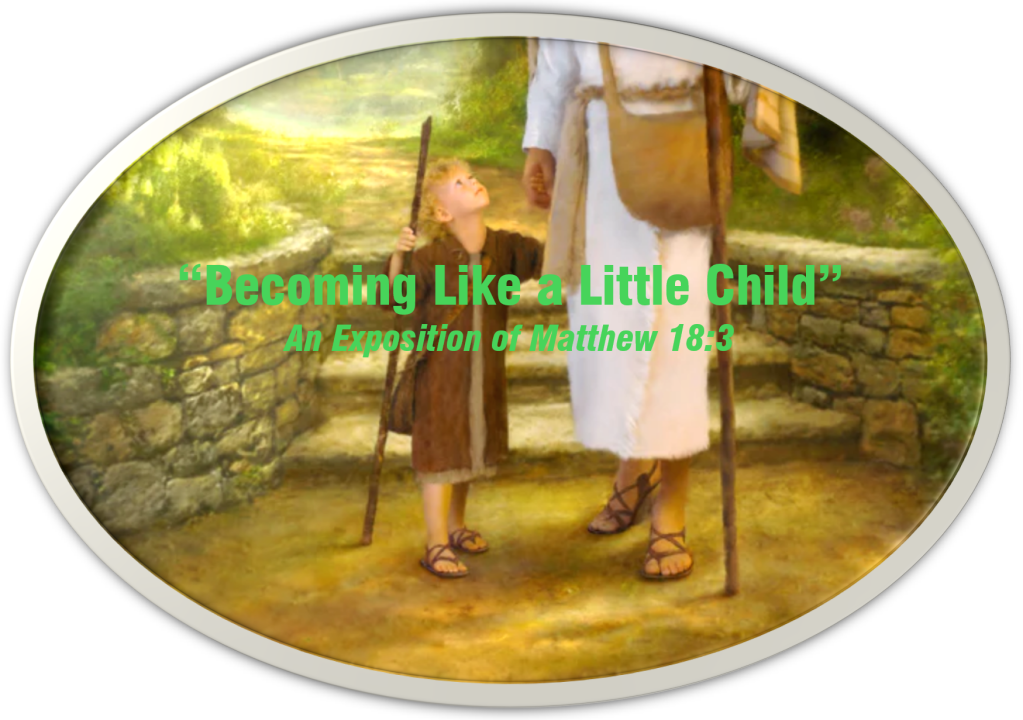
Focus Text: “Truly I tell you, unless you turn about-face and become like little children, you will never enter the kingdom of heaven” (Matthew 18:3).
Introduction
THE GREEK WORD I HAVE TRANSLATED HERE as “turn about-face” is στρέφω, strephó. It appears in various Bible translations as “turn” or “convert” or “change”. But it is even more dynamic than that. In modern Greek one of its meanings is to swivel, which is in tune with the meaning in the Koine Greek of the Bible. The word implies a complete and utter change, an about-turn in one’s thinking and being, which is the process involved in becoming a genuine disciple of Christ. The term “about-face” means a 180-degree turn. That is the kind of change being referred to here. It is life-changing.
This process is surely related to what lies behind the Greek word metanoia, which has traditionally been translated as “repentance”. But really metanoia goes deeper than that. It is made up of two words, νοέω, noeo, to think or perceive, and the prefix, μετά, meta, which means ‘after’ or ‘beyond’, such as in ‘to transcend’ (e.g., metaphysics means elements which transcend or go beyond conventional physics). Thus, metanoeo literally means ‘to have a transformed mind’ which transcends the conventional understanding of ‘the mind’ and the limited way that it works in this present evil age and the satanic world-system in which it operates. The apostle Paul referred to this when he said, “Do not be conformed to [the world-system of] this age, but be transformed by the renewing of your mind” (Romans 12:2). It is the transformation inherent in metanoia which actually enables a person to repent at all. The repentance would not be there without the metanoia being worked in the human heart by God. The ‘transformed mind’ which is involved here means a complete inner sea-change in one’s thinking and being, so that one becomes a new kind of human — a “new creation”, in fact (2 Corinthians 5:17). So that whole idea of metanoia is being reiterated in our focus text when Jesus says, “Unless you turn about-face and become like little children, you will never enter the kingdom of heaven”.
This “turning about-face” and “having a transformed mind”, which is supposed to happen in the life of the one who becomes a disciple of Christ, is compared by Him in our focus text to becoming “like little children”. I believe that this is also related to another saying of the Lord Jesus when He said to the Apostles, “Behold, I am sending you out like sheep among wolves; therefore be as shrewd as snakes and as innocent as doves” (Matthew 10:16). This being “innocent as doves” is the parallel of being “like little children” which is in our focus text. The Greek word translated as “innocent” there is ἀκέραιος, akeraios, which literally means being pure, untainted by any mixture, which is what Jesus means by becoming like a little child. So we are not only to be childlike, innocent, but also “as shrewd as snakes”. We are to get wisdom above all else, for that is the principal thing needed (Proverbs 4:7). Then, having got that wisdom, rather than becoming ‘smartasses’, we must cultivate a purity and innocence which is childlike in its character.
Remember, before saying this Jesus had “invited a little child to stand among them” (Matthew 18:2). The context was the disciples first asking Jesus, “Who is the greatest in the kingdom of heaven” (Matthew 18:1). Jesus was then showing them that being the greatest is just a worldly ambition and that one should instead seek to be like a little child. Remember also that being a child in Jesus’ days was not like being a child now, where one goes to a school full of kids warped by TV or into drug use, sexual promiscuity, corrupt views about sexual preference being taught by teachers as part of the official curriculum, viewing porn (see https://news.sky.com/story/how-britains-children-are-being-exposed-and-becoming-addicted-to-porn-13489554 if you don’t believe me), playing violent video games, and containing many screwed-up kids who are bullies and who exert peer-pressure on weaker children into many different kinds of anti-social activities.
Children in Jesus’ day were much more extended family oriented. They did go to schools which were connected with the local synagogue, known as Beth Sefer, meaning “House of the Book”, starting at age five. The teaching focused primarily on the Torah, reading, writing, and memorizing Scripture. At age ten, they then began to stay at home to help with the family, unless any of the boys were especially gifted, in which case that Torah education continued in great depth. This kind of education and environment is a zillion miles away from the corrupted schools of today, where a child quickly learns how to be an expert sinner.
The Qualities of Little Children which We Must Emulate
So when Jesus says that we must “become like little children or we will never enter the kingdom of heaven”, what are the qualities and characteristics of little children which stand us in good stead as far as the kingdom is concerned? What are little children like? This is not teenagers. It is little children at an age before taintedness by the evil world has taken place (probably around 5 to 7 years old), in a country and at a time when children did not learn the evil ways of the world but learned the Torah and were immersed in families which had old matriarchs and patriarchs who could give wise direction. Thus…
1) Becoming like little children means that we must have wide-eyed innocence and a sense of simple wonder. That means having a lack of cynicism, not being worldly-wise and world-weary, but able to recognise the wonders of creation and be bowled over by them, taking pleasure in the simple things which enhance our experience.
2) Becoming like little children means being ignorant and in need of education. Not wilfully ignorant but naturally so, therefore eager to learn, as are little children. Their little faces are looking up at a grown-up for advice, succour and education. Thus, becoming like a little child means having a teachable spirit. It means that one looks to those wiser and more mature for vital guidance in all respects.
3) Becoming like little children means being comparatively helpless and unable to take proper care of oneself without the vital input from parents and other elders. It means recognising that one is not autonomous or self-sufficient but dependent for living. This would translate for the disciple of Christ into crying out for and accepting assistance from the Divine in all matters. That means initially confessing our helplessness before God in so many respects in this life. “Our Father, who art in heaven… give us this day our daily bread”; which does not only refer to food but all forms of nourishment, physical and spiritual.
4) Becoming like little children means being obedient to parents and beholden to them, as little children are. The obvious connection here is that Jesus’ disciples need to be obedient to their spiritual Father too — as those who are in-lawed to Christ (1 Corinthians 9:21).
5) Becoming like little children means not seeking notoriety or trying to be clever. Therefore, it means being humble, as it says in the verse following our focus text: “Therefore, whoever will humble himself like this little child is the greatest in the kingdom of heaven” (see Matthew 18:4). This means accepting our position as servants of God rather than trying to puff ourselves up in any way.
6) Becoming like little children means being hyper-observant. Little children do not miss a trick. They see things which ‘grown-ups’ often miss. They are very observant of subtleties which would pass many of us by, often because our minds are so cluttered. How many times have you heard a child say, in a public place, something like this: “Mummy (or Daddy), why does that man look so sad?” You hadn’t noticed but they had. They don’t miss a trick. This is the kind of pointed awareness which the disciple of Christ needs in this world. We need to pick up on people’s suffering, even if it is not obvious. We need to notice the little things which others miss.
7) Becoming like little children means being disarmingly honest. Children tend to tell it how it is. For example, if someone has a big hairy wart on their face which no one ever mentions, a little child will often say . “Auntie, how did you get that thing on your face?” And Auntie will tell that little child, being quite grateful that you dared to mention something about which she is normally very self-conscious but which everyone politely avoids even looking at. A genuine disciple of Christ is not afraid to raise matters of truth which others politely avoid. There is, of course, nothing wrong with politeness but not if it is at the expense of truth.
Conclusion
Remember that Jesus compared those who believe in Him to “little children” only a couple of verses later, saying, “If anyone causes one of these little ones who believe in Me to stumble, it would be better for him to have a large millstone hung around his neck and to be drowned in the depths of the sea” (Matthew 18:6). That is what we are. “Little ones”. We aren’t bigshots. We aren’t hifalutin top dogs. We aren’t big wigs, big noises or big names. We are actually “the scum of the earth, the dregs of humanity” (1 Corinthians 4:13) — hated by the world if one is honest and if one shows one’s true colours to the world (John 15:18-21; 1 John 3:13).
But in the midst of all that, no matter how much wisdom or knowledge we have accrued, or shrewdness we have accumulated — even if it surpasses that of a snake in the grass — we are called to be like little children with the purity and innocence of doves. That means always looking to the Father through His Son, always having that spiritual and material dependence on the Divine, always having a sense of wonder and joy just for having life anew — just like small children seem to be able to take joy in the simplest of things and are so easily in awe.
May we be enabled to cultivate this childlike nature, this sense of purity and untaintedness, while also developing in wisdom, knowledge and understanding (Proverbs 2:6).
.
.
.
© Copyright, Alan Morrison, 2026
[The copyright on my works is merely to protect them from any wanton plagiarism which could result in undesirable changes (as has actually happened!). Readers are free to reproduce my work, so long as it is in the same format and with the exact same content and its origin is acknowledged]
.


Amen, Alan. Thank you.
To get wisdom we have to be teachable like little children.
LikeLiked by 1 person