

QUESTIONER: “Mr Morrison, Do you really think it’s right for a Christian teacher to be making videos singing songs WITH A GUITAR in public. And I’ve noticed that your hair is getting rather long lately. Paul said “Doth not even nature itself teach you, that, if a man have long hair, it is a shame unto him? (1 Corinthians 11:14)”.
ALAN’S RESPONSE: I had to smile at your words; especially at your capitalisation of the words “WITH A GUITAR”.😊 Is a guitar intrinsically evil or ‘anti-christian’? Were Andrés Segovia or Julian Bream agents of Satan?👹👿🤣 My guitar is very beautiful and was wonderfully made around a decade ago in the Canadian Appalachian Mountains in Quebec out of Bubinga wood and AAAA Adirondack red spruce, with a Mahogany neck and Indian Rosewood fingerboard. (And by the way I unequivocally recommend D’Addario XS phosphor bronze strings! Great character and longevity). I am wondering where you get your prejudices from. As to your snidey remark about my hair, I do not think that I could be mistaken for a woman from any angle. The purpose of Paul’s words in the 1 Corinthians verse you quote is about the necessary differentiation between men and women. In the last video, my hair was hardly woman’s length, so your observation is misplaced (and somewhat mischievous😉).
However, I looked on your profile and saw that your wife, in common with many elderly ladies, bless them, has short hair. Imagine if I made a similar remark to you about how your wife lacks the “glory” which would be the long hair she does not have (1 Corinthians 11:15). You would no doubt be livid! But I do not have a legalistic bone in my body. So I would not dream of saying such a thing, or even thinking it. I am just proving a point. My feeling is that your words (which seem like an overreaction) mask an aggression which has another foundation and that what you are saying is not the real issue that you have. Maybe I ‘stood on your toes’ with an article I’ve written. Perhaps I criticised one of your treasured shibboleths. I’ve seen it all before with legalistic, uptight folks. I think you should search your heart to discover what lies behind your passive-aggressive outburst. Self-awareness is a very great work of the Holy Spirit in God’s people.
QUESTIONER: “Hi Alan, I was wondering why the articles that you put on your website and sometimes on the Diakrisis Facebook group do not appear on your regular Facebook profile”.
ALAN’S RESPONSE: The main reason for that is because the vast majority of my “friends” on Facebook are not disciples of Christ. These are people who have gradually accrued over nearly twenty years from different walks of life. If something is openly evangelistic or investigative or involves critiquing political nonsense, I will put it on there. There is also on that regular profile much poetry and sonnets which I write, plus music recommendations or my own “Living-Room Videos” of personal compositions. I have found that many people calling themselves “Christians” (especially the “Christian Right” or heavily “Reformed”, or pietist types) are not really interested in poetry or the arts in general, of which they are suspicious and wrongly regard as being solely the province of liberals and lefty woke influence. So I do not generally put ‘arty’ stuff on the website or the Diakrisis Facebook group, though sometimes I might if I deem it spiritually appropriate.
However, most of the articles on my website are about deep theological matters, or meaty Bible exposition, which I do not think are appropriate for the audience on my regular Facebook page. Or they are about various Church controversies and I do not like to hang the Church’s ‘dirty washing’ out in public. It’s not a good look evangelistically. Unbelievers already have a bad enough impression of the Church without me adding to it through making them witness the nonsense which goes on within it.
Some “Christian” folks seem to have no awareness of this whatsoever and put piles of stuff, day after day, on their FB profile, having a go at various doctrines they don’t like, or doing takedowns on (in their view) heretics, or airing many controversies, or showing beefs they have with certain public figures in the Christian scene, or sharing the most outlandish Endtimes scenarios. That is not the way I operate. I run a tight ship and like to publish audience-appropriate material. I hope that explains things. My website is advertised openly on my Facebook profile if anyone is interested. However, I get very little interest on Fakebook about anything. But then again, it’s not much better on the website!😆 The successful internet model is sensationalism, wacky conspiracies, soft porn (OnlyFans), “Influencer”-style sales techniques, or sucking up to the crowd. Really, I’m a comparative dinosaur (though only a Brontosaurus).🦕
QUESTIONER: “I have this question Alan: I have a pastor that has hurt me seriously, giving me a lot of pain. I have forgiven him during many years, over and over again. This pastor is a true follower of Christ, loving, and a good bible teacher, but he is not willing to see what he has done to me. Is he completely blinded? I have no doubt that he will enter the kingdom. Will his eternal rewards be reduced, or what will happen to him?”
ALAN’S RESPONSE: My dear friend, I really feel for you because this is one of the great conundrums (enigmas, puzzles, riddles, quandaries) of the Christian scene. I have known so many pastors/elders who were otherwise spot on in their teaching and seemed to be soundly saved, but yet they could also behave in such a manner that I can only call evil in relation to how they have treated others — often gossiping some terrible lies about them (as I myself have experienced).
Personally, I have always found it very strange that someone who has truly been regenerated could behave in such an evil manner, as I have seen on many occasions, with many others too. Because of that great evil, which was never repented of by them, I did question in myself whether those people were really and truly saved. How could regenerated people not have the ability to see their badness and want to be rid of it? I strongly felt that a driving force in these people is a sort of resentment of anyone who seems as if they could see through them, and a jealousy of them because they seem to be more insightful than them. In darker moments, such behaviour made me wonder if the whole Christian schtick was just an elaborate illusion if big-deal names in the Christian scene (which they were) could behave in an underhand, dishonest and manipulative manner such as I had not even seen in the secular world prior to my conversion in the mid-1980s. Such madness did make me drop out from the Christian scene for some years as I could not reconcile it with what I thought was supposed to be the ‘suburbs of heaven’.
However, in the end, rather than try and understand anything about those pastors, I chose instead to see that professing “Christians” behaving nastily towards someone has to be something permitted by God in order to chasten the ones who received the bad treatment so that they would grow and progress in terms of their ongoing sanctification. That is the only way that I have been able to make any sense of it in a positive manner. Because the reality is that despite the nastiness received and its fallout, somehow my life and my soulness improved and my next situation after that was always a better one. So their evil toward me was doing me a favour. I love that!
Regarding what will happen to those pastors in the life to come, I cannot categorically say as it is above my ‘pay-grade’. Mercifully, I do not have to make those decisions. I would no doubt only get it wrong anyway. As you say, there are indeed varying degrees of eternal rewards for those who are saved, just as there are varying degrees of condemnation for the unsaved. The Scriptures reveal that very clearly. You will find a whole section about these ‘degrees’ in the 2025 second edition of my commentary on the Book of Revelation, on pages 539-546, which you can download from here: https://diakrisis-project.com/2025/03/12/second-edition-of-the-essential-apocalypse-is-now-available-as-an-e-book-in-pdf-format/ . I guess that one has to concede that this could well be the case with these professing “Christian” people who commit such acts of cruelty to others.
I have to admit, though, that from time to time I do doubt that such people could be saved, otherwise it gives rise to a kind of antinomianism whereby people who are supposedly saved can somehow be ‘given a pass’ to commit acts of real nastiness without a hint of repentance at any stage of their lives. Wouldn’t that make a mockery of regeneration — of being a new creation? As I said above, “this is one of the great conundrums (enigmas, puzzles, riddles, quandaries) of the Christian scene”. I guess it has to remain that way and you and I can only try to be as gracious as we can regarding the whole mess that it is. If you are interested, I have written an article about spiritual abuse in the Christian scene. You will find it here: https://diakrisis-project.com/2023/08/23/new-book-swept-under-the-carpet-the-scandal-of-spiritual-abuse-in-churches-today/ ).
I hope all that has been of some help and that I have not confused you even more! 🙂
QUESTIONER: “Comparatively few of our church members have heard of the so-called “Toronto Blessing”. Virtually none have heard of Alan Morrison or Diakrisis. So I have pointed several, mainly the more mature, to your website. But while you continue to publish “under the radar”, I really can’t see your readership growing in a way that reflects the great value of what you write. I can understand that it has probably been wise to keep your head down during these years of research and writing. But there are so many folk out there who need to be challenged, informed and equipped for all that lies ahead. Not just the disillusioned and hurting, but the ill-informed, ill-equipped and half-asleep. Am I alone among your subscribers longing to see some at least of what you write published – and reviewed – much more widely? I know that might well be a risky course of action but you’ve already said many times that’s a future for which we all need to be prepared. Here is an observation: Occasionally I reluctantly hold back from referring folk, usually the less mature, to your website. The vituperation and use of some slang words is sometimes such that I feel I need to warn folk that there will be occasional “Ouch!” moments as they read. That’s a shame. Continuing to give thanks to God for you, and to pray that His wisdom, grace, protection and rich blessing will be with you in all you do”.
ALAN’S RESPONSE: Thank you for your comments. If I mention the “Toronto Blessing” in an article, it is very easy for anyone who does not know what that is to check it out. Just put “Toronto Blessing” in Google search and thousands of articles come up, even on Wikipedia. I give my readership credit for being able to carry out their own research if they want to know something. In any case, the “Toronto Blessing” has come to fruition in a massive outbreak of madness in an increasing number of churches over the more than thirty years since it happened. The guy who was known as “the bartender of the Holy Spirit”, making people drunk and disorderly on nothing but hype and his own huge ego, Rodney Howard-Browne — one of the main protagonists of the “Toronto Blessing” — is still going strong today, thirty years later, at his church in Florida, as you can see from this video of a recent church “service” ( https://www.youtube.com/watch?v=rjn9jCvTG5c ). The multitude of comments under that video show how many people have been brainwashed into thinking that this is true Christianity. Three videos of the talks I gave thirty years ago exposing the evil of this phenomenon — complete with samples of Howard-Browne’s antics — when I was a terribly naïve young pastor, are still right there on YouTube after all these years!
I am not really “under the radar”. I have a public website that is available for all to see. People who like it can tell their friends (but most do not bother). I have a Facebook Diakrisis Group which is not wholly private but publicly visible. Anyone can join. But people are not interested. I recently invited nearly 60 Christians to join and only two responded. A vast number of professing Christians (probably the majority, i.e., more than 50%) are into fluff or baloney and they can tell that I am not. But in my experience, bigger is not better in the Christian scene, in terms of quantity. Most people do not want to read in-depth material. So be it.
I have also found that most people merely want their current narrative or set of beliefs to be validated rather than challenged. Therefore, many who find my material drop out the moment they see a piece critiquing the pre-tribulational rapture or saying that gibberish ‘tongues’ or Apostleship are not extant today, or saying that when one is truly saved then one will persevere to the end, or that Divine election is a thing, or that the ‘mark of the beast’ is a spiritual mark rather than a physical one, etc. Most people do not like to have their shibboleths challenged. Therefore they soon drop out. It happens all the time. It has become amusing for me to behold it. Someone joins the group or subscribes to the website and is “all over me” like a rash. I just smile to myself knowing what comes next. Within a fortnight, or a month or two, they just disappear. Another knowing sigh and a ‘so be it’.
Moreover, the more people one ministers to, the more likely there are to be troublemakers and twisters. There are far more tares than wheat in the visible church now. So I am quite happy to ‘bottom along’ without all that hassle. I am now far wiser than I was twenty or thirty years ago when I allowed myself to be promoted and “put out there” as some kind of ‘viral’ phenomenon. So I am not going to be dragged into the madhouse which is the church today. I fly solo and maintain independence. I don’t think many realise just how awful the state of the visible church actually is. I know what happens to people who refuse to sit on the fence, who refuse to compromise in any way. The church is full of politicians rather than ministers. I do not play ball with such people. I have been dwelling spiritually in something similar to the Cave of Adullam for a long time and it suits me. No one can bother me there. I can write with a white-hot pen. You see, nothing is more threatening to most churches — even Evangelical ones — than a thinking disciple of Christ whose allegiance is far more to Christ than it is to any elders or pastor.
Frankly, I am made for small things (about which I wrote an article with that title: https://diakrisis-project.com/2025/10/04/i-am-made-for-small-things-updated/ ). You mention “ill-informed, ill-equipped and half-asleep” people. From my experience, such folks (especially the latter two categories) are unlikely to resonate with the subjects or manner of imparting them which is on my website, unless they happen to be among the tiny few of those who want to be more informed or better equipped or who are aware enough to know that they need to wake up (which, frankly, is not very likely). If you or anyone else knows anyone who they think are “ill-informed, ill-equipped and half-asleep”, then just tell them about my website and see if they follow up. I operate chiefly by word of mouth and I want to keep it that way.
While the big-deal folks are blustering away in their pulpits and heading-up conferences and all that, I just quietly hive away at my desk doing what I do. But I’m not tucked away from everyone in an ivory tower. Anyone can contact me anytime they like. I am here. So I do not want to have what I write “published – and reviewed – much more widely”. I am very wary of the “Christian” press and I do not think I would get an easy ride from them. I deal with a number of unconventional subjects unconventionally. That is not deliberate; it’s just how it is, and I want to keep it like that. I do not want to become “mainstream”. That, to me, would be like the kiss of death.
Currently there is an average of around 600 visitors to my website each week. Whether those 600 read my stuff, I do not know. I suspect not. On Facebook, I actually receive statistics from Meta about contact interactions with my posts. On average, most of those who visit a post I make (which can be anything up to 300) have just a 3-second engagement. They do not even bother to check it out properly. Hardly any fully engage with the post by reacting or commenting. I do not see why it would be much different on the website. I hardly receive any reactions or comments there either. It’s like writing into a vacuum. I do not write soundbites or make “reels” (dreadful word). But that is what mostpeople want. I do not cater to mostpeople. Deliberately.
You speak of “the vituperation and use of some slang words” in my writings. I reject absolutely that there is any “vituperation” in my writings. I passed this across one of my article checkers who I asked if she thought I was vituperative in my writings and she was astonished that anyone could say such a thing. She responded, “Whoever wrote that has a problem and is probably like that themselves”, meaning that she is citing the psychological concept of projection as a likelihood. In case people do not know what “vituperation” means, I gleaned definitions from my English language app, which contains five dictionaries (including Chamber’s, Collins, and the Oxford). Vituperation = “The use of violently abusive language or venomous censure”, “To be violently abusive or censorious”, “To berate or rail (against) abusively; to revile”. I categorically deny that I employ any of those characteristics in my writings. I go out of my way to be as gracious as possible, but sometimes one has to ‘call a spade a spade’ and not mince words but that has nothing whatsoever to do with vituperation. These days, if one does not sit on the fence and continually prevaricate, shilly-shally, waffle, or pussyfoot, one is regarded as a troublemaker or… well… vituperative.🙂
Here’s a question: Was Jesus being vituperative when He called the Pharisees a “brood of vipers” (Matthew 3:7; 12:34; 23:33), or “whitewashed tombs” (Matthew 23:27), or “Hypocrites” (Matthew 23:13-15,25,27), or “Blind guides” (Matthew 23:16,24), or “Children of hell” (Matthew 23:15), or “of their father the devil” (John 8:44)? Was Stephen being vituperative when he said to the Jews, “You stiff-necked people with uncircumcised hearts and ears!” (Acts 7:51)? Was Paul being vituperative when he quoted a saying about the Cretans being “always liars, evil brutes, lazy gluttons” and said it was true (Titus 1:12-13)? Was John the Baptist being vituperative when he said to the crowds who came to him to be baptised, “You brood of vipers! Who warned you to flee from the coming wrath?” (Luke 3:7)? I don’t think I’ve gone that far yet. Maybe I should turn it up a notch so as to fit your description! 😂 I may occasionally have to use some sort of ‘polemic’ to ensure a point goes home when dealing with an ugly evil in the churches, but this is all part of being a “forthteller”. However, I go out of my way to avoid being unnecessarily antagonistic.
There have been many who have tried to control (i.e., castrate) Diakrisis over the years but without success. They wanted to take the balls out of it and subvert its character. That’s precisely why I do not go mainstream. I write for my friends — people who know what I’m about and who appreciate it. Ecce sto!

As far as the use of some slang words is concerned, as a wordsmith my intention is always to use the most appropriate word possible. My standard of writing for myself is very high, verging on perfectionist tendencies. I have to smile because even WordPress (the host of my website) recognised that recently (see images above) and gave me a “Secret” “Achievement” award of “Perfectionist” when it noticed that I repeatedly edit articles. Haha! It also gave me the “Secret” “Achievement” award of “War and Peace” because I publish articles of more than 10,000 words! (For those who may not know, “War and Peace” is a very long novel by Russian writer Leo Tolstoy consisting of around 1,400 pages!). Anyway, about those “some slang words” the questioner mentioned, only very occasionally in a few articles have I used words which those of an overly nervous disposition might take issue with. I have used the word “crap” a few times, but what is wrong with that? If something is crap, it deserves to be called so. After all, there is no end to the amount of crap in the “Christian” scene today! Another word I have occasionally used is “bullshit”. I only use that word when the subject concerned truly IS bullshit. In the 620 articles on my website, only a handful of pieces have that word in it. That is hardly worth sending out a dire warning to potential readers! Somewhat over the top if you ask me, and more likely to put people off reading! If you can look at the word without wearing the spectacles of middle-class outrage you will see the truth of what lies behind it. Moreover, if you are making such a big deal out of these words by warning the people to whom you are recommending my writings about them then you are doing a disservice to those articles and defeating your stated objective of making my work more accessible. In any case, one thing I have always wondered is why are people so much more concerned about the use of the word “bullshit” than they are about the bullshit itself?!? Maybe they need to get out more! Or read some Martin Luther because he was far worse on the feisty language front than I have ever been.
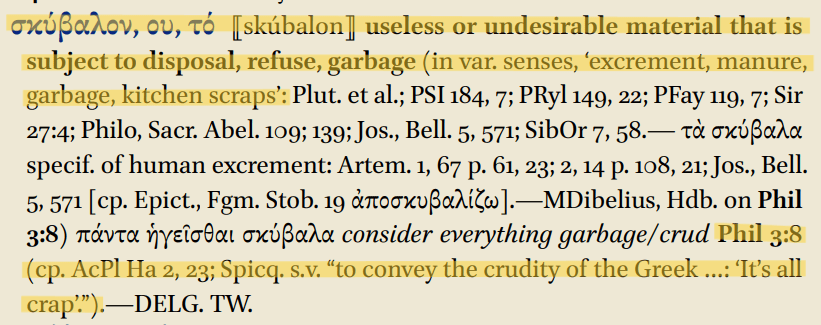
In fact, it is highly likely that Paul used a word identical to “bullshit” or “crap” when he wrote in Greek in Philippians 3:8, the word σκύβαλον, skubalon, which is often politely and euphemistically translated as “dung” or “refuse” or “rubbish” so as not to shock the ladies in their Sunday-Best hats in the pews. Referring to his former Jewish credentials, Paul says, “I count all things as loss compared to the surpassing excellence of knowing Christ Jesus my Lord, for whom I have lost all things. I consider them skubalon, that I may gain Christ”. Interestingly, the NET Bible saw fit to include a footnote on that word: “Skubalon was often used in Greek as a vulgar term for fecal matter. As such it would most likely have had a certain shock value for the readers. This may well be Paul’s meaning here, especially since the context is about what the flesh produces” (let the reader understand that last phrase!). In the leading “Greek-English Lexicon of the New Testament and other Early Christian Literature” by Walter Bauer, on the use of skubalon in Philippians 3:8, it says, “to convey the crudity of the Greek…: ‘It’s all crap’”, as you can see in the highlighted text in the image above, which is really quite extraordinary from such a weighty academic tome! Even AI, when asked about “the real meaning of skubalon”, replied:
“By using this term in Philippians, Paul uses highly forceful language. While some contemporary translations sanitize the text with words like ‘rubbish’ or ‘garbage’ to make it polite, many theologians note that σκύβαλον carried the visceral crudity and revulsion of excrement or foul, rotting waste. Paul used it as a deliberate contrast: all the ‘best’ things he had earned in his life, apart from Jesus, were fundamentally worthless and spiritually repulsive”.
I would only use these words to bring home to people the absolute crappiness of a thing, its worthiness only as bullshit. Therefore, it spices up the text in only a handful of my 620 articles. After all, there’s a lot of it about these days. In my researches, I keep stepping in it all the time! Yuk! If Bible translators were to be brave enough to translate skubalon as I believe that it really should be translated in this context of Philippians 3:4-9, no doubt it would produce an “Ouch moment” or two from the fainthearted.😉 However, let it be said that Paul was not using profanity but speaking reality! And so was I.
QUESTIONER: “Why do people claim that we are being grafted into Israel rather than grafted into Jesus when looking at Romans 11?”
ALAN’S RESPONSE: Short answer: Because they do not understand the spiritual nature of the New Covenant and are stuck in the fleshy aspects of the Old Covenant. What people are being “grafted” into today is the family of God with roots in believing, faithful Abraham. That is what the olive tree represents. Believing, Christ-loving Jews and Gentiles being as one in the “Israel of God”, which is now the true Ekklesia, Church and body of Christ (Galatians 6:16). For the people of God are described thus: “If you belong to Christ, then you are Abraham’s seed and heirs according to the promise” (Galatians 3:29). Those “heirs” are synonymous with the “Israel of God” (Galatians 6:16). This is what the believing Gentiles and Jews are being grafted into, as one, together.
The reason that people would say that Gentiles are being grafted into the Old Covenant nation of Israel is because they have a fleshly rather than a spiritual view of these matters. The movement of the Old Covenant to the New Covenant in Christ is a movement from the physical (which was typological) to the spiritual (which is a fulfilment of those types). Under the Old Covenant, the physical nation of Israel was made up of physical descendants of tribes. There were all the physical sacrifices and rituals, the ark, tabernacle and temple made with physical hands, occupying a physical geographical area of land. It was all physical, as a type or precursor of what would become the spiritual after Christ had come. Those who were the few genuinely spiritual remnant in Israel were aware of all this, that the physical somehow pointed towards spiritual realities. So in the New Covenant, the emphasis is on the spiritual. In the New Covenant we, as the Church, become “a holy nation” (1 Peter 2:9), not based on geographical territory, because we seek “a better country” than geographical Israel (Hebrews 11:16). Christ’s sacrifice on the cross was the final fulfilment of all the Old Testament physical sacrifices and rituals to do away with the guilt of sin. Instead of having to put physical lamb’s blood on our door lintel to save us from death (Exodus 12:23), now believing in Christ and His shed blood saves us from the second (spiritual) death. In the New Covenant, we do not need any physical tabernacle or temple made with hands, for Jesus is the temple (John 2:19-22), and in Him we become the spiritual temple of God (Ephesians 2:21-22). For in reality, as Paul revealed, “A man is not a Jew because he is one outwardly, nor is circumcision only outward and physical. No, a man is a Jew because he is one inwardly, and circumcision is a matter of the heart, by the Spirit, not by the written code” (Romans 2:28-29). The movement from the Old Covenant to the New has been a movement from the physical to the spiritual. That was the intention all along:
“For [Christ] Himself is our peace, who has made the two one and has torn down the dividing wall of hostility by abolishing in His flesh the law of commandments and decrees. He did this to create in Himself one new man out of the two, thus making peace and reconciling both of them to God in one body through the cross, by which He put to death their hostility” (Ephesians 2:14-16).
This spiritual nation of believing Jews and Gentiles is what we are grafted into. Not into Israel, for that physical nation is finished, having served its precursory purpose — despite the fact that so many woefully think otherwise, and despite the fact that many impostors have poured into a physical territory in the Middle-East claiming to be descendants of Old Covenant Israel people. All this is happening because people have not grasped the movement from material/physical to spiritual. That is why “we fix our eyes not on what is seen, but on what is unseen. For what is seen is temporary, but what is unseen is eternal” (2 Corinthians 4:18). [For more information on all this, see my free-to-download eBook here: https://diakrisis-project.com/2022/12/06/new-entirely-updated-120-page-ebook-abraham-our-father-jerusalem-our-mother/ ].
I hope this goes some way to answering your question.
QUESTIONER: “Hi Alan: I have a question in regards to witnessing to Catholics. Can you identify who first started teaching the heresy of baptismal regeneration? Emperor Constantine waited till on his deathbed to be baptized. I believe he was never truly converted and remained a sun worshipper his whole life. I looked into the role of Simon Magus who was a high sorcerer in Babylon. He was baptized as recorded in the New Testament. My main point is that in the early church in Rome there were at least 2 true house churches that were Orthodox. It is reported that Simon Magus started a house church there to compete with the Orthodox ones. The Roman Catholic church has used this in the form of infant baptism and also with the many forced conversions at the edge of a sword. This has only fanned the flames of syncretism whereby indigenous people got baptized but continued their mother earth worship and the like. Thanks and blessings”.
ALAN’S RESPONSE: In regard to “witnessing to Catholics”, I say that it is the same as witnessing to anyone else. While it is good to have some knowledge of how a community or group functions before presenting the Gospel to them so as to help make it more efficacious, it should be the same Gospel that is being presented to them all. For the big underlying fact about evangelism is that it is not the evangelist who causes people to be saved but it is God who births people from above (John 3:3). As Paul put it: “Neither the one planting nor the one watering is anything, but only God is the One giving growth” (1 Corinthians 3:7). I know that the common view is that “if only we could evangelise a little harder, then more would be saved”, but that is not how it works. That is just fleshly thinking and is what lies behind the whole ‘revivalist’ movement which imagines it can generate a global revival. We are just the medium, but God is the activator. He is the One who ignites the spark of regeneration; though we must do our bit to be the planters and waterers.
I agree with what you say about the flames of syncretism being fanned by Roman Catholic ‘evangelism’ in countries with satanic indigenous pagan religion. In “The Serpent and the Cross” (page 970), I wrote about this as follows:
“It will help our understanding considerably if we realise that when we are dealing with the Vatican, we are not dealing merely with one of many manifestations of professing Christianity; we are dealing with syncretism, pure and simple. This syncretism works on two levels, diffusive and infusive. On the diffusive level Catholicism has compromised with indigenous heathen religions everywhere it has taken its mission in the world. Among the more notable examples are in Latin America, where Romanism has easily been blended with indigenous sorcery into occult religions such as Umbanda. In a BBC World Service report, journalist Ben Bradshaw spoke in some detail about the Brazilian Catholic Church’s bringing of local mysticism and spiritism into conventional Roman Catholic beliefs and practice (BBC World Service report on 20th August 1993 at 1345 GMT). In Guatemala, too, there has been an open blending of Romanism with the predominant indigenous Mayan religion, which can be observed in the major cathedrals”.
No doubt it is the same in the Latin-American country in which you are situated. So, yes, one is dealing with something very insidious there. That quote above is from a section headed, “Romanism IS Syncretism”. What you refer to as “baptismal regeneration” — the idea that water baptism itself has a magical quality so that it actually regenerates the one being baptised, whatever their age, or regardless of whether they know anything about Christ — is also a very insidious idea which completely devalues the process of regeneration and, most importantly, the metanoia (deep repentance and major life-turnaround) involved in that regeneration. Unfortunately, a number of the early church fathers adopted this view, including Justin Martyr (c. 100–165 AD), Tertullian (c. 150–222 AD), and even Augustine of Hippo (354–430 AD). This view lingered on for many centuries.
This whole concept is based on a mistaken understanding of John 3:5, “Truly, truly, I tell you, no one can enter the kingdom of God unless he is born of water and the Spirit”. To extrapolate from these words that baptism with water itself makes one able to enter the kingdom of God is a very far reach indeed. The key to understanding this lies in seeing the relation between water and Spirit, especially in terms of John the Baptist’s baptism with water (John 1:26) and Jesus’s baptism with the Holy Spirit. John the Baptist proclaimed: “After me will come One more powerful than I, the straps of whose sandals I am not worthy to stoop down and untie. I baptize you with water, but He will baptize you with the Holy Spirit” (Mark 1:7-8). John’s baptism with water was not one of regeneration but of repentance. That is what his baptism in water represented. Jesus’ baptism with the Holy Spirit represents and brings about regeneration. So when Jesus says to Nicodemus that “no one can enter the kingdom of God unless he is born of water and the Spirit”, this is referring to the need for both repentance before God and regeneration by the Holy Spirit. Water baptism itself does not confer some kind of magical experience of regeneration. But it is a worthy symbol of what the Spirit does for us when repentance has taken place. For the subsequent work of the Spirit in a soul through regeneration (new birth) is likened to being washed clean and renewed:
“When the kindness of God our Savior and His love for mankind appeared, He saved us, not by the righteous deeds we had done, but according to His mercy, through the washing of new birth and renewal by the Holy Spirit. This is the Spirit He poured out on us abundantly through Jesus Christ our Savior, so that, having been justified by His grace, we would become heirs with the hope of eternal life” (Titus 3:4-7).
So the whole Roman Catholic doctrine of baptismal regeneration is a fiction and has engendered a massive amount of delusional ideas regarding salvation — not to mention all that syncretism with indigenous populations.
Regarding Simon the Sorcerer (Acts 8:9-25), who hung out in Samaria, there are divergent views on what happened with him. The reality is that after asking for Apostolic power to be given to him for a fee, Peter pronounced to him, “Repent, therefore, of your wickedness, and pray to the Lord. Perhaps He will forgive you for the intent of your heart” (see Acts 8:18-23), Simon did not express any sense of disgrace for the guilt of what he had asked, but simply expressed his acute fear of the punishment which might come upon him (Acts 8:24). He did not pray to the Lord (as Peter had told him to) but asked Peter to pray for him instead.
People have often said that Simon must have been regenerated because the Scriptures say that he “believed and was baptised” (Acts 8:13), and those are spoken of as the qualifications for salvation (e.g., Mark 16:16). But that in itself does not prove anything solid. For a number of people in the New Testament are said to have “believed” yet it was not a ‘whole-soul’ belief but either a temporary dalliance or superficial sensation. For example, when Jesus “was in Jerusalem at the Passover Feast, many people saw the signs He was doing and believed in His name” (John 2:23). However, the text then goes on to say, “But Jesus did not entrust Himself to them, because of His knowing all. He did not need any testimony about mankind, for He knew what was in people” (John 2:23-25). So, although it is said that those people believed in Him, He did not trust them. For their belief was simply the result of seeing His miracles and being impressed by them but no real heart change had taken place. Again, there was another occasion when “many believed in Him” (John 8:30). So He then said specifically “to the Jews who had believed Him, If you continue in My word, you are truly My disciples. Then you will know the truth, and the truth will set you free” (John 8:31-32). But they immediately started arguing with Him and just a few verses later Jesus said that they were trying to kill Him (John 8:37) and “you are unable to accept My message. You belong to your father, the devil, and you want to carry out his desires” (John 8:43-44) — hardly a description of penitent believers! Those allegedly believing Jews even accused Jesus of having a demon (John 8:52)! Finally the Scripture says that those same Jews who had believed in Him— after they heard what else He had to say — subsequently “picked up stones to throw at Him” (John 8:59). So much for their alleged “belief”. It was not a solid all-the-way-into-the-heart life-changing belief. It was merely superficial, a temporary dalliance. The same was surely true of Simon the Sorcerer. He “believed” because he was simply impressed by the superior supernatural powers of the Apostles and he then wanted that power for himself and tried to buy it off them! But people are so desperate to believe that this sorcerer was saved because they want Jesus to be the winner and also because most professing “Christians” have a very superficial attitude themselves to what qualifies as belief (you know, “easy-believism”). Surely, if one such as Simon the Sorcerer (a potential model trophy conversion) had been saved, God would have ensured that the Scriptures recorded it rather than leaving it without any resolution other than Simon’s hollow request for prayer but no prayer of his own.
Some may say, does that not then prove that believers can fall away and that therefore salvation is not assured? No, it does not prove that at all. Simon may have superficially believed because he was impressed by the superior ‘sorcery’ of the Apostles and wanted to get in on the act himself, but that’s all. (Actually, the same can be said of so many “believers” today who also covet what amount to sorcerous powers of so-called healing, demon-busting, laying hands on people to make them laugh uncontrollably, etc. The churches today are filled with characters like Simon the Sorcerer!). But it is doubtful that Simon had undergone a truly salvific kind of belief, which is not about being intellectually or emotionally impressed but believing with every atom of one’s being because one knows it to be true. If Simon the Sorcerer had been truly saved, and therefore one of Jesus’ sheep, then nothing and no one would have been able to snatch him out of Jesus’ hand (as it specifically says in John 10:29). You would have seen a humble continuance in quiet belief rather than wanting to continue his sorcery with a ‘Christian’ gloss by buying it from the Apostles. Some of the early church fathers said that this Simon went on to become one of the main founders of a branch of Gnosticism. I can believe that.
QUESTIONER: “Unless you’re using proof-readers, does anyone else have the opportunity to read and comment on what you write before it’s published on the Diakrisis-Project website?”
ALAN’S RESPONSE: Yes. I have a number of people for that. They do not see everything, but I send those pieces that I would like a second opinion about. I have known them for decades and they know what I am about. They make helpful suggestions. On a rather amusing note, I once tried to set up a kind of “board” of people who had put themselves forward to read through articles before I send them out. But I abandoned it when I realised that they just wanted to ensure that I didn’t tread on their shibboleths and that they really wanted to “rein me in” so as not to offend anyone.😀 The mind boggles!
QUESTIONER: “Having studied your commentary on Matthew 24 and 25, I had a look at Luke 21. Am I correct in concluding that in Luke 21: (a) On the basis of “The time is at hand!” in verse 9, and “the end will not be at once”, verses 8 and 9 point to a period post AD70; (b) On the basis of the end of verse 11, verses 10 and 11 also point to the same period; (c) Particularly on the basis of verses 12 (the mention of “synagogues”) and 15, verses 12 to 19 point to a period prior to AD70; (d) Verses 20 to 24 refer to the events of AD70 and immediately prior; (e) Verses 25 to 28 point to the end times, well after AD70?”
ALAN’S RESPONSE: Thank you for your questions. As with Matthew 24, there are verses which apply to the debacle in AD 70 and the circumstances leading up to it and others which apply to the time of the end of the age, though there are also verses which apply to the entire age. Matthew 24 is a fuller account and the one I would go to first for that. For example, the disciples only ask one question in Luke’s truncated version, which is about the destruction of the temple (Luke 21:7), whereas there are two questions in Matthew’s edition (Matthew 24:3), the second being about the end of the age and the coming of Christ. However, there are one or two additional glosses in Luke’s account which are helpful.
In Luke 21, Verses 8-11 apply to the events affecting the entire age, including up to AD 70.
Verses 12-24a apply to what leads up to the AD 70 event and the event itself, the destruction of Jerusalem and the temple. Verse 24b, “Jerusalem will be trodden down by the Gentiles, until the times of the Gentiles are fulfilled” (which only Luke records), refers to the entire period of this age after the destruction of Jerusalem, including the period of time when the Antichrist will be in power and the great tribulation will be in operation. After the times of the Gentiles are fulfilled, Christ will return to dethrone the Antichrist, bring the tribulation to a close, take His people from this earth (the real ‘rapture’!), destroy the world and bring in the judgement.
Verses 25-28 apply to the time of the end, just before and including the cataclysmic return of Christ.
I hope this sufficiently answers your questions, and I think that my answers more or less tally with your own thoughts.🙂
QUESTIONER: “Are there any circumstances under which you would be willing to pastor a church again?”
ALAN’S RESPONSE: Well, the short answer to that is simple: If I was utterly convinced that this is the direction that God wanted me to take, then it would be a no-brainer. But I am old now and maybe that is not old man’s work. Besides, in a way, I already am a kind of pastor, but on an online basis.
The problem is that in a great many churches there are undercurrents which do not favour a pastor-teacher who will not bend with the wind. Most of the ordinary members in the pews never discover these undercurrents and blissfully attend all the meetings thinking that everything is hunky-dory. But I know, both from personal experience and from a multitude of accounts given to me by pastors who have been abused, that there is a war which can be waged against a pastor who will not play ball with the forces of evil which are vying for power in a church. Frankly, I just cannot be bothered with all that anymore. It is utterly debilitating. Though, as I say, I will not argue with God’s will when it is clearly shown.
QUESTIONER: I have questions. I read your article about women and teaching/leading in the church, and I really appreciated it. I found it very true and explains what the Bible really says about it. And you went deep enough to make us understand the “secret” of giving up oneself and the joy of following God’s plans for women and men. I used to follow a woman on Facebook who claims to be a prophet. She says that nobody in church has confirmed it in any way. But she says that God is speaking to her and she knows it is God because everything she receives is according to the Bible. I liked her in the beginning and I thought she had wise thoughts. And she is very strict Bible-believing and I like that. But later it didn’t feel right in different ways. The way she treats other Christians and how she often speaks about herself, among other things. I don’t know 🤔 God doesn’t use perfect people I guess and maybe she just adds a lot of her own personality? But still…
Question nr 1:
In the Bible there are prophetesses. Are they teaching sometimes? Or leading? Because this woman is in a way teaching and leading when explaining what God showed her. And using the Bible to confirm her sayings. (But I don’t recognize God’s voice in it. I think.)
Question nr 2:
One time she was ill and had a fever and she wrote that she could hear demonic activity in her apartment. She prayed and it didn’t stop. Then God told her to pray for the protection of the blood of Jesus. And it stopped. And this is a common prayer I know. But are we not already protected when in Christ, since he gave his blood for us on Calvary? I have never read this in the Bible.🤔
Thank You and blessings
ALAN’S RESPONSE: Thank you for your questions. First of all, there can be no genuine prophets today. “God’s household”, the Ekklesia, is “built on the foundation of the apostles and prophets, with Christ Jesus Himself as the cornerstone” (Ephesians 2:20; see also Revelation 21:14, in which the foundation of the walls of the new creation bear “the names of the twelve apostles of the Lamb”). This verse clearly says that in the New Testament Church, Apostles and Prophets were given by God for that all-important foundation-laying period of Church history. The logical deduction here is that when these foundations had been laid, Apostles and Prophets were no longer necessary. The Lord Jesus Himself was the ultimate Prophet and the absolute pinnacle of all prophetic revelation (Deuteronomy 18: 15-19). As it has been put: “God, who at various times and in different ways spoke in time past to the fathers by the prophets, has in these last days spoken to us by His Son, whom He has appointed heir of all things” (Hebrews 1:1-2). Jesus is both the apex of all prophecy and the very spirit of it (Revelation 19:10). All prophecy culminates in Him as the One to be revealed to men and women; and prophecy was only intended to continue until that revelation was complete. Once the Messianic age was fully established (i.e., once Jerusalem and the old order of Israel had finally been dissolved with the destruction of the temple and of Jerusalem in AD 70) and the written revelation was complete, the purpose of prophecy was fulfilled and encapsulated in the Holy Scriptures, which alone reveal Jesus Christ.
Today, people attend specially organised ‘Prophetic Conferences’ in churches, at which fortune-tellers who claim a full-time ‘prophetic ministry’ give ‘words’ to evangelical leaders who listen enraptured to the ‘message from beyond’ — often changing their lives, and those of others, according to the ‘revelation’. These circuses are about as far removed from the biblical gift of prophecy that one can get. This is actually ‘soothsaying’, which is outlawed in Scripture (Deuteronomy 18:10).
In just the same way that if you want to ‘claim your miracle’ you can open your Bible, so if you want to give or hear a prophecy today you can read out or meditate on your Bible, in which all prophecy has been sealed, as the world awaits the final judgement of the great and terrible Day of the Lord (Revelation 19:10-21).
The spiritual gift of prophecy as set forth in the First Letter to the Corinthians had no more functionality in the Church once its Apostolic foundations had been laid and the writing of Scripture had been completed. In fact, the last of the books of the Bible, the Revelation of Jesus Christ, is a masterpiece of New Testament prophecy, written by the last of the Apostles at the end of his long life. The writing of those words was the final word in prophecy and set the seal on the revealed words of God. This is why, in the closing verses of his book, John wrote, “If anyone adds to these things, God will add to him the plagues that are written in this book” (Revelation 22:18). All those who wilfully attempt to resurrect Divine prophecy today will rain down on themselves the plagues of that judgement, for they will be adding to what is written in that Book. The book of prophecy has been closed. That being said, the Church still needs fearless ‘forthtellers’, powerful preachers and wakeful ‘watchmen’ — the only near equivalents today of the prophets of old.
The whole subject of prophecy begins to take on an awesome eschatological dimension when it is claimed by men and women beyond the Apostolic era. Anyone today who dares to preface his or her own words with, “Thus says the Lord” or “Thus says the Holy Spirit” must surely fall into the same category of prophet that is referred to by our Lord in the Gospel of Matthew, chapter 24, verses 24-25, and is chillingly exposed in the same Gospel in chapter 7, verses 21-23. Anyone who attempts to exercise the gift of Prophecy or call themselves a New Testament prophet today is practising lawlessness.
The woman to whom you refer has set herself up with a teaching ministry masquerading as a prophetic ministry. That is invalid on two fronts: 1) Claiming to be a prophet and 2) A woman practising a teaching ministry to many. In other words, she is a false prophet and false teacher.
Regarding your second question, the idea of using the blood of Jesus as some kind of spiritual warfare talisman (Svenska: amulett) is part of a whole raft of superstitions which are practised by so many charismatic types today. The genuine disciple of Christ has no need to pray for any special protection of the blood of Jesus. His blood was shed in a once-for-all-time atonement rather than as something one waves in Satan’s face like a clove of garlic or a cross shown to a vampire! The alleged “demonic activity” in her apartment was an entirely subjective notion, as was also her claim that it stopped when the protection of Jesus’ blood was prayed for. There was no validation of the “demonic activity”. It was all in her mind, as those people see demons everywhere that they think they have to engage with in hand-to-hand combat. But while they are so busy bolting the front-door against imaginary demons, the real demons just walk in through the unlocked back-door and fill their heads with unbiblical ideas and get them to act out unbiblical practices!
There is nothing wrong with praying for protection from any affliction. But this “pleading the blood” superstition is something very different, like a magical formula, and is therefore to be rejected.
QUESTIONER: “Hi there Alan. “What about pastors preaching wrong doctrines about salvation, i.e. no repentance necessary. The grace of God and faith in Jesus Christ are all we need, so they say. This is according to their theological system. During the years I have met some wonderful people believing this. If they continue in their faith, will they be denied entrance to the kingdom?”
ALAN’S RESPONSE: Thank you for these questions. Firstly, let me say that it is (fortunately) not up to me to say who will personally be admitted or denied entrance to the kingdom. You are presumably referring here to the “easy-believist” approach to evangelism, involving a ‘quick-fix’ little ‘sinners prayer’, or altar calls to the front of the church, and so on. The whole thrust of conversions in the New Testament is that people repented because they were “pierced to the heart” when they heard the Gospel (Acts 2:37). The need for deep repentance and that piercing to the heart is an intrinsic part of the Gospel. As Jesus Himself said: “The Christ will suffer and rise from the dead on the third day, and in His name repentance and forgiveness of sins will be proclaimed to all nations” (Luke 24:46-47). Repentance and forgiveness. The two stand together.
A huge problem today is that so many fail to realise that coming to Christ is not necessarily a split-second decision made after an emotionally manipulative meeting. This is why mass altar-calls must be called into question. Merely going to the front of a church after a highly manipulative exhortation is not a guarantee of genuine faith and repentance. Furthermore, it may encourage people to focus their minds on their own act of going to the front instead of on Christ’s finished work on the cross. In fact, it is at baptism that one publicly declares one’s faith rather than in a public walk to the ‘altar’ at the front of a church in which one often has manipulative hands laid on one, and various expectations are made.
You say that over the years you have “met some wonderful people” who believe in this “repentanceless” conversion. Firstly, appearing to be a “wonderful person” is no guarantee that the person actually is wonderful. I have met many pagans who outwardly appeared to be what some may call a “wonderful person”. You know, smiling a lot, saying all the right things, and so on. But that does not mean that they are heaven-bound. “The LORD does not see as man does. For man sees the outward appearance, but the LORD sees the heart” (1 Samuel 16:7). Secondly, how can someone possibly be “a wonderful person” when they have cancelled the need for repentance being a necessary precursor to regeneration yet still claim that regeneration has occurred? They could be “misled people”, or “false gospel proclaimers”, or “twisters of Scripture”. But are they “wonderful people”? Surely not! For those are not qualities of spiritual wonderfulness. It is very perverse to be proclaiming a Gospel which has no repentance in it, for that makes it no Gospel at all.
However, it is not for me to say with any certainty whether they will enter the kingdom with those credentials. I only know the little that you have told me. But I do wonder what planet such people could be on and I would certainly like to ask them why they have gone down this road. Because if one is proclaiming a Gospel that has no repentance in it, then one is generating a mass of false professors or faith, which cannot be good for the future of one’s soul.
Well, that is my take on what you shared with me. I hope it is in some way helpful.
QUESTIONER: “Hi Alan, there are people who say that in order to be healed you must put your faith in God alone and deny any medical care and just fast and pray. I just don’t know how to ask this question, but is this a salvational issue? I would hope not. There literally are people who need medical care and some people act like well if you have enough faith you should be healed. I pray all the time and yes it does feel like I am stuck in a rut but I also feel like I am blessed to be around others who are suffering worse things than I and have good attitudes about it. Also, is this going to be one of those things that one of these days I am going to have to make a choice to go without medical care to deny digital ID?”
ALAN’S RESPONSE: Thank you for sharing that. There seem to be two questions in there. 1) Is it wrong to rely on medical aid instead of simply fasting and praying for healing and would it affect my salvation? 2) Am I going to have to go without medical care if I accept the likely upcoming Digital ID? I hope I have paraphrased correctly. So here goes…
The people who say that genuine Christians should rely on God to heal them instead of getting medical care have made something into an ‘either/or’ situation instead of a ‘both/and’ one. It is not a question of either medicine’s way or God’s way. The fact is that God uses ‘means’, intermediaries, agencies, instruments, avenues, and vehicles to further His will on earth. He uses doctors to aid sick people, especially His people. Luke the gospel-writer was a doctor! If God disapproved of medical aid, why would He choose Luke as the writer of a Gospel and the first book of early church history, the Acts of the Apostles? Paul referred to Luke as “the beloved physician” (Colossians 4:14). Doctors are agents of health and God uses them. So do not listen to all that harmful baloney about needing to rely solely on prayer to be healed. God uses ‘means’ to carry out His operations (in all senses! 🔪🙂). Obviously, it would be faithless to go to a physician believing that God has no part in the matter. As I say, it is a ‘both/and’ scenario. Also, this is very much not a salvation issue. I would instead question the salvation of those who want to guilt-trip others into thinking that it is a sin to prayerfully seek medical help from gifted professionals who care about people. For that is the way that some cults behave.
That being said, a lot of allopathic medicine can be harmful and pharmaceutical companies are not to be trusted. So one has to pick one’s way around what is on offer. Refusing unnecessary and toxic vaccines (e.g., Covid) is an action I would always commend (as laid out in my article “You Have Been Spooked”, available here: https://diakrisis-project.com/2021/06/06/you-have-been-spooked/ ). But provided it is good medicine, then go for it! Like I said above, it should be “both/and” rather than “either/or”. So both prayer and medicine, if necessary.
Regarding your other question about Digital ID’s, this is something which we will all be faced with at some stage. I think initially the Digital-ID will just be made out to be only for one or two things, such as applying for a job or accommodation and will be voluntary. Then, gradually, other things will be sneaked in and it will become compulsory. One of those sneaked-in elements could well be medical aid/care. Obviously, at that point decisions will have to be made. As you know from my many writings on the matter, I do not think that the “mark of the beast” (Revelation 13:16-17) will be a physical thing — just like the name of God written on the foreheads of the faithful a couple of verses after that (Revelation 14:1) will also not be a physical thing. Therefore, I do not believe that the ‘mark of the beast’ can be the Digital ID, although there are many sensationalists who will tell you that it is. Ignore them. God does not send people to hell solely on the basis of whether or not they partake in a dodgy government operation (read Revelation 14:9-11)!
However, some very sick people will be faced with a dilemma regarding the reach of the surveillance-state into their lives. I do not think that having the Digital ID will be some terrible sin before God, as such, depending on the motivation, of course. For example, if a disciple of Christ participates in it because of cowardice, then that is reprehensible, as cowardice is definitely a serious sin (Revelation 21:8). But this is really all about ethics, and anyone who has high ethical standards could find they have to go wholly off-grid. Those who are really sick and genuinely need medical care could find that they may have to compromise, especially if they have offspring or others who are dependent on them and they want to be responsible. It is going to be a very trying time, and one will have to engage in the utmost wisdom. Even so, it will only be the beginning of that trying time. Worse will be to come. One will have to pick one’s way through it with great wisdom and aplomb built on deep faith and a sound knowledge of prophecy. So long as one does not compromise one’s faith or one’s proclamation of truth, then that is what will count.
I could say a great deal more, but I hope that gives some light on these matters, my friend.
.
.
.
© Copyright, Alan Morrison, 2026
[The copyright on my works is merely to protect them from any wanton plagiarism which could result in undesirable changes (as has actually happened!). Readers are free to reproduce my work, so long as it is in the same format and with the exact same content and its origin is acknowledged]
.


Thanks Alan for this. Some very good questions and excellent answers too. Thank you for answering mine as well.
Blessings to you and your day!
LikeLiked by 1 person
THANK YOU!
I’m amazed that having proofread both of those books, I missed that!!! I guess my focus was on grammar and spelling….
LikeLike
In the middle of the night a question came to me, but I see, now, it’s too late to ask, however, I will ask anyway.
In Revelation 3, the Laodicians are urged to buy, from God, gold and eye salve. I had wondered about how to do that, but I have come to believe that the “currency” God expects is deep repentance, after which we are regenerated. In the parable of the ten virgins, the foolish virgins are urged to buy oil (Holy Spirit) from those who sell oil. It is my opinion that the Holy Spirit is only sold or exchanged by God/Christ with the currency of deep repentance and regeneration. However, when these virgins obtained the “oil” it was too late. So, were they able to obtain the Holy Spirit? If so, why were they rejected? Or, have I interpreted the metaphor incorrectly?
LikeLike
Excerpt from my commentary on Revelation: “One can be rich in material wealth but be destitute spiritually. So Christ offers them gold, white clothes, and eye-ointment, which are respectively symbols of spiritual riches of glory, the righteousness which is accounted to all true disciples of Christ, and spiritual eyesight”.
Regarding the parable of the virgins, remember it is only a parable, but the naughty virgins never obtained any oil: “While they were on their way to buy it, the bridegroom arrived” (Matthew 25:10). You can read about that in my commentary on Matthew 24 and 25, available here: https://diakrisis-project.com/2026/04/23/new-in-depth-commentary-on-matthew-24-and-25/ .
LikeLike